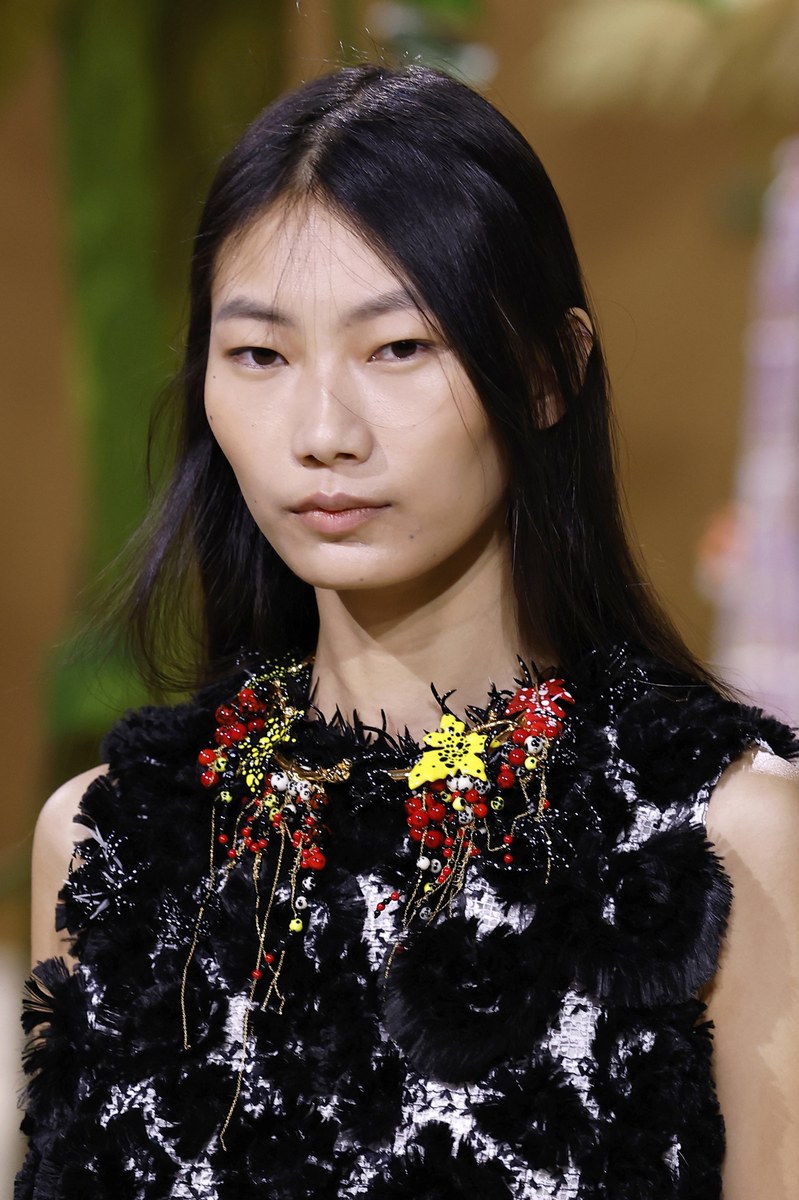
Pauline Dujancourt FW26 Women Looks Report
London Fashion Week
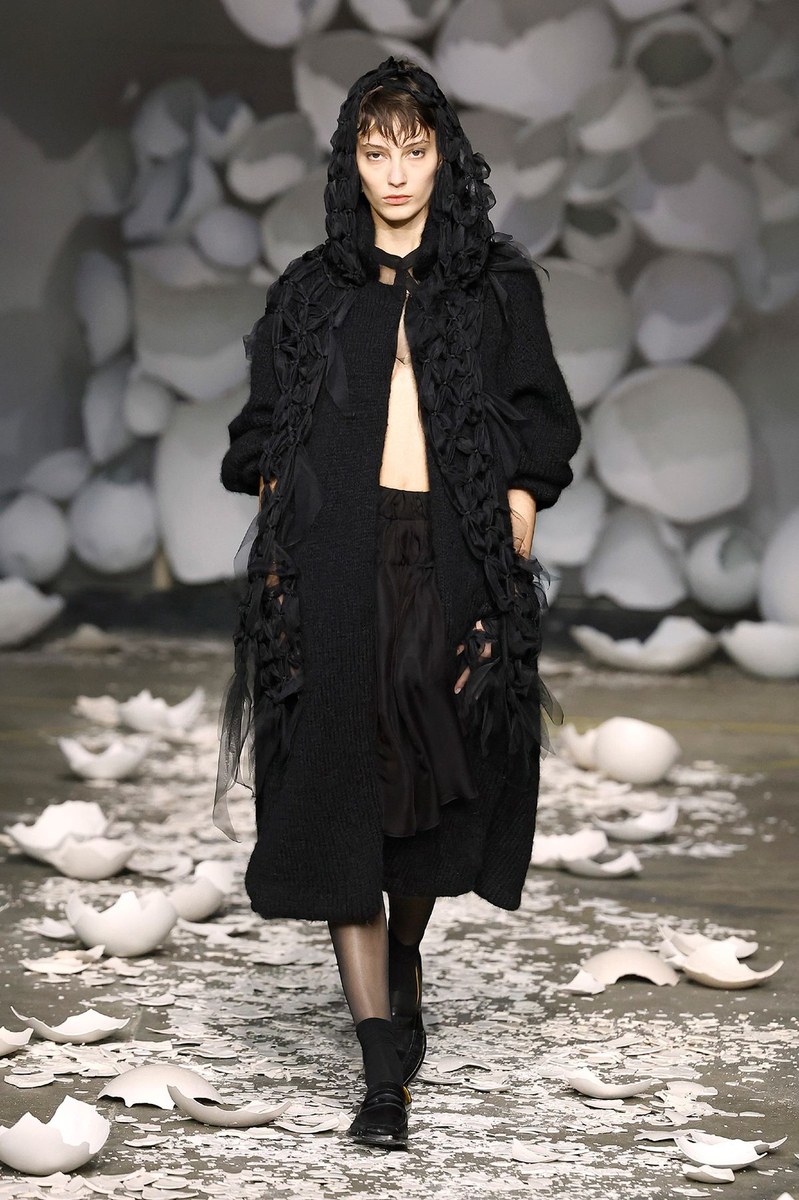
Pauline Dujancourt builds FW26 around the visual and structural logic of emergence, using broken eggshell set dressing not as backdrop but as conceptual anchor for a collection that moves from dense, protective darkness toward fragile, translucent light. For buyers, this collection arrives at a moment when the market is actively seeking handcraft-intensive, conversation-starting pieces that hold their own in an era of algorithmic sameness.
Silhouette and Volume
The collection opens with enveloping, body-obscuring coats and gradually strips away to cropped tops and sheer midi silhouettes by its midpoint. Oversized sleeves, gathered waistbands and ballooned skirt hems appear repeatedly, but always anchored by a narrow or cropped counterpoint. Look 2 carries volume in the skirt alone, with the torso left sleek and unadorned. Look 14 returns to the full coat architecture of Look 1, this time in teal, confirming that the cocoon coat is a deliberate signature and not an opener's flourish.
Color Palette
Pure black dominates Looks 1 through 7, an unbroken and intentional statement before any other color enters. Pale celadon and eggshell mint arrive with Look 8 and carry through Look 10, creating a visual exhale after the black sequence. A deep peacock teal governs Looks 11 through 16, sitting between the two prior groups and functioning as the collection's most commercially versatile tone. Slate grey closes the visible range in Looks 17 and 18, with a dusty periwinkle in Look 19 serving as the final chromatic note before the designer's bow.

Materials and Textures
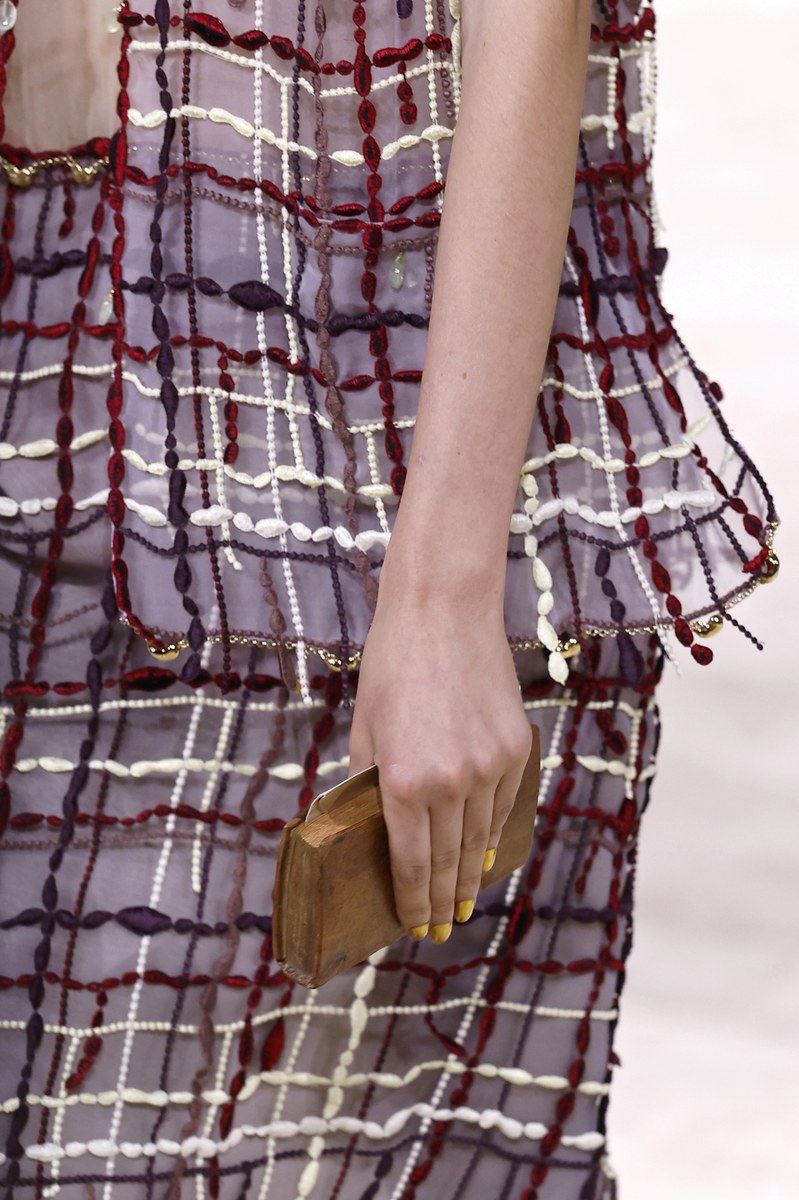
Chunky hand-knit wools in open rib constructions appear in both the black and teal chapters, carrying visible air and loft without stiffness. Sheer silk organza and chiffon layer over these heavier grounds in Looks 3, 7, 8 and 13, creating weight contrast within single looks. Hand-tied knots spaced across a mesh base first appear in Look 6 and resurface in Look 19, reading as a proprietary textile technique. Lace ranges from fine Chantilly-weight to heavier guipure in Looks 4, 5 and 18, always placed against skin or sheer underlayers to maximize contrast.

Styling and Layering
A handcraft-textured upper layer sits over a lighter, often sheer, foundation garment throughout. Gloves in Looks 5, 10, 11 and 16 are styled as fingerless or wrist-length knit and organza combinations that read as accessories with structural purpose rather than weather function. Footwear splits cleanly between white platform lace-up boots and white loafers on the lighter looks, and black chunky loafers or black lace-up ankle boots on the darker ones. The crocheted balaclava hood, appearing in Looks 1, 8, 14 and 15, functions as the collection's most repeatable and retail-translatable accessory.
Look by Look Highlights
Look 1 Opens the show with a black open-knit coat layered over a satin slip skirt, with a ruffled organza-trimmed balaclava that sets the handcraft vocabulary for everything that follows.

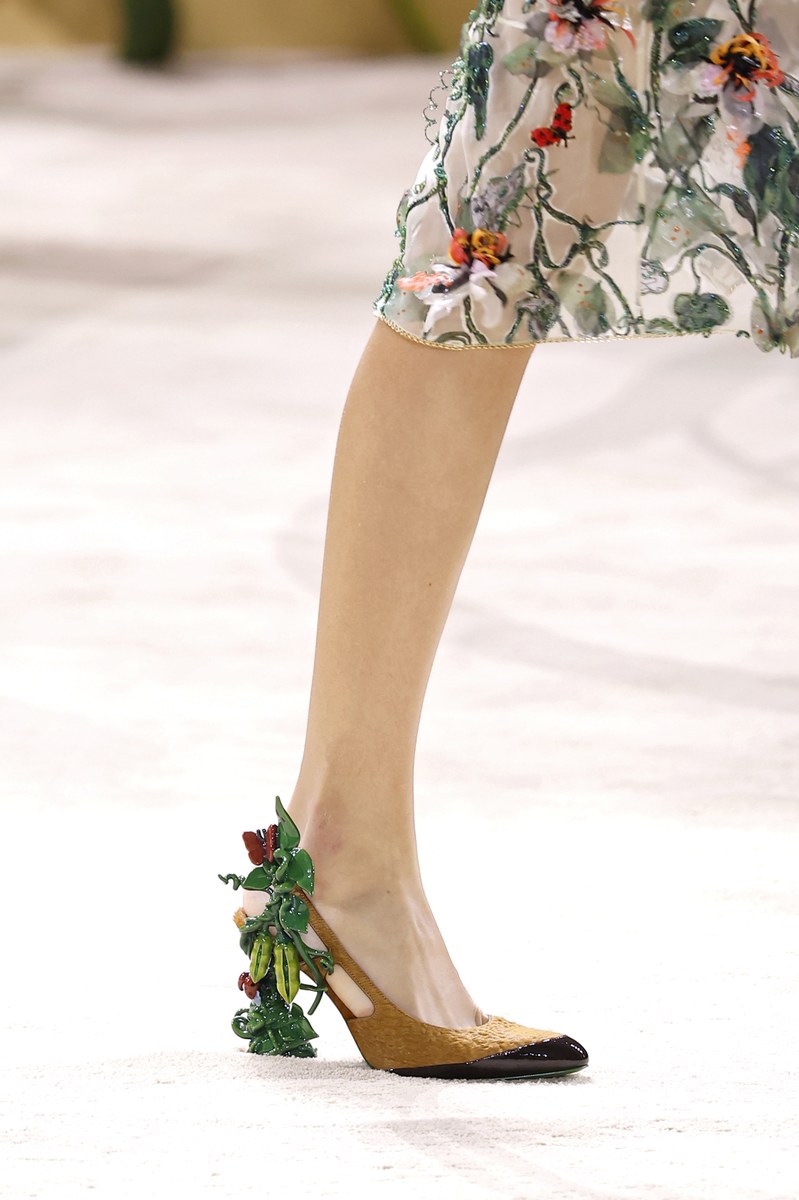
Look 4 Pairs a sheer black lace-bodice gown with a floral-appliqué organza skirt, making it the strongest evening proposition in the collection and the most likely candidate for wholesale placement in luxury multibrand retailers.

Look 6 Deploys the knotted-net textile across a full column silhouette with a chunky knit wrap at the shoulder, demonstrating that the technique scales from accent to primary fabric without losing structural clarity.
Look 8 Marks the color shift with celadon silk organza wide-leg trousers and a floral-jacquard cropped jacket worn over a sheer dress, with the crochet balaclava and woven bucket bag completing a head-to-toe editorial unit.
Look 13 Combines the knotted teal bodice over a sheer layer with a voluminous printed sashiko-patterned skirt in midnight teal, delivering the collection's most complex textile layering story in a single look.

Look 15 Pulls every teal element into one monochromatic unit, with the textured floral-appliqué column dress, matching balaclava and knotted tote bag creating a total-look proposition that photographs as a complete brand statement.

Look 17 Steps outside the handcraft-dominant language with a structured grey wool sleeveless dress paired with sheer organza sleeves and a knit glove, signaling that the collection has room for a cleaner, more wearable entry point.

Look 19 Closes with the periwinkle knotted-net gown, where the macrame-style construction graduates from tight at the bodice to loose and fringe-like at the hem, making it the most technically ambitious piece in the line.

Operational Insights
Textile development lead times The knotted-net and hand-tied macrame textiles seen in Looks 6 and 19 require significant handcraft labor, meaning buyers who pursue these pieces need to build 16 to 20 week minimums into their production calendars and should confirm sample availability before committing to volume.
Colorway sequencing Three distinct color chapters, black, celadon, teal and grey, map directly onto a phased delivery strategy. Style directors can plan a dark early-season drop followed by a light and then a saturated midseason delivery without the collection reading as disjointed.
Accessory pull-through The crochet balaclava and knotted tote bag each appear in four looks and function as standalone SKUs. Buyers at accessory-focused retailers should isolate these pieces for independent purchasing, as they carry the collection's handcraft identity without requiring full garment commitment.
Sheer underlayer logic Most looks depend on a sheer foundation garment, either organza or chiffon, to achieve their full visual effect. Product managers sourcing individual pieces should develop these base layers in parallel, as selling the textured upper layer alone risks flattening the intended aesthetic.
Evening versus daywear split Looks 4 and 19 are the clearest formal evening placements. Everything else, including the knit-and-satin combinations and the grey wool dress in Look 17, sits in dressed-up daywear or occasion-adjacent territory, which broadens the potential retail context beyond event-specific buying.
Complete Collection


About the Designer
Pauline Dujancourt, the 31-year-old French designer grew up with handknitting instilled by her grandmother, though she initially pursued theater before fashion. A former theater student in Paris, she once played Nina in Anton Chekhov's "The Seagull," a character that would later provide comfort during personal loss. After studying fashion and textile design at École Duperré in Paris, Dujancourt moved to London where she completed her MA in Fashion at Central Saint Martins in 2022.
Before launching her eponymous label in April 2022, she gained experience working for established designers including Simone Rocha, Rejina Pyo, and Alexander Wang in London and New York. This foundation shaped her understanding of the industry while she quietly developed her passion for creating unique fabrics through hand techniques. Her transition from theater to fashion wasn't immediate, but both disciplines share her fascination with storytelling through visual expression.
Her aesthetic draws from contrasts and opposites, seeking tension where beauty meets raw, disturbing elements. She finds inspiration in ancestral domestic making traditions, particularly referencing East German women who created elegant garments at home during supply shortages, using DDR fashion magazines like 'Sibylle' for patterns. Her collections blend deconstructed knitwear with delicate metallic crochet trims she calls "jewellery knits," moving away from vintage aesthetics toward contemporary sensuality.
Now established as a British Fashion Council NEWGEN recipient and LVMH Prize finalist, Dujancourt collaborates with female artisans worldwide, including a community of knitters in Lima, Peru. Her London-based studio overlooks the Thames, where her team creates intricate pieces that pay tribute to everyday women knitting for their loved ones.
"She was so skilful and so humble about it. And no one really realised how much work it takes and how much technique it takes." Speaking of her grandmother's influence, she adds: "As long as she has faith in her calling, her passion, then life does not hurt so much anymore."
✦ This report was generated with AI — combining human editorial vision with Claude by Anthropic. Because the future of fashion intelligence is already here.