Pierre Cardin FW26 Women Looks Report
Paris Fashion Week
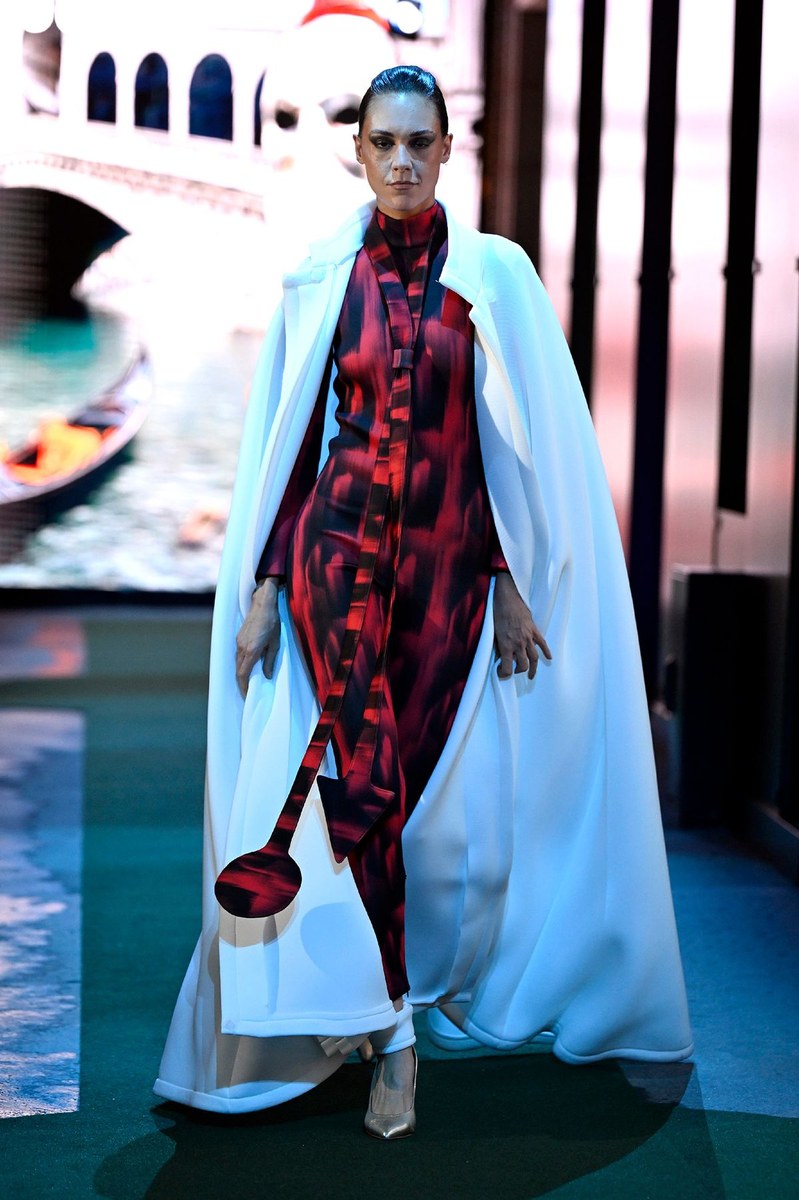
Geometric, space-age vocabulary defines this collection, anchored firmly in outerwear architecture. Every look builds around the cape as the primary commercial unit. Buyers and style directors will recognize a clear, scalable story with strong visual identity on the floor.
Silhouette and Volume
The cape dominates. Cropped shoulder wraps appear in Look 15, while floor-sweeping opera-length constructions anchor Looks 1, 2, and 8. Looks 4 and 5 feature structured, exaggerated shoulders. Look 20's vertical fringe strips fracture the silhouette into something far more graphic than draped. Wide and volumetric at the top, narrow through the trousers or fitted base layer below, the silhouette maintains consistent top-heavy proportions that photograph at scale.
Color Palette
Royal cobalt blue recurs most aggressively across Looks 3, 9, 11, 14, and 19, functioning as the collection's commercial spine. Crimson red appears in Looks 1, 2, 14, and 19, often paired with cobalt or white to create flag-like boldness. White grounds Looks 1, 10, and 12. Look 7 lands a sharp contrast between cobalt and warm champagne gold. Looks 4, 13, 16, and 17 embrace all-black moments, which will likely move fastest at retail.

Materials and Textures
Heavy wool and thick double-faced jersey carry the structural capes, visible in Looks 4, 11, 14, and 18. Looks 2 and 7 deploy liquid satin for high-sheen contrast against matte wool pieces. Look 8 features a metallic mesh or chainmail-weight lamé that catches light differently in motion. Look 20's lilac cape is cut from matte scuba-weight fabric, rigid enough to hold the fringed straps without collapsing.

Styling and Layering
Every look builds on a fitted black turtleneck base, making the cape the interchangeable outer statement. Slim trousers run in black, white, or bold accent colors, as in Look 17's magenta. Pointed-toe black pumps carry nearly the full lineup, with silver metallic heels in Look 1 and gold platforms in Look 19 as the only departures. Sculptural black frames in Looks 7, 9, and 16 function as visible accessory category, signaling a co-sell opportunity for buyers.

Look by Look Highlights
Look 2 A floor-length red satin cape with a single oversized three-dimensional rose at the chest gives buyers a hero piece with a clear visual hook for campaign imagery.

Look 4 A full-length black wool coat with two large bronze ring-shaped hardware cutouts at the hip pockets makes the hardware itself the product story, not the garment construction.

Look 5 A cobalt blue foam-like structured yoke piece over a black fitted base reads closer to wearable sculpture than outerwear and signals the range of the line for editorial placement.

Look 10 A white cape scattered with dark crimson triangle appliqués, one replaced by a holographic triangle, builds a print logic that translates directly to a repeatable surface pattern for production.

Look 12 A rigid white trapezoidal cape with a magenta ribbed belt and gem closure is the clearest day-to-event crossover piece in the lineup, with a strong accessory focal point.

Look 19 Vertical color-blocked satin panels in red, cobalt, and orange under a gold brocade collar reference the Armenian tricolor directly, adding cultural specificity that press and editorial will amplify.

Look 20 Lilac fringe straps weighted with geometric buckles over a full gold metallic bodysuit is the closing statement piece, built for trunk show and special-order rather than open stock.

Look 16 An asymmetric black-and-white cape with graphic rectangular white panels outlined in black leather trim delivers the strongest black-and-white commercial option, legible at a glance from the floor.

Operational Insights
Cape as the core SKU: The entire assortment logic builds around a single outerwear silhouette in varied lengths, materials, and embellishment levels. Plan a cape-led capsule rather than treating these as one-off statement pieces.
Base layer standardization: The black fitted turtleneck base worn under nearly every look represents a high-velocity replenishment item. Stock it as a coordinating essential rather than an afterthought.
Hardware and embellishment as upsell: Looks 2, 4, 12, and 20 showcase the rose, bronze rings, gem closure, and buckled fringe respectively, each representing add-on manufacturing complexity that justifies a premium price tier and creates a natural good-better-best range within the same silhouette.
Color-blocking for wholesale visibility: Cobalt and red combinations photograph with high contrast on hangers and in digital thumbnails, making them strong choices for wholesale catalog leads and e-commerce hero images.
Eyewear as category extension: Sculptural oversized frames in Looks 7, 9, 11, and 16 are styled as integral to the look rather than decorative. Buyers with accessory open-to-buy should evaluate the eyewear line for co-exclusive or bundled program potential.
Complete Collection


Fashion Designer

About the Designer
Rodrigo Basilicati Cardin was born on December 29, 1970, in Padua, in the Veneto region of northeastern Italy, the same date that would later become, fifty years later, the day his great-uncle Pierre Cardin died. He grew up in the Veneto far from Paris and far from fashion, with two parallel obsessions: engineering and music. He began studying piano at eight years old, continued at the Padua Conservatory, and eventually completed advanced studies at the Franz Liszt Academy in Budapest, where he trained as a concert pianist and won prizes in international competitions. Simultaneously he pursued civil engineering at the University of Padua, completing degrees in both disciplines. He first met Pierre Cardin at twenty-four, brought to Paris by his grandfather, Cardin's brother. The encounter became the fulcrum of his adult life.
Cardin recognized something in him and drew him into his orbit. He installed Rodrigo in Venice and gradually brought him into the business, starting with the Sculptures Utilitaires furniture line, a series of functional objects designed in the direct formal vocabulary of Space Age geometry. Over the following decades Rodrigo directed the group's Italian companies, produced dozens of artistic productions at the Espace Pierre Cardin theater across the world, developed furniture and accessories, and worked on a transparent luminous gondola prototype for Venice. In 2018 Cardin formally appointed him CEO; two days after the founder's death on December 29, 2020, Rodrigo became president and artistic director of the house. He has described his formation as inseparable from thirty years alongside his great-uncle: structural engineering for spatial thinking, music for discipline and sensitivity, and a daily proximity to one of the twentieth century's most determined futurists.
His references are those he inherited and internalized rather than invented: the Space Age optimism that Cardin pioneered in the 1960s, geometric construction as the language of dress, the idea that clothing operates like architecture. He has spoken of his childhood ambition to become an aerospace engineer, and of how that impulse feeds directly into his current work, including a collaboration with the European Space Agency on a lunar training suit. He has deliberately refused to hire an outside creative director, insisting that the design language of Pierre Cardin cannot be separated from the house's internal culture and should be extended rather than replaced. He launched the Pierre Cardin Young Designers Award in 2022 to bring emerging international talent into the process. Rodrigo Basilicati Cardin continues as president, artistic director, and creative director of Pierre Cardin, presenting on the Paris Fashion Week calendar.
"I don't seek to imitate him. I have internalized his deepest concepts. I draw on the essence of the brand, its audacity, its independence, its futurist spirit, and I express it in my own language. That is how I honor his DNA by creating something authentic and new."
"Since childhood I have functioned like him: what matters is daring to bring completely different worlds together to create wonder, which is the foundation of all vision."
✦ This report was generated with AI — combining human editorial vision with Claude by Anthropic. Because the future of fashion intelligence is already here.