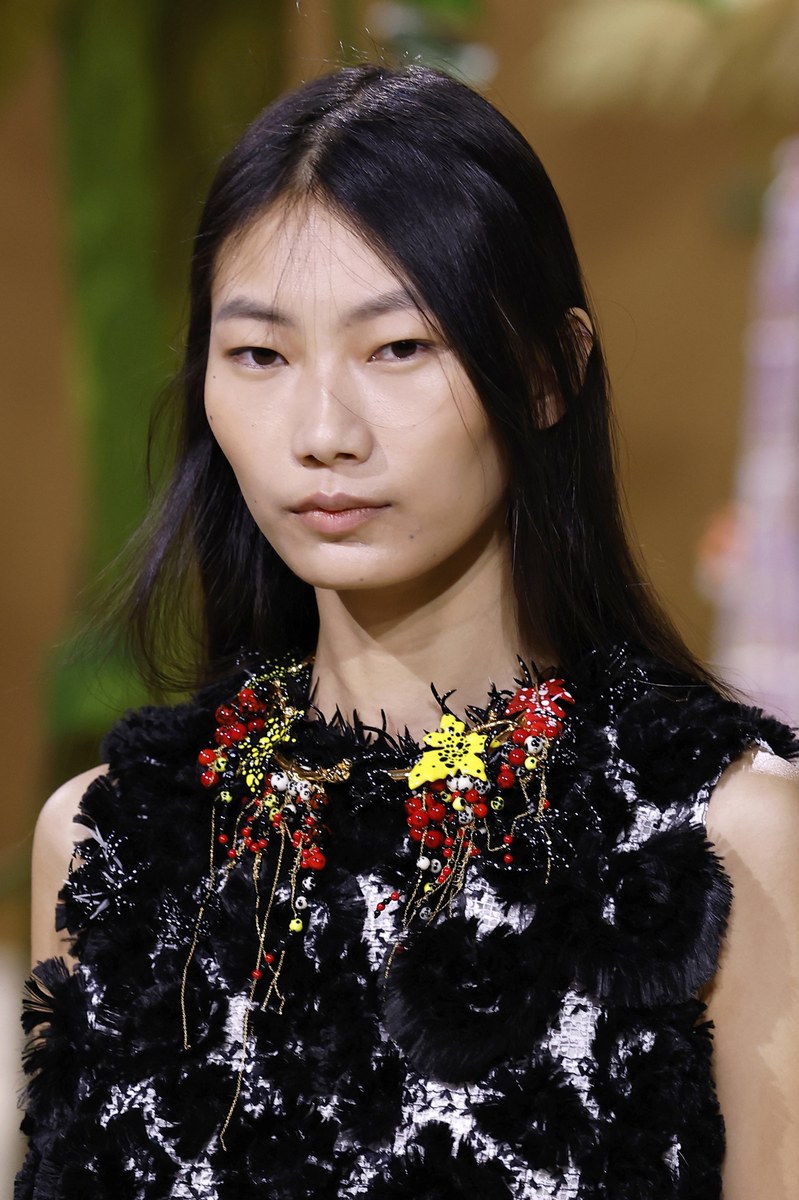
Prada FW26 Women Looks Report

Prada FW26 Women Looks Report
Prada FW26 Women Looks Report

Milan Fashion Week

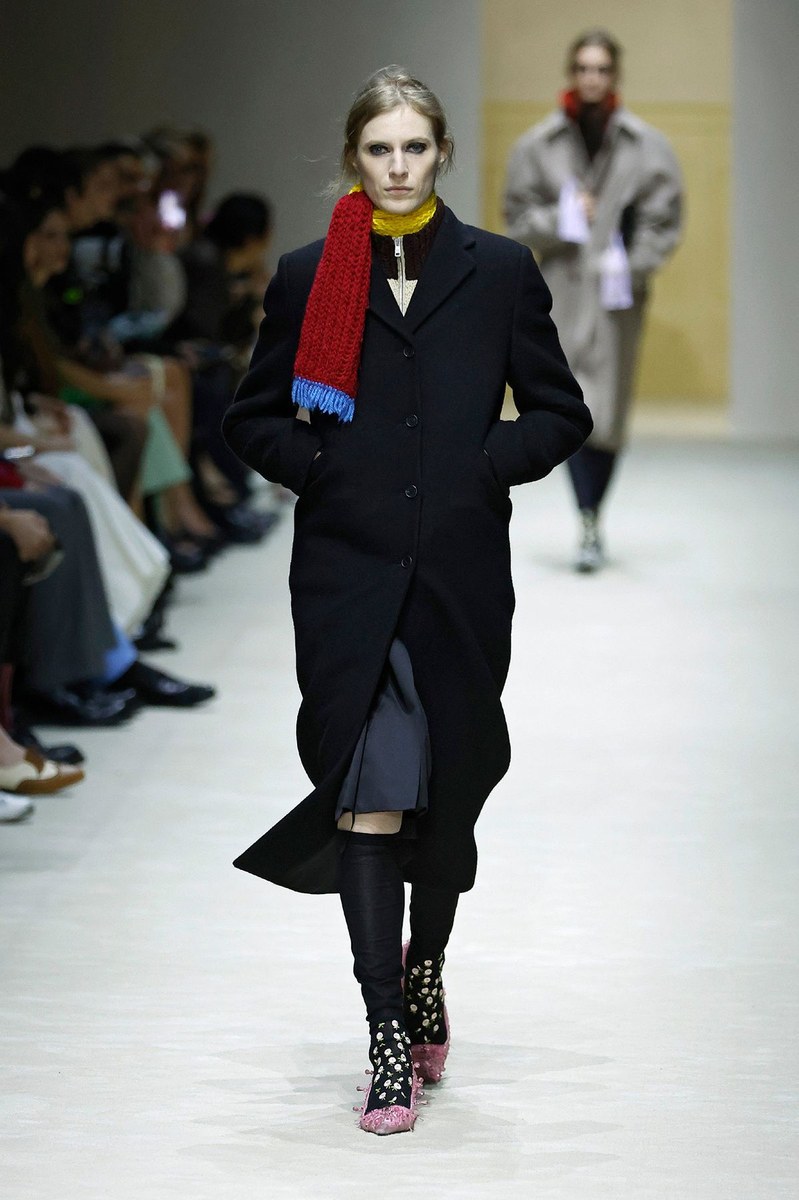
Prada FW26 builds its argument around deliberate friction, placing utilitarian outerwear against luxury accessories, knitwear against sheer organza, and muted stone tones against hard primary color hits. For buyers and style directors, the commercial path is clear: wardrobe investment pieces anchored in outerwear, activated by high-margin accessories and footwear with strong visual identity.

Silhouette and Volume

A mid-length hemline sits consistently below the knee, creating sober, structured proportions across coats, skirts and dresses. Jackets read oversized at the shoulder but taper or cinch at the waist when layered, as in Look 4 and Look 17, where nylon utility shells are worn over long wool coats to create a stacked, two-register volume. Look 3 features a lean, androgynous blazer silhouette, a deliberate contrast to the ballooned upper bodies elsewhere. Volume is purposeful and directional, never decorative.
Look 4
Look 4

Color Palette

Opening in near-black, the collection moves through stone, khaki, and slate grey before igniting with magenta in Look 14, red in Look 17, and yellow in Look 4 and Look 11. Primary red scarf accents recur across Looks 1, 13, and 16, functioning as a chromatic signature rather than a styling afterthought. Look 19 introduces white as a reset, clean and graphic against a printed classical motif at the hem. Northern European restraint punctuated by moments of blunt, saturated heat sets the overall mood.

Look 14
Look 14

Materials and Textures

Heavy wool coats layer with cotton nylon shells, creating visible seams of weight and finish between garments. Look 6 features a dark brown leather coat that reads smooth and dense, while the crushed black velvet or astrakhan-effect jacket in Look 11 carries a crinkled, light-absorbing surface quality that reads as tactile even from a distance. Sheer midi skirts or coat linings in organza appear across Looks 7, 9, and 10, adding translucency without softness. Hardware and surface contrast extend from clothing into accessories, confirmed by the denim mini bag in Look 19 and the patent leather bag in Look 16.

Look 6
Look 6

Styling and Layering

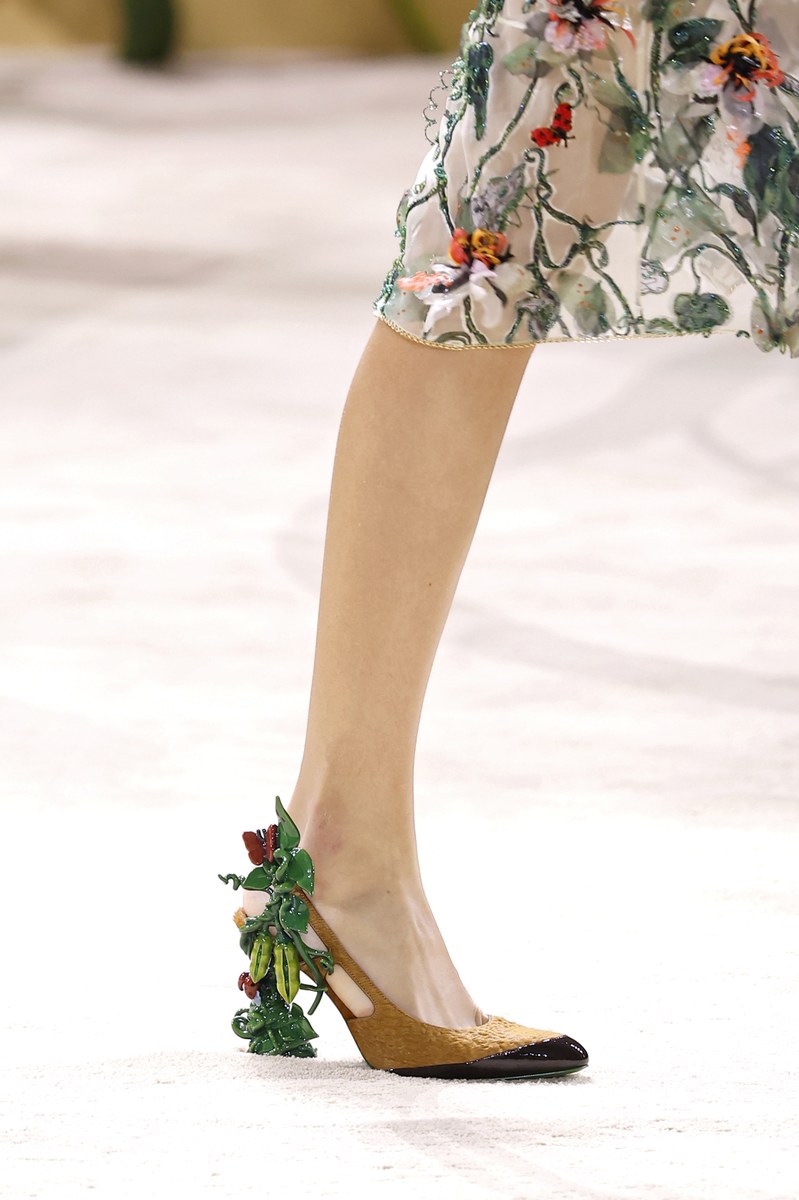
Distinct visible layers characterize each look, with inner garments, typically shirting or knits in a contrasting color or fabric, allowed to read clearly beneath and beyond the outer layer. Light blue oxford shirt cuffs extending past the black sweater in Look 18 represent the cleaner, market-ready version of this logic, but the pattern recurs in more complex form in Looks 2, 5, 8, and 12, where shirting panels, waistbands and inner coat facings all surface deliberately. Lace-up knee boots in white, grey and black appear across at least eight looks, often with floral or crystal embellishment at the toe and ankle. Footwear carries enormous editorial weight. Bags are small and structured, carried by hand, and treated as punctuation rather than volume.

Look 18
Look 18

Look by Look Highlights

Look 1 Anchors the collection's tone with a double-breasted black wool overcoat worn over a red chunky-knit scarf with blue fringe, and a gold arrow pendant at the collar, a formula that layers warmth, color and hardware in a single sellable moment.

Look 1
Look 1

Look 4 Pairs a yellow nylon cargo-pocket shell jacket over a long navy double-breasted wool coat with a dark fur stole at the neckline, demonstrating the two-outerwear-at-once proposition in its most commercially bold configuration.

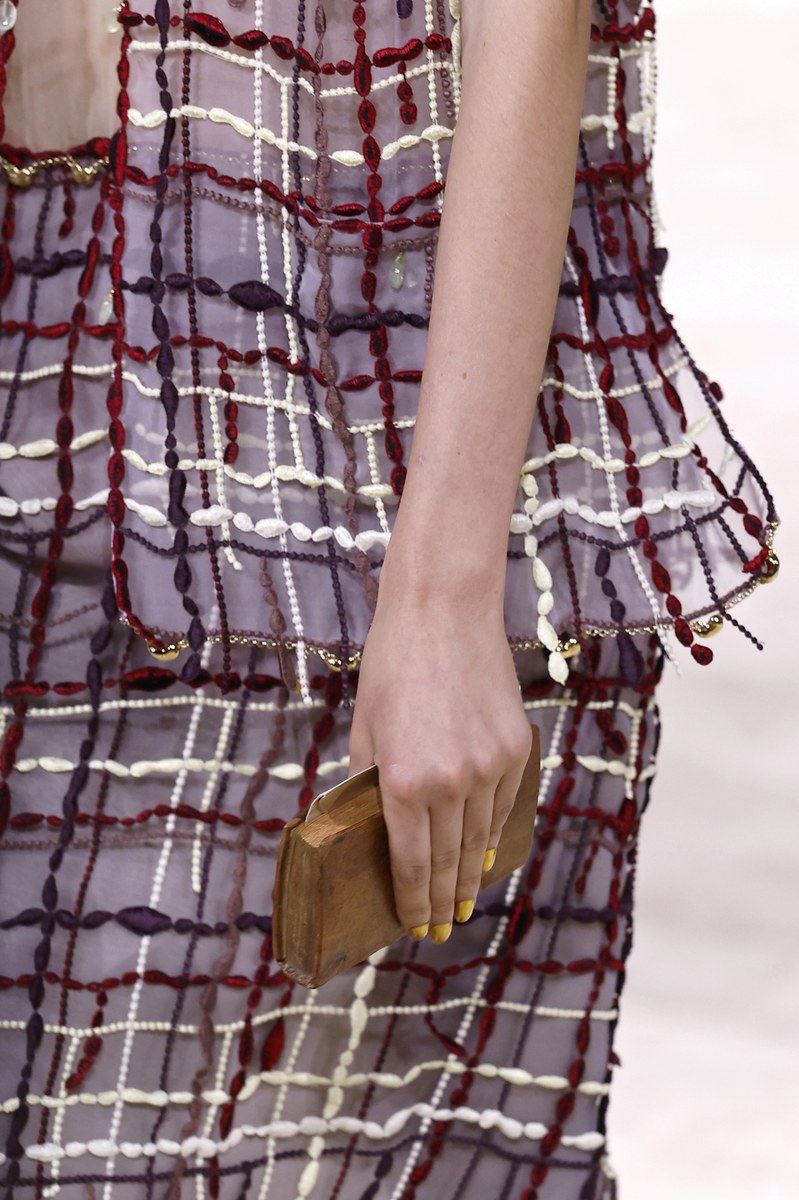
Look 7 Combines a cream and navy striped zip-front textured knit with a layered organza and wool midi skirt in deep burgundy and navy, then grounds the look on burgundy opaque tights, producing a strong, full-priced knitwear and skirt story.

Look 7
Look 7

Look 8 Features the most complex layering in the show with a crystal-embellished grey denim coat over leopard fur collar, yellow high-neck, blue shirt and printed skirt, a directional editorial look with identifiable separates that can each be sold individually.

Look 8
Look 8

Look 11 Stands as the strongest single-garment statement: a voluminous black astrakhan-texture jacket worn against a dark teal organza skirt and neon yellow floral knee boots, a clear anchor for a FW26 outerwear campaign.

Look 11
Look 11

Look 14 Delivers the collection's most direct commercial signal in magenta, a chunky cable zip-front cardigan in deep fuchsia over a pink satin midi skirt, with burgundy knee-high boots and a striped scarf, a full look with strong gifting and knitwear buy potential.

Look 19 Closes the ready-to-wear sequence with a white cotton drawstring dress printed with a classical sculptural face and lace fan motif, worn with white lace-up knee boots and a denim handbag, a graphic, season-defining dress that will photograph as a cover story.

Look 19
Look 19

Look 15 Features a burgundy leather bomber-cut jacket over a charcoal tweed midi skirt with a pink leather inner lining visible at the chest, confirming that contrast linings and inner panels are a key construction detail worth building into the buyer's fabric order conversation.

Look 15
Look 15

Operational Insights

Outerwear as the primary revenue driver: Wool coats, nylon utility shells, leather bombers and fur-effect jackets dominate the commercial category. Buyers should plan for deep SKU investment here across a range of price points, from the lean wool blazer in Look 3 to the embellished grey coat in Look 8.

Look 3
Look 3

Two-garment outerwear layering: Multiple looks pair two full outer layers worn simultaneously. Retailers should consider merchandising and mannequin strategies that display this double-outerwear logic in-store, as the styling proposition will not read on a flat hanger.

Boot category with embellishment detail: Knee-high lace-up boots carry floral, crystal and tassel embellishment at toe and ankle across the majority of looks. Product managers should prioritize these as a high-visibility footwear delivery for early FW26 floor sets, as they carry the visual signature of the collection.

Color accent scarves as entry price point: Red, orange and striped knit scarves appear in Looks 1, 13, 14 and 16 as consistent color anchors. These represent a low-cost, high-visibility entry product for wholesale and gifting channels and should be ordered in volume.

Print and graphic dress for editorial pull: Look 19 produces a single dress with strong standalone editorial potential. Style directors should request early access to press samples, and buyers should consider it as a window or campaign hero for mid-season newness drops.

Complete Collection

Look 2
Look 2
Look 5
Look 5
Look 9
Look 9
Look 10
Look 10
Look 12
Look 12
Look 13
Look 13
Look 16
Look 16
Look 17
Look 17
Look 20
Look 20
Look 21
Look 21
Look 22
Look 22
Look 23
Look 23
Look 24
Look 24
Look 25
Look 25
Look 26
Look 26
Look 27
Look 27
Look 28
Look 28
Look 29
Look 29
Look 30
Look 30
Look 31
Look 31
Look 32
Look 32
Look 33
Look 33
Look 34
Look 34
Look 35
Look 35
Look 36
Look 36
Look 37
Look 37
Look 38
Look 38
Look 39
Look 39
Look 40
Look 40
Look 41
Look 41
Look 42
Look 42
Look 43
Look 43
Look 44
Look 44
Look 45
Look 45
Look 46
Look 46
Look 47
Look 47
Look 48
Look 48
Look 49
Look 49
Look 50
Look 50
Look 51
Look 51
Look 52
Look 52
Look 53
Look 53
Look 54
Look 54
Look 55
Look 55
Look 56
Look 56
Look 57
Look 57
Look 58
Look 58
Look 59
Look 59
Look 60
Look 60
Look 61
Miuccia Prada and Raf Simons

About the Designer

Miuccia Prada Co-Creative Director, Prada

She was born Maria Bianchi in Milan in 1949, the granddaughter of Mario Prada, who had opened a leather goods shop in the Galleria Vittorio Emanuele II in 1913. Her father manufactured putting-green mowers. Her mother ran a company that had dwindled, by the time Miuccia joined it in the late 1970s, to a single store. None of this pointed obviously toward fashion. At university she completed a doctorate in political science, joined the Italian Communist Party, and distributed flyers at demonstrations. She then spent five years training as a mime at the Piccolo Teatro under Giorgio Strehler, the most rigorous theatrical school in Milan, learning how to communicate without words. It was only in 1978, after her mother stepped down, that she entered the family business under any kind of obligation, and even then with no formal design training.

What she had instead was a set of intellectual coordinates that had nothing to do with the industry she was entering: feminist theory, Marxist politics, the language of the body in theatrical space, an instinct for what bourgeois comfort conceals about itself. Her first design decision of consequence was a nylon backpack, a fabric used in military tents, which she launched in 1979 and redesigned in 1985 with a small triangular logo. It became an object of desire precisely because it refused to look like one. Her first ready-to-wear collection in 1988 was described as "uniforms for the slightly disenfranchised," and the phrase captures her method: clothing that flatters by appearing to withhold. She launched Miu Miu in 1993, named after her own childhood nickname, and together with her husband Patrizio Bertelli built the Prada Group into one of the most intellectually rigorous commercial empires in fashion. In April 2020 she invited Raf Simons to become her co-creative director, the first time in the house's history that she had shared the creative role.

"I was sometimes criticized for not doing collaborations, so now I am doing one."

"The more we do what we like, the more it's good."


Raf Simons Co-Creative Director, Prada

Raf Simons was born in 1968 in Neerpelt, a small rural town in the Flemish province of Limburg, Belgium. His father was an army night watchman, his mother a house cleaner. The childhood was modest and quiet, far from any creative industry, but the Flemish countryside in the 1970s and 1980s was also a culture that produced an extraordinary generation of designers, and Simons absorbed their work from a distance before he understood what to do with it. He studied industrial design and furniture design at the LUCA School of Arts in Genk, graduating in 1991, and began working as a furniture designer for galleries, making modular, minimalist structures with a sensibility formed more by modernist architecture than by anything in fashion. His thesis project, titled Corpo, consisted of seven accessory cabinets that treated furniture as something to be dressed, using metal tubes wrapped in fabric and leather to suggest the parallels between adorning an object and adorning a body.

Fashion entered his life through a single event. His mentor during his student years, Walter Van Beirendonck, one of the Antwerp Six, took him to a Paris Fashion Week in 1991 where Simons saw Martin Margiela's all-white show. He walked out of it knowing what he was going to do. Linda Loppa, then head of the fashion department at the Royal Academy of Fine Arts Antwerp, encouraged him to teach himself menswear design without enrolling in any program, and in 1995 he launched his Raf Simons label from a creative circle that included photographer Willy Vanderperre and stylist Olivier Rizzo, gathering at an Antwerp café to argue about Helmut Lang and Margiela. His aesthetic fused the uniform logic of workwear and military clothing with the energy of subcultural youth, Joy Division and rave and gabba and the visual grammar of adolescent rebellion. He served as creative director of Jil Sander from 2005 to 2012, artistic director of Christian Dior from 2012 to 2015, and chief creative officer of Calvin Klein from 2016 to 2018. In April 2020 he joined Prada as co-creative director alongside Miuccia Prada, with equal creative authority, the first partnership of its kind at any house of comparable scale.

"As a student I always thought that fashion was a bit superficial, all glitz and glamour, but this show changed everything for me. I walked out of it and I thought: that's what I'm going to do."

"I don't want to show clothes. I want to show my attitude, my past, present and future."

✦ This report was generated with AI — combining human editorial vision with Claude by Anthropic. Because the future of fashion intelligence is already here.