Private Policy FW26 Details
Private Policy FW26 Details Report
Private Policy FW26 pushes accessories into deliberately layered, culturally loaded territory, mixing utilitarian hardware, sport-inflected eyewear, and structured millinery within a single coherent vision. For buyers and product managers, this signals strong commercial appetite for pieces that carry clear identity codes without relying on logo repetition.
Category Overview
Three categories anchor the accessories story: dress details, eyewear, and headwear. Dress details range from industrial snap-stud closures and rope ties (Detail 1) to sequined ground cloth loaded with souvenir enamel pins and chains (Detail 3), while the knit embroidery of Detail 2 pulls toward collegiate Americana. Eyewear commits to a single shield silhouette across two executions (Details 4 and 5). Headwear works entirely within the newsboy and beret family across three variations (Details 6, 7, and 8). The strategy is tight, not scattered. Each category reads as a deliberate program rather than a collection of one-offs.
Material and Construction
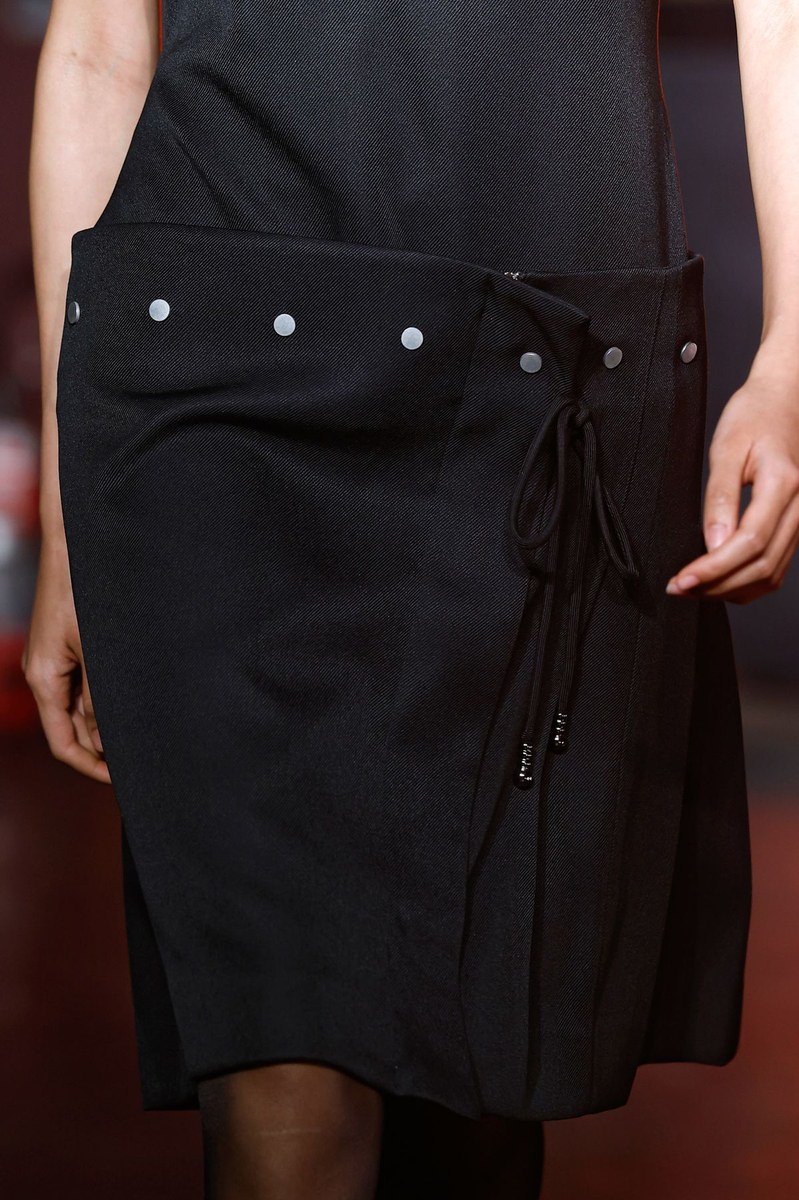
Heavy wool-blend suiting fabric anchors Detail 1, where flat silver snap buttons are set at even intervals along a wide waistband. The closure system combines a center zip with a cord-and-toggle tie, suggesting multiple functional layers built into a single panel. Detail 3 uses a fine black sequin mesh as the base, with individual souvenir pins attached via small jump rings and short link chains. This construction method requires hand-assembly and will carry significant production labor costs. Detail 2 is a cable-knit cardigan in medium-weight wool with chenille or thick yarn varsity lettering applied in a caramel gold tone. Headwear moves between a brushed alpaca or mohair-blend oversized baker boy (Detail 6), a smooth pressed-wool baker boy in camel (Detail 7), and a classic flat felt beret in black (Detail 8).
Color and Finish Direction
Black dominates the dress details, appearing in the suiting of Detail 1 and the sequin ground of Detail 3. Hardware in Detail 1 is a cool matte silver, not polished chrome. Detail 2 breaks cleanly from this palette with a high-saturation kelly green, offset by warm caramel lettering, a pairing that reads as vintage sportswear rather than fashion-season color. Headwear stays within a narrow neutral corridor of camel, sand, and black. Eyewear mirrors that restraint with an all-black shield frame in Detail 5 and a black-and-warm-tortoise frame with clear lower lens in Detail 4. The palette for the season reads as disciplined near-neutrals punctuated by one loud cultural color statement.
Key Pieces and Details
Detail 3 is the commercial centerpiece of the accessories program. The souvenir pin dress functions as a modular concept, allowing buyers to consider the pin-and-chain attachment system as a separate hardware add-on applicable to outerwear or bags. This extends the concept beyond a single SKU. Detail 1 is equally actionable as a separate waistband or belt accessory, since the snap-stud panel and rope closure could translate directly into a cincher belt for wholesale production. The shield eyewear silhouette repeated across Details 4 and 5 confirms that this frame shape is no longer a novelty. Accessories directors should treat it as a core shape for FW26 eyewear assortments rather than a statement style.

Detail by Detail Highlights
Detail 1 (Dress Detail) A wide black suiting waistband carries seven flat matte silver snap buttons at equal spacing, closes with a center zip, and secures further with a doubled black cord tied in a loose bow at the right hip, layering three closure systems into one functional piece.
Detail 2 (Dress Detail) A kelly green cable-knit cardigan in a medium gauge carries arched varsity lettering reading NEW YORK in caramel-toned chunky yarn across the chest, positioned over a white Oxford shirt and paired with raw-hem khaki trousers to anchor the collegiate American reference.

Detail 3 (Dress Detail) A black micro-sequin dress serves as a base for dozens of souvenir destination pins, including California and New York enamel badges, each individually linked to the fabric via small silver jump rings and short chain drops, creating a moving, sound-generating surface.
Detail 4 (Eyewear) A flat-top shield frame in black acetate with a semi-transparent warm brown lower bar and fully clear lens wraps close to the face, worn with mint green disc earrings and a slicked pompadour to sharpen the retro-futurist tension.

Detail 5 (Eyewear) A full wraparound shield in solid black with a matte frame body and a barely visible row of small silver studs along the top bar delivers a sport-utilitarian read that aligns directly with current demand for performance-adjacent fashion eyewear.

Detail 6 (Headwear) An oversized baker boy cap in a brushed camel fiber, likely mohair or alpaca blend, sits with a generous rounded crown and wide brim, its soft pile texture contrasting against the structured satin lapels of a pale gold blazer beneath.

Detail 7 (Headwear) A smooth pressed-wool baker boy in mid-camel sits low and tight on the head with a narrow flat brim, worn alongside a caramel hoop earring and a green plaid shirt-dress. A sculpted black hair knot at the nape adds a graphic counter-shape.

Detail 8 (Headwear) A classic flat beret in black felt wool covers the crown fully and tilts forward, paired with dome-shaped polished silver disc earrings and a pale yellow coated-cotton shirt, a combination that keeps the silhouette contemporary without altering the form.

Operational Insights
Modular hardware strategy: The snap-stud and cord closure system in Detail 1 should be evaluated as a standalone belt or cincher accessory. It can be produced independently from the skirt and opens a lower price-point entry for accessories buyers.
Pin-and-chain attachment as a kit concept: The jump-ring attachment method in Detail 3 presents a strong opportunity for a capsule souvenir pin set sold as a customization kit for bags or outerwear, reducing per-unit production complexity while creating a high-margin add-on SKU.
Shield frame as a core shape: The repetition of the shield silhouette across two distinct colorways in Details 4 and 5 confirms buyer commitment to this frame as a seasonal anchor. Eyewear buyers should plan depth in both optic and sun executions rather than treating it as a single fashion unit.
Baker boy breadth: Three distinct baker boy executions across Details 6, 7, and 8 in different fabrications and colors indicate that this silhouette carries enough range to support a multi-SKU headwear program. Material and color serve as the primary differentiation levers.
Collegiate color as a punctuation play: The kelly green and caramel combination in Detail 2 reads as a targeted injection of color into an otherwise neutral collection. Product managers should position this colorway as a limited-depth punctuation piece rather than a core color story to avoid overexposure at retail.
✦ This report was generated with AI — combining human editorial vision with Claude by Anthropic. Because the future of fashion intelligence is already here.