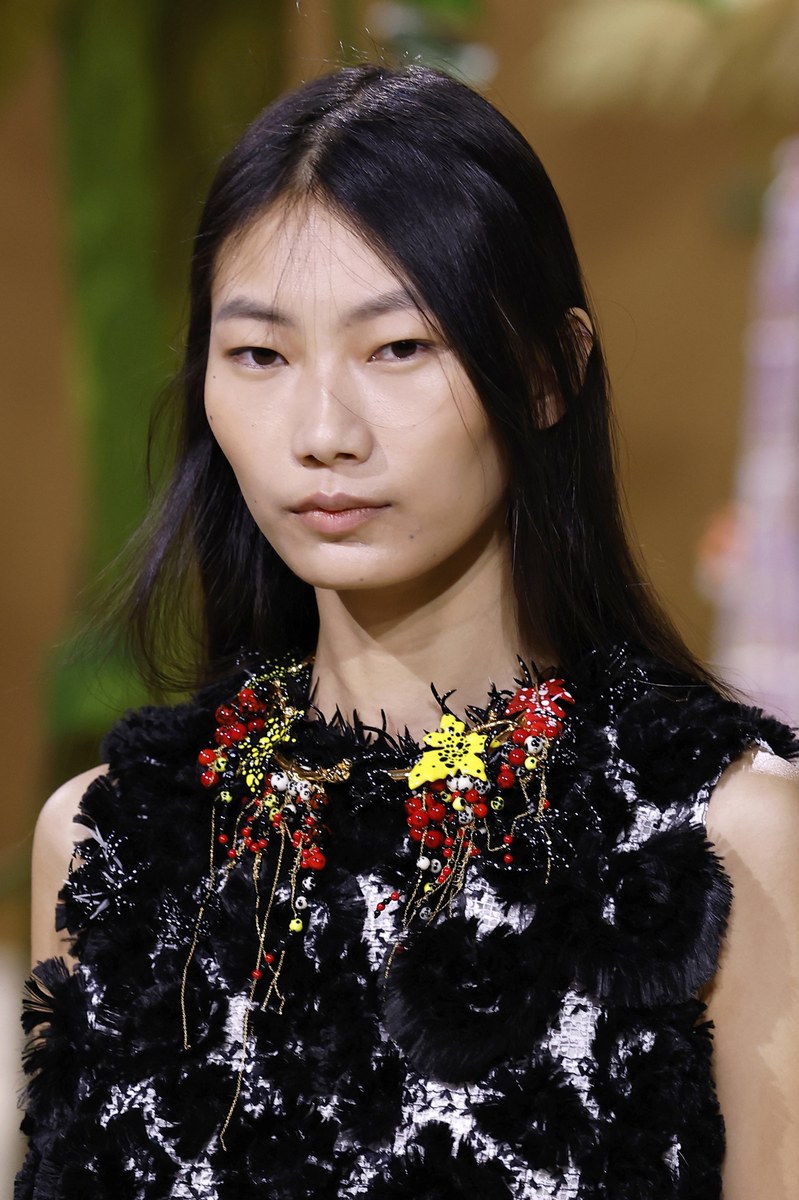
Rabanne FW26 Details

Rabanne FW26 Details
Rabanne FW26 Details Report

Rabanne FW26 builds its accessories strategy around two poles: the slim, logo-buckled leather belt worn over layered outerwear, and heavily embellished dress details that fuse chainmail, beading, and metal hardware into the garment's structure itself. For buyers and product managers, this split signals a dual commercial opportunity, one in accessible everyday leather goods and one in high-investment statement pieces with significant fabrication complexity.

Category Overview

Two distinct categories emerge here. Belts (Details 1 through 7, plus appearances in Details 8, 9, 11, and 12) anchor the collection, while Dress Details (Details 8 through 20) carry the narrative forward. The belt functions as a recurring unifying device across wildly different outerwear and layering combinations, making accessories far more than decorative afterthought. Pattern-heavy, multi-layer looks find their anchor at a single waist point, while dress details carry the house's signature metal and chainmail DNA directly into construction. Material logic runs from smooth polished leather to scaled python-embossed leather to sequined fabric, chainmail mesh, fringe, and sculptural cone hardware.
Material and Construction

Details 1 through 7 share a narrow-width construction, roughly 2 to 3 centimeters wide, in smooth full-grain leather, croc-embossed leather (Detail 3), and python-print leather (Detail 7). Colorways shift across entries but hardware remains consistent, a round coin-style or rectangular box buckle in aged gold or silver tone. The dress details move into far more complex fabrication territory. Detail 14 and Detail 20 show rows of silver cone-shaped metal pendants threaded above long crimson suede fringe, a construction that demands significant handwork and metal component sourcing. Detail 19 features a draped chainmail body with crystal pin-based waist detailing, while Detail 16 presents a white sequin ground with multicolored beaded floral embroidery and a beaded fringe hem.

Detail 3
Detail 3

Color and Finish Direction

Belt leathers span oxblood burgundy (Detail 1), cognac tan (Detail 2, Detail 11), medium brown croc (Detail 3), caramel (Detail 4), black patent (Detail 5), black smooth (Detail 6), and natural python (Detail 7), covering almost every neutral register. Gold-tone hardware dominates in Details 1, 2, 6, and 7, while silver-tone hardware appears in Details 4 and 5, and a gunmetal-adjacent finish appears in Detail 9. Crimson red fringe against polished silver cone hardware in Details 14 and 20 reads as the collection's most directional color contrast. Sequin grounds in iridescent white (Detail 16) and pale lavender-pink (Detail 17) carry a softer luminosity that counters the harder metal work elsewhere.

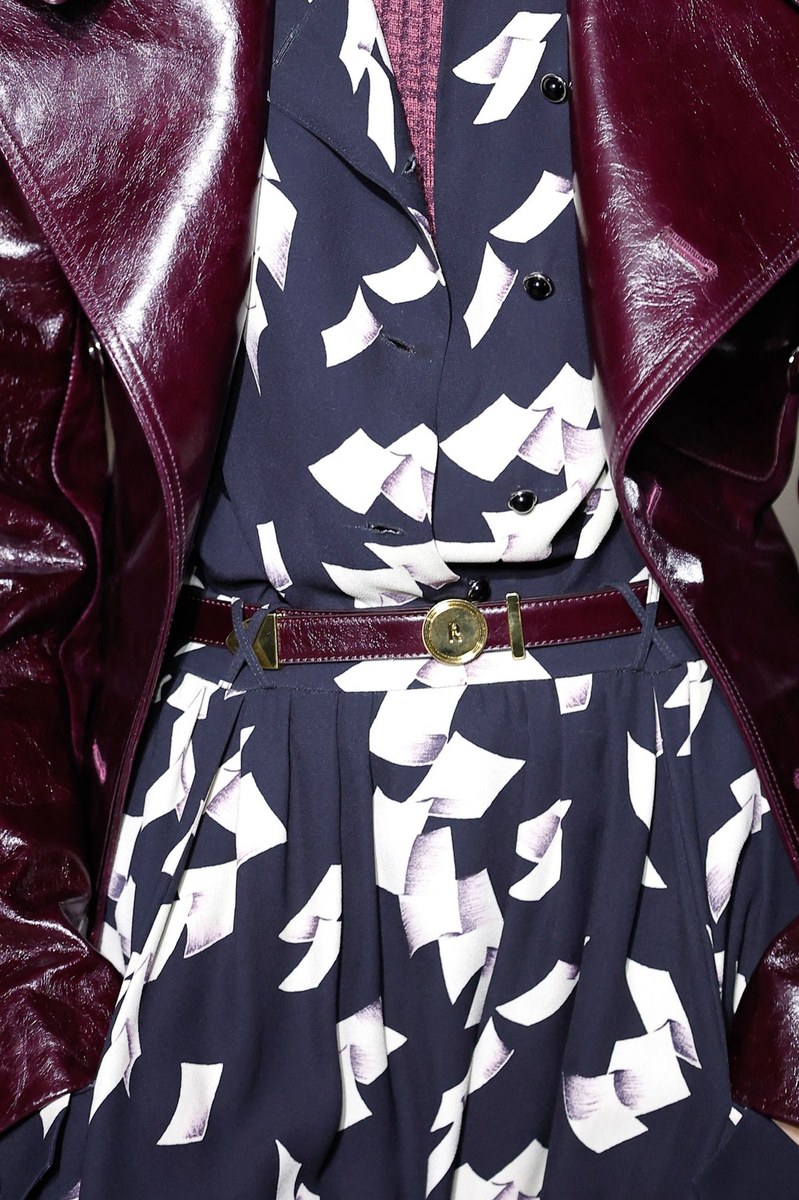
Detail 1
Detail 1

Key Pieces and Details

The slim leather belt with a house-logo buckle is the clearest commercial entry point, versatile enough to cross category into coats, blazers, dresses, and trousers as evidenced across nearly a dozen looks. Silver cone-and-crimson-fringe construction in Details 14 and 20 represents the collection's highest-impact piece, relevant for specialty retail, editorial placement, and red carpet buying where fabrication drama justifies a high price ceiling. Detail 19's chainmail dress with crystal waist pins and Detail 16's iridescent white beaded sequin top represent the house's core archival metal-craft in updated silhouette applications.

Detail 19
Detail 19

Detail by Detail Highlights

Detail 1 (Belt) The narrow oxblood burgundy leather belt with an aged gold coin buckle threads through belt loops on a navy paper-print dress and pulls double duty with a matching burgundy patent leather biker jacket, establishing the house's monochrome accessory logic.

Detail 2 (Belt) A tan smooth leather belt with a large gold coin buckle cinches a black multicolor sequin dress at the natural waist, demonstrating how a warm neutral belt can ground an otherwise high-glitter surface.

Detail 2
Detail 2

Detail 4 (Belt) A caramel leather belt with a rectangular silver-tone logo buckle sits on a black mohair-blend coat with cream fur collar, proving the slim belt's commercial viability as an outerwear styling tool.

Detail 4
Detail 4

Detail 7 (Belt) The natural python-print leather belt with a matte gold box buckle worn through the waistband of a grey Glen plaid trouser suit introduces exotic material texture at a proportionally minimal scale, an approachable entry into skin-print goods.

Detail 7
Detail 7

Detail 14 (Dress Detail) Rows of polished silver cone-shaped metal drops are sewn directly onto a ribbed dark brown jersey waistband, with long crimson suede fringe hanging beneath, a piece that blurs the line between belt, skirt, and sculptural hardware object.

Detail 14
Detail 14

Detail 16 (Dress Detail) A short-sleeve top in iridescent white sequin ground carries hand-applied multicolor beaded florals, gold bead swag chains across the hem, and a beaded fringe border, representing the most labor-intensive construction in the entire accessories and detail edit.

Detail 16
Detail 16

Detail 19 (Dress Detail) A draped green and silver chainmail wrap dress is pinned at the empire waist with clusters of clear crystal baguette pins, with pocket openings trimmed in matching crystal clusters, extending the Rabanne metal-work vocabulary into wearable structure rather than surface ornament.

Detail 15 (Dress Detail) A teal floral chiffon dress uses a wide silver chainmail placket running from collar to hem as its central closure element, with the mesh collar acting as both hardware and neckline detail simultaneously.

Detail 15
Detail 15

Operational Insights

Belt assortment depth The slim logo-buckle belt appears in at least seven distinct leather colors and three hardware finishes across this collection. Buyers should plan a full colorway run rather than selecting one or two options, because the belt functions as a cross-category styling anchor with broad SKU versatility.

Hardware sourcing lead time The coin and box buckles carry a house-logo die, which requires branded tooling. Product managers should confirm tooling timelines with hardware suppliers early in the development calendar to avoid buckle-related delays that push belt delivery windows.

Fringe and cone component procurement Details 14 and 20 depend on a very specific pressed-metal cone component in a high-shine silver finish. This part is unlikely to be available as a stock finding and will require custom fabrication, buyers evaluating these pieces for wholesale should request a minimum order quantity for the cone component before committing.

Chainmail allocation Chainmail appears in Details 2, 15, and 19 in different weights and weave scales. Product managers should establish whether these fabrics share a single mill source, which would allow consolidated yardage orders and reduce per-unit cost on the mesh components.

Layering as retail narrative Nearly every belt detail is styled over a minimum of two to three garments. Visual merchandising teams and e-commerce directors should build editorial content around the belt-as-layering-tool concept rather than presenting the accessory as a standalone product, which significantly increases average transaction value per customer.

More Details

Detail 5
Detail 5
Detail 6
Detail 6
Detail 8
Detail 8
Detail 9
Detail 9
Detail 10
Detail 10
Detail 11
Detail 11
Detail 12
Detail 12
Detail 13
Detail 13
Detail 17
Detail 17
Detail 18
Detail 18
Detail 20
Detail 20
Detail 21
Detail 21
Detail 22
Detail 22

✦ This report was generated with AI — combining human editorial vision with Claude by Anthropic. Because the future of fashion intelligence is already here.