Rabanne FW26 Women Looks Report
Paris Fashion Week
Rabanne FW26 builds its identity around deliberate collision, stacking prairie florals against patent leather, sequined tops against plaid suiting, and lace trims against faux fur bombers to produce a woman who dresses in layers of contradiction rather than coordination. For buyers and product managers, this signals a clear commercial shift toward mix-and-match wardrobing over head-to-toe looks, which plays directly into the multi-purchase basket strategy.
Silhouette and Volume
Midi length dominates from waist to hem, appearing in full pleated skirts, straight suiting skirts, and fluid wrap silhouettes across Looks 1, 8, 9, 10, and 12. Tops run oversized and blouse-like on the upper body before getting cinched by slim belts, a proportion the house returns to repeatedly. Tailored coats and bombers add bulk at the shoulder without extending past the hip. Wide, high-waisted trousers appear in Looks 11, 13, 14, and 16, giving the collection a gender-fluid range that broadens its floor appeal.
Color Palette
Burgundy, oxblood, and deep mahogany run through outerwear and footwear as anchoring neutrals across at least a third of the looks. Against those dark bases, the collection fires lavender tights, orange turtlenecks, fuchsia fur collars, and acid yellow knit bands in Look 12 and Look 18, creating a high-contrast palette that reads bold on the floor without requiring a full outfit commitment from the consumer. Ecru and dusty blush handle the quieter moments in Looks 1, 5, and 7, ensuring the sequined and embroidered pieces read clearly rather than compete. Red functions as a punctuation color, most forcefully in the orange-red cowboy boots of Look 19 and the lacquered red T-bar pumps of Looks 6, 14, and 17.

Materials and Textures
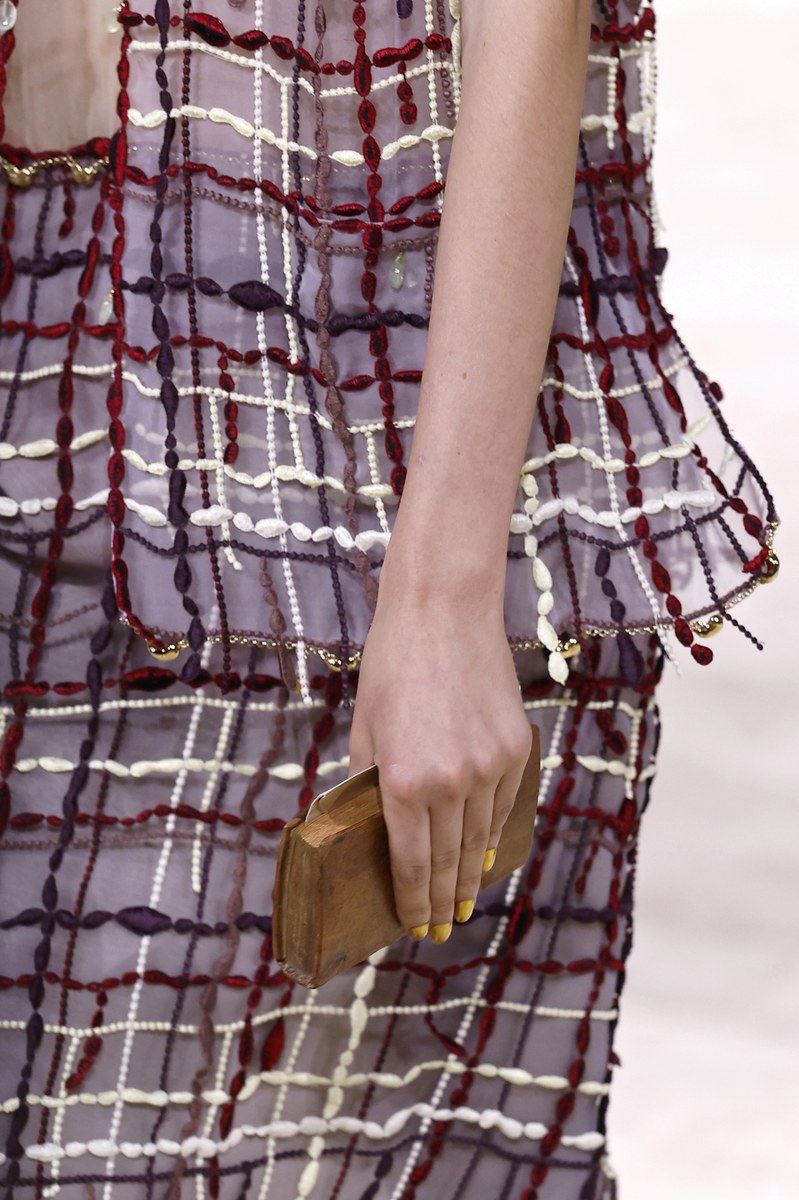
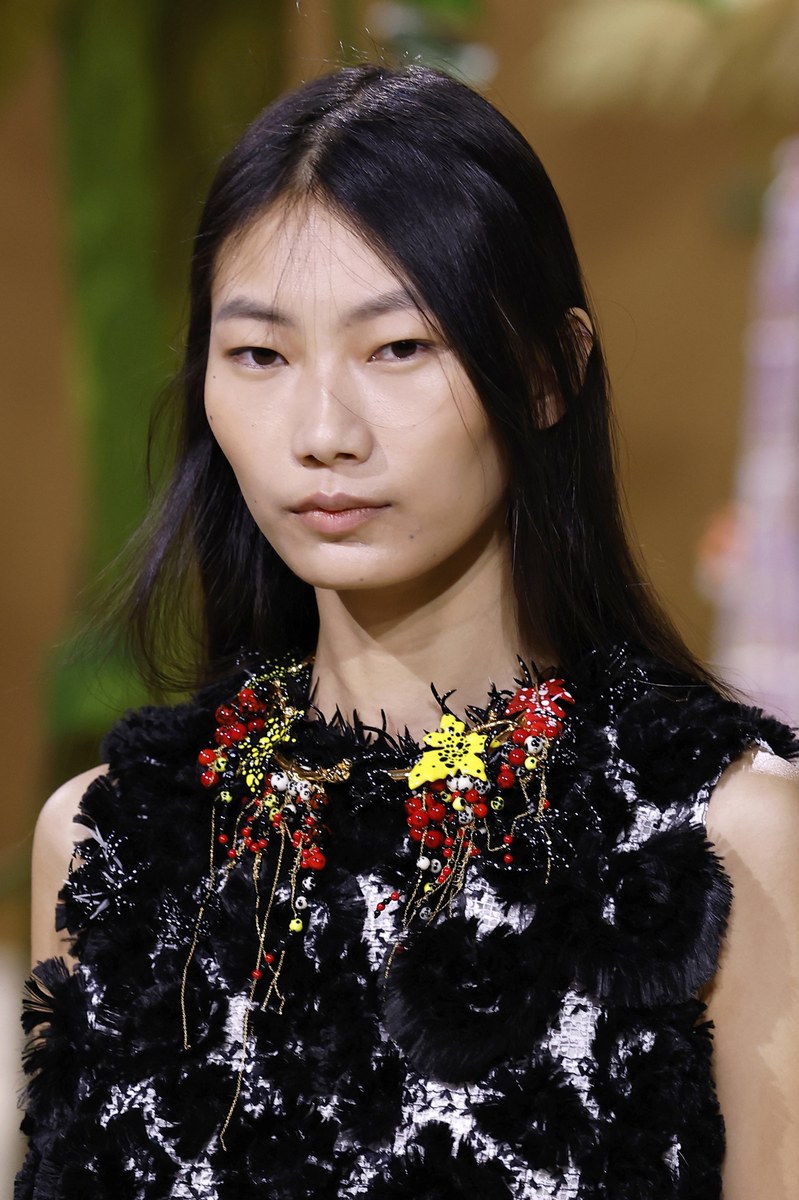
Patent and croc-embossed leather carry significant weight, appearing in long coats, bombers, and trousers in Looks 8, 14, 16, and 18, giving those pieces a high-gloss rigidity that contrasts directly with the soft drape placed underneath. Sequined and beaded fabrics recur across Looks 2, 5, 7, and 19, ranging from densely packed all-over sequin to scattered floral bead embroidery on mesh grounds, with fringe trims finishing several of those hemlines. Plaid wool surfaces in multiple weights, from a lightweight tailored check in Look 3 to a heavier purple and brown tartan in Look 13, and it functions as the collection's primary suiting language. Lace inserts and lace trim hems appear in Looks 6, 7, 10, 17, and 18 as a recurring feminine counter-note to the harder materials surrounding them.

Styling and Layering
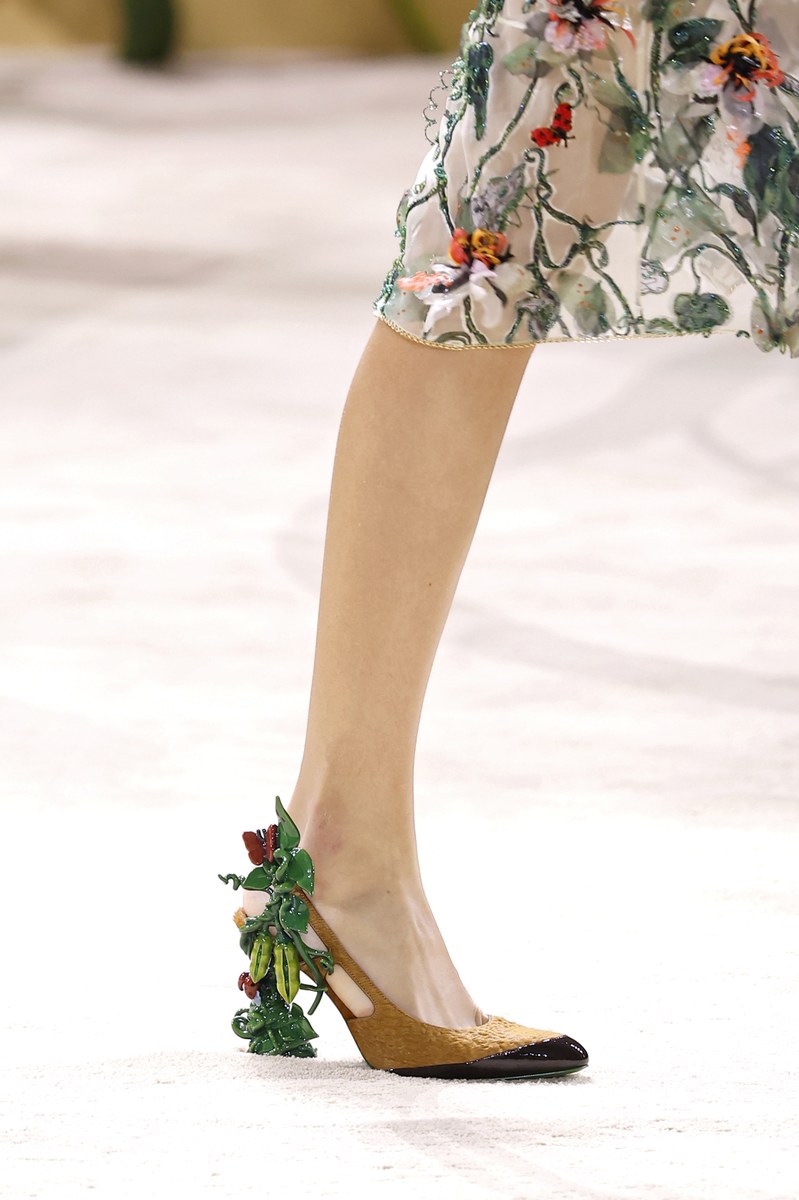
Every look builds through visible layering, and the layers are intentionally mismatched in register, so a sequined floral top sits over a lace camisole inside a plaid coat in Look 16, or a printed floral blouse reads beneath a zigzag intarsia knit vest in Look 4. Turtlenecks in knit or ribbed jersey appear under almost every opened outerwear piece, functioning as the connective tissue that holds disparate layers together. Slim leather belts, almost always in tan or chocolate brown, cinch the mid-body on dressed silhouettes from Look 1 through Look 20, acting as the one consistent styling tool that gives structure to otherwise loose compositions. Footwear splits into two clear directions: a multi-colored block-heeled pump with a pointed toe that closes most feminine looks, and a lacquered red T-bar heel that adds a retro seventies signal to the more dressed-up exits.

Look by Look Highlights
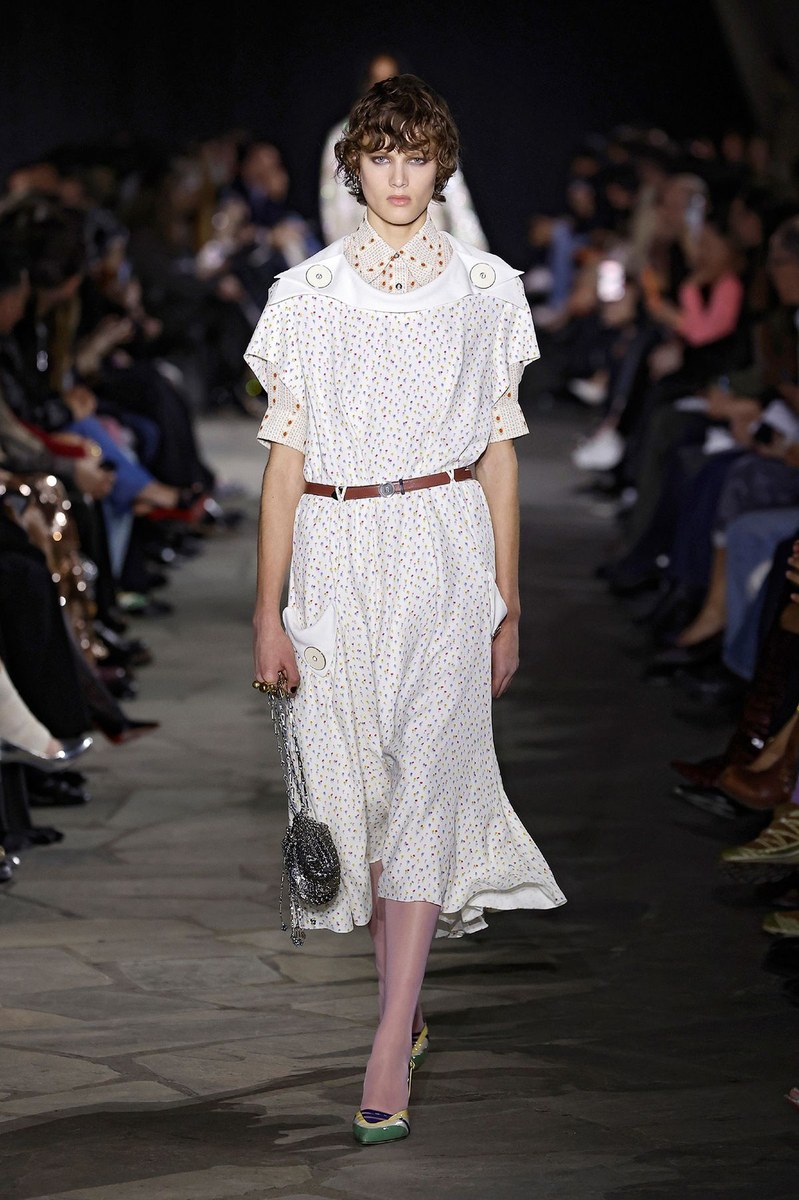
Look 1 The white ditsy-print midi dress with oversized sailor collar and large button shoulder tabs reads as the collection's clearest commercial entry point, accessible in price architecture and easy to photograph for e-commerce.

Look 5 A blush pink sleeveless sequin dress with scalloped beaded hem worn over a short-sleeved broderie blouse gives buyers a strong cocktail-to-evening option that layers multiple SKUs into one display opportunity.

Look 8 The deep burgundy patent leather longline coat with powder blue fur collar over a graphic black-and-white print dress is the highest-impact outerwear piece in the lineup and will perform as a hero coat for editorial and window placement.

Look 13 Wide plaid wool trousers in purple and rust plaid paired with a navy polka-dot oversized blazer and a layered floral blouse underneath demonstrates the house's strongest argument for a separates-led buying strategy.

Look 16 Long purple plaid overcoat with brown fur lapels, worn over brown patent wide-leg trousers and a layered intarsia cardigan, targets the menswear-influenced luxury buyer and would anchor a unisex floor set effectively.
Look 19 An all-over gold and silver sequin ruched mini dress with floor-length black fringe skirt and orange-red knee-high lace-up boots is the collection's most directional exit and will drive editorial coverage disproportionate to its commercial volume.

Look 20 Black oversized mohair-blend coat with a wide mustard yellow faux fur shawl collar belted over a color-block knit and printed skirt is the most wearable statement coat and the most probable volume driver in the outerwear category.

Look 4 A burgundy patent bomber with black and cream faux fur collar layered over a purple zigzag intarsia knit vest and a pale floral midi skirt with red tights is the collection's best argument for a three-piece cross-category bundle at retail.

Operational Insights
Belts as category driver: Every cinched look uses a slim tan or brown leather belt as a styling anchor, and buyers should treat this as a standalone accessory SKU with strong attach-rate potential at checkout.
Tights as a color vehicle: Lavender, red, and grey tights appear across more than half the looks, functioning as the collection's most affordable color statement. Style directors should plan tights in these exact shades as companion buys to the midi skirt and dress assortment.
Outerwear fur-collar logic: Fur and faux fur collar treatments appear on at least six coats and bombers, varying by color from powder blue to fuchsia to mustard. Several of these trims are detachable, which opens a trim-as-accessory commercial angle worth noting for buyers.
Separates over looks: Higher SKU counts emerge when the collection is bought as separates rather than total looks. Product managers should map the blouses, knit vests, plaid trousers, and skirts as mix-and-match families rather than pre-styled outfits to maximize sell-through flexibility.
Embellishment tiering: Sequin and bead embroidery spans a clear price ladder from scattered floral bead tops in Look 7 to the fully encrusted fringe dress in Look 19. Style directors should tier the floor by embellishment density to guide the customer from entry to aspirational price points without visual competition between pieces.

Complete Collection


Fashion Designer

About the Designer
Julien Dossena was born in 1982 in Ploemeur, a small coastal town in Brittany whose name in Breton translates roughly to "black hole." His parents divorced when he was six, and he and his sister spent his childhood moving between Paris, Berlin, and the south of France with their mother before returning to Brittany for high school. His father owned the local nightclub, and Dossena has described being brought there as a small child during the daytime, watching the cleaning staff work through a dark, deflated space, then returning at night to the transformation of light and music and people who seemed to him unlike anyone in the rest of his world. He drew obsessively as a child, first whales, then speedboats, then female figures derived from his father's collection of Italian comics, women who struck him as superheroic. As a teenager he surfed, skated, and absorbed British magazines like i-D, The Face, and Dazed, which gave him the first evidence that fashion existed as a vocation. His first memory of a fashion show was a Jean Paul Gaultier runway on television in the late 1980s. He watched it and thought: "That looks fun. And that's a job?"
He studied art history at the École Supérieure des Arts Appliqués Duperré in Paris, then moved to Brussels to enroll at La Cambre, the visual arts school whose fashion graduates include Anthony Vaccarello and Matthieu Blazy. There he found his real orientation in the work of the Belgian generation, particularly Martin Margiela and Dries Van Noten. His student collection won the special jury prize at the Hyères International Festival of Fashion and Photography in 2006. After graduating, he made repeated attempts to get into Balenciaga under Nicolas Ghesquière, finally secured an internship in 2008, and rose to senior ready-to-wear designer over four years, becoming, in Pierre Hardy's words, "totally, totally concentrated on the fit of the clothes, very sensitive to the body." When Ghesquière departed in late 2012, Dossena left with him and launched his own label, Atto, with fellow Balenciaga alumni. The label was a finalist for the LVMH Prize in 2014. It was the stylist Marie-Amélie Sauvé, Ghesquière's longtime collaborator, who brought Dossena to the attention of Marc Puig. He joined Paco Rabanne in early 2013, and was given the creative director title eight months later.
For his first four years at the house, he deliberately avoided the archive, building the brand on precise tailoring and commercial foundations before earning what he felt was the right to recontextualize what Paco Rabanne had made. When he finally entered the archive, he stayed for three days, photographing everything. What struck him was not any single garment but the overwhelming personality of the founder transmitted through old photographs and editorial tear sheets and discarded chainmail tests. His references since have combined the Space Age futurism of the 1960s Paris that produced the house, the club cultures of Brittany and Paris where he came of age, video games, J.G. Ballard's science fiction, and the particular energy of the queer community he described as his earliest and most natural customer base. In 2023 the house dropped "Paco" from its name, becoming simply Rabanne, under which it became the first Puig brand to exceed one billion euros in revenue. Dossena remains its creative director.
"When you see a girl wearing a mesh dress coming into a nightclub or a restaurant, she brings the party with her; it's as if she's the only person in the room."
"I didn't want to fall into the trap of recreating or being retro. Then, at some point, I thought we were solid enough to recontextualise the archive. When I did, I didn't leave for three days."
✦ This report was generated with AI — combining human editorial vision with Claude by Anthropic. Because the future of fashion intelligence is already here.