Raul Peñaranda FW26 Women Looks Report
New York Fashion Week
Raul Peñaranda FW26 pulls between two distinct registers: the polished restraint of tailored separates and the theatrical charge of heavily embellished eveningwear, often within the same look. For buyers navigating a market that demands versatility without sacrificing occasion dressing, this collection lands at a commercially useful intersection.
Silhouette and Volume
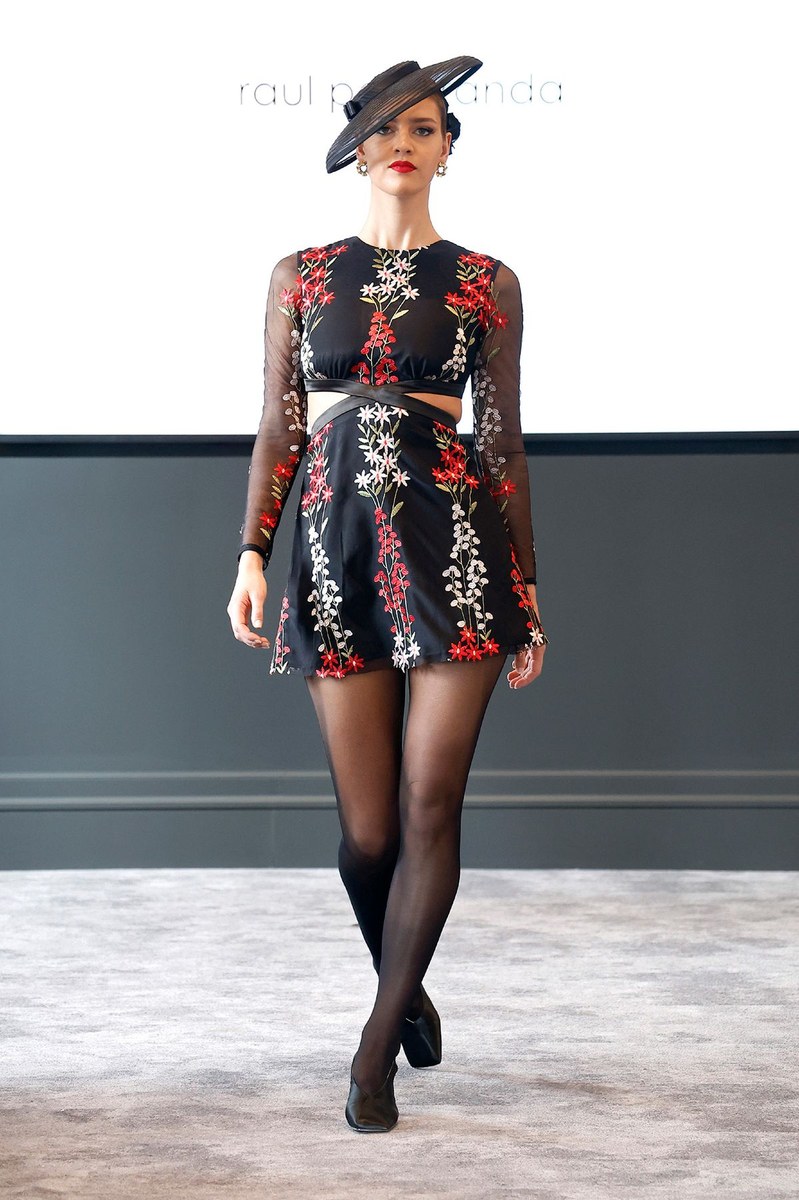
The floor-length column dominates, appearing in stretch metallic jersey (Look 8), sequined plaid (Look 9), leopard-pattern burnout (Look 13), and floral velvet (Look 17), each one body-conscious through the torso and releasing at the hem. Wide-leg trousers counter that verticality in Looks 2, 4 and 5, cut with deep pleats and enough sweep to read as formal. Shorter silhouettes appear in Looks 1, 6, 7 and 11, where above-the-knee hemlines are paired with opaque black tights to maintain the same polished weight as the longer pieces. A cutout waist, used in Looks 1, 16 and 18, acts as a recurring structural punctuation rather than a seasonal novelty.
Color Palette
Black anchors at least half the collection, running from the floral embroidered mini in Look 1 through the all-black lace and suiting separates in Looks 6 and 7. Warm cognac-rust appears in Look 2 and returns as a full-length dress in Look 17, creating the strongest day-to-evening thread across separate categories. Navy, gold and teal plaid recurs across Looks 9, 10 and 11, giving the collection a built-in capsule unit. Look 4 pushes into punchy territory with fuchsia lace against red satin wide-leg trousers, while Look 15 pulls the entire register toward rose gold with blush pink sequins and sheer sparkle panels.

Materials and Textures
Lace carries heavy lifting across multiple price points, appearing in dense fuchsia in Look 4, scalloped black in Look 7, tri-color blocked panels in Look 14, and full-skirted black in Look 6. Metallic stretch jersey in Looks 3 and 8 is liquid and close-woven, behaving more like liquid lamé than a disco-era novelty fabric, which affects how it photographs and moves on the body. Sequined plaid in Looks 9, 10 and 11 reads as an engineered fabric with genuine structure, not a stretch base with applied sequins, suggesting a higher construction cost per garment. Floral embroidery on tulle in Look 1 and velvet-flocked floral on a matte ground in Looks 12 and 17 add surface richness at different price tiers.

Styling and Layering
Hats appear in Looks 1, 6, 11 and 16, with wide-brim and tilted fascinator styles placing several looks clearly in the occasionwear and races-dressing market. Bags track a tight logic: structured black leather totes and mini bucket shapes in Looks 2, 5 and 6 keep daywear grounded, while eveningwear goes accessory-light. Footwear splits between lace-up block heels and strappy sandals on the evening pieces and patent loafers, chunky flatforms or ankle boots on the separates, drawing a clear line between the dresswear and ready-to-wear categories. Necklaces, particularly the large gold medallion in Look 16 and the pearl-and-chain layering in Look 2, do more compositional work than belts here.

Look by Look Highlights
Look 1 Black embroidered tulle crop top and flared mini skirt with red and white floral detailing, styled with a wide black brim hat, reads as a complete occasionwear unit that requires minimal additional accessory investment from a buyer.
Look 4 Fuchsia lace jacket with satin lapels worn over red wide-leg trousers lands as the collection's single boldest color pairing and has clear standalone separates potential for markets with appetite for vivid occasion dressing.
Look 8 All-over gold liquid metallic column gown with asymmetric shoulder seaming is the collection's most commercially direct evening statement and the piece most likely to perform across gala, award and formal event dressing.
Look 9 Sleeveless navy and gold plaid sequin column with a side slit carries the capsule fabric story in its clearest form and shows how engineered plaid reads as sophisticated rather than costume when cut to a minimalist silhouette.

Look 14 Three-way color-blocked lace construction in fuchsia, ivory and black, worn as a top with a full black lace skirt, demonstrates a material-mixing strategy that allows the same lace fabrics from the ready-to-wear pieces to be repositioned in an eveningwear context.

Look 15 Blush pink strapless sequin corset with matching embellished mini and sheer sparkle wide-leg overlay trousers is the collection's clearest red-carpet crossover piece and the one most likely to attract editorial placement.

Look 16 Navy lace long-sleeve crop top with cutout waist and a floor-length charcoal floral printed skirt, styled with a large navy bow fascinator, packages the day-to-evening tension of the collection into a single look that works as a wedding guest or races reference.
Look 18 Multi-stripe blue, red, silver and white sequin cut-out column gown carries the collection's heaviest surface embellishment and reads as a closing statement piece with the broadest wholesale appeal across North American and Latin American formal dressing markets.

Operational Insights
Capsule fabric anchor: Navy, teal and gold plaid sequin appears across three looks (9, 10, 11) at different silhouette lengths and sleeve treatments, giving buyers a logical three-piece capsule within a single material investment.
Lace tiering: Lace is deployed across at least five price points in this collection, from stretch lace bodysuits to structured plaid lace jackets to tri-color blocked lace tops, which allows style directors to open lace across multiple floor categories rather than confining it to eveningwear.
Cutout construction: This detail appears in Looks 1, 16 and 18 across entirely different fabric types and price positions, signaling that it is intended as a season signature rather than a one-off. Product managers should anticipate pattern and fit complexity in production.
Separates read as eveningwear: Looks 2, 4 and 5 each build evening weight from separate top and trouser combinations, which is a direct buying advantage for markets where full-length gowns are a harder category to move but dressed separates sell at volume.
Accessories as margin builders: Recurring hats, structured bags and statement necklaces are not decorative afterthoughts. They function as category extensions that could be developed as licensed or in-house accessories to lift average transaction value, particularly in the occasionwear and races-dressing segments where Looks 1, 6 and 16 already establish a clear hat-styling logic.
Complete Collection


About the Designer
Raúl Peñaranda was born in Cali, Colombia, grew up in Caracas, and spent his formative years moving through a South American childhood shaped by displacement and reinvention. His mother was a seamstress who never called what she did fashion; she called it storytelling. That distinction stuck. His father, by contrast, ran on discipline. Between the two of them, Peñaranda was handed both an emotional vocabulary and the work ethic to do something with it. When his family relocated to Miami and then he pushed on alone to New York in 2000, he arrived not as a hobbyist with a dream but as someone who had already been watching fabric and bodies his whole life.
He enrolled at FIT and Parsons simultaneously, taking a freelance position at Liz Claiborne to pay his way through, and spent the following decade accumulating experience at houses that could not be more different from each other: Oscar de la Renta, Donna Karan, Zac Posen, Nicole Miller, Tommy Hilfiger. He moved through CAD and textile design, trend forecasting, head design roles, absorbing not just technique but the specific logic of each house, how an aesthetic becomes a system. By the time he launched his own label in 2010 at New York Fashion Week, he had spent a decade studying the industry from the inside before asking anyone to look at what he made.
The brand he launched is built on a few clear commitments: every garment manufactured in the United States, cruelty-free and sustainable materials, and a womenswear sensibility that treats clothing as an emotional act rather than a product category. Within two years of his debut, Forbes cited him as one of the fastest-growing fashion entrepreneurs to emerge from the independent sector. Vogue Mexico gave him the headline "new king of NYFW." He has since shown over thirty consecutive collections on the seasonal calendar, and debuted on the official CFDA schedule in 2026 with his collection "Bolero Nights," a milestone that marks the beginning of what he describes as a new chapter.
"My mother, a talented seamstress, inspired me to pursue fashion design — or as she called it, storytelling."
"As a storyteller, all my inspiration comes from the emotions I'm experiencing at a specific moment in my life. I don't feel that I design dresses — I create emotions."
✦ This report was generated with AI — combining human editorial vision with Claude by Anthropic. Because the future of fashion intelligence is already here.