Raw Mango FW26 Women Looks Report
London Fashion Week
Raw Mango FW26 builds a visual language around handcrafted surface work, placing tufted, looped and embroidered textile construction at the center of every garment decision. For buyers sourcing craft-forward luxury with genuine artisanal provenance, this collection arrives at exactly the moment when the market is hungry for alternatives to logo-driven European heritage.
Silhouette and Volume
The collection moves between two poles: generous, draped volume that envelops the body completely and lean, column-shaped cuts that let the textile do structural work on its own. Oversized cocoon coats appear in Looks 2 and 4, while fitted midi and floor-length silhouettes anchor Looks 8, 10 and 12. A boxy, dropped-shoulder top shape recurs across Looks 1, 3 and 15, functioning almost like a uniform base layer. The designer rarely meets the body at the waist, preferring hemlines that fall below the knee and proportions that read as deliberately unresolved.
Color Palette
Black and ecru dominate throughout, appearing together in nearly every other look and creating a binary that feels austere rather than minimal. Gold enters as a third note through metallic embroidery in Looks 3, 4, 8 and 18, warming the palette without pulling it toward eveningwear territory. Neon yellow surfaces in Looks 13 and 17 as a deliberate jolt against the predominantly muted ground. Dusty pink appears in Looks 14 and 16, and forest green functions as an accent in Looks 16, 18 and 19, giving buyers two secondary color families to build around.
Materials and Textures
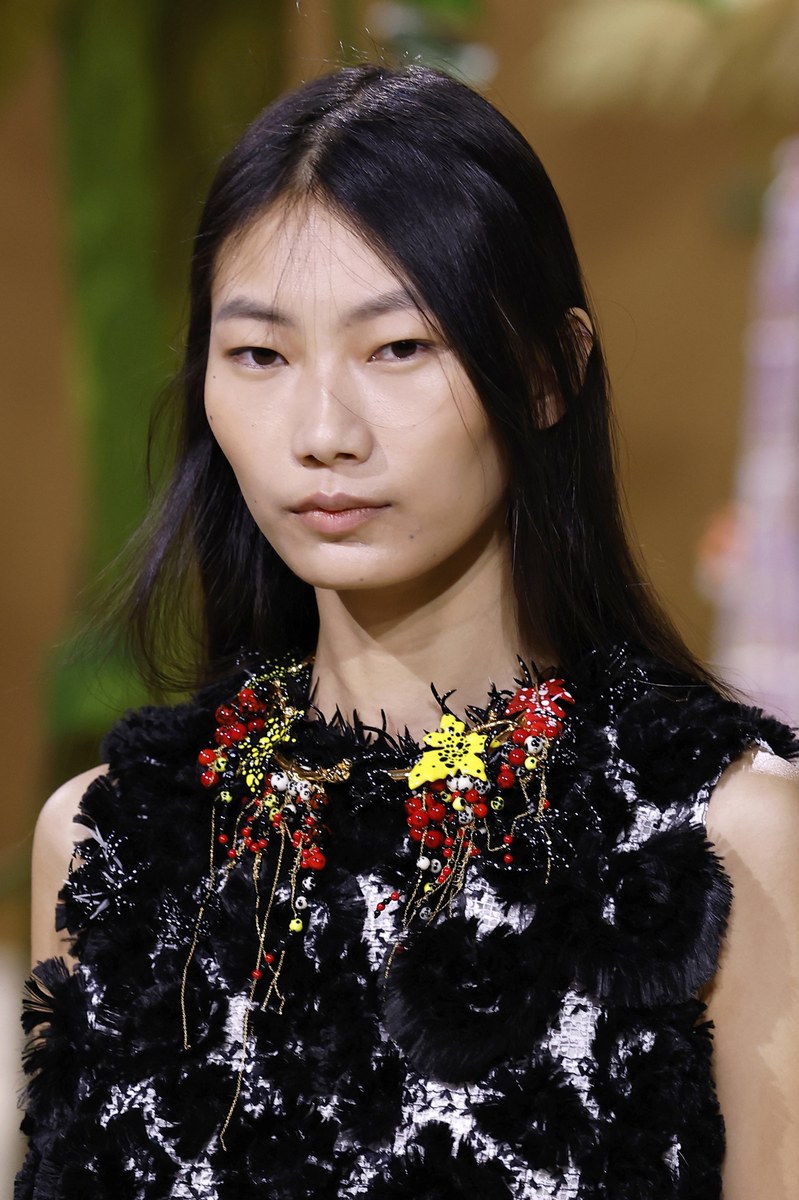
Dense, looped tufting applied to fabric panels serves as the signature surface throughout, visible in the cream skirt of Look 1, the fringe structure of Look 7 and the collar treatment of Looks 6, 9 and 12. Hand embroidery in a scalloped drape motif, executed in gold bugle beads on dark ground fabric, appears across Looks 3, 4 and 8. Heavier woven textiles carry visible depth and weight in Look 2 and Look 18, while the white draped garment in Look 5 reads as a sheer linen or fine cotton muslin. Look 10 introduces what appears to be a hand-embroidered dark silk with a dense dot-and-arc repeat pattern. A jacquard weave with a scalloped hem cut defines the pink skirt in Look 16.

Styling and Layering
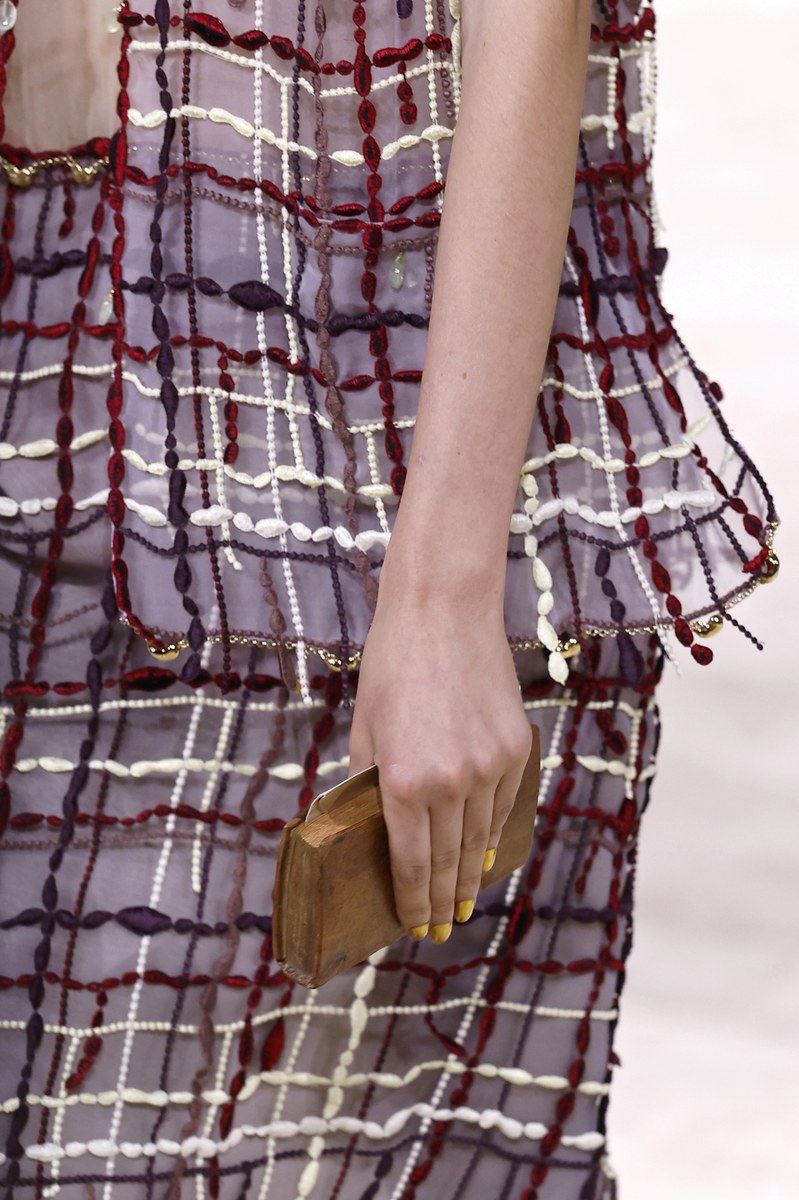
Layering logic here is additive and physical rather than optical. Tufted pieces sit on top of fluid underlayers, and in Look 12 a dramatic black crepe cape drapes over a sheer ivory column dress with a diagonal tufted sash. Footwear runs consistently to a black ballet flat with a transparent acrylic sole and sculptural black resin toe block, a house-specific construction that appears in the majority of looks. Accessories remain deliberate and sparse: a dome-shaped terrarium carried in Look 9, a rolled textile object in Look 15 and a dark textured clutch in Look 4 all read as conceptual props rather than commercial bag shapes.

Look by Look Highlights
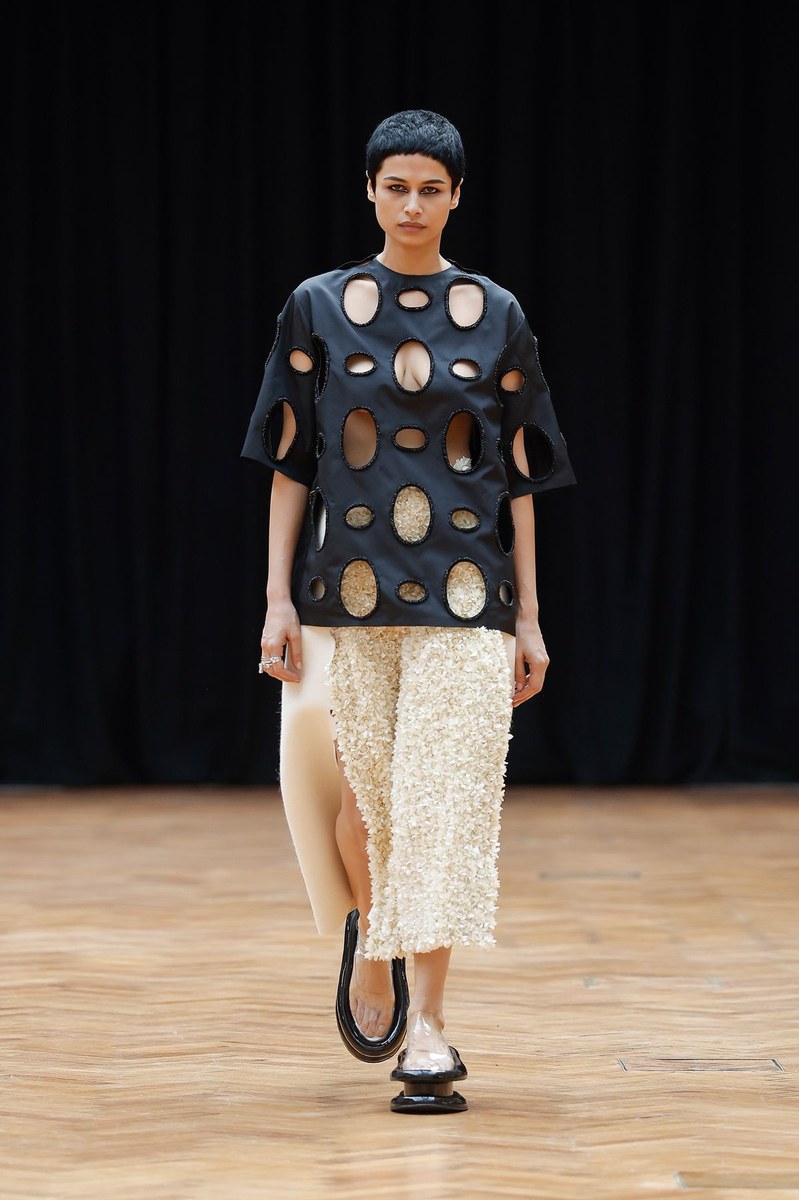
Look 1 Pairs a perforated black leather or coated fabric top with irregular oval cutouts over a cream tufted skirt, creating a direct conversation between negative space and dense surface that is immediately legible as a hero print pairing for editorial buyers.
Look 4 Delivers the collection's highest commercial drama through a black oversized blazer-coat covered end to end in a gold bugle-bead swag-and-tassel embroidery, worn open to reveal bare legs, making it a viable single-piece evening purchase.

Look 7 Builds a strapless bodice from the same cream tufted material then extends it into floor-length vertical fringe columns, a construction that requires significant handwork hours and signals a price point well above the collection's simpler separates.

Look 8 Presents the embroidered black-and-gold scallop pattern at its most resolved in a sleeveless midi dress where the repeat covers the body continuously from shoulder to hem, making this the clearest candidate for a key buy in the embroidered category.

Look 10 Wraps the body in a long-sleeved midi coat covered in a white-dot arc embroidery on near-black ground, then partially reveals a dark floral print underneath, giving buyers a two-fabric layering story within a single silhouette.

Look 12 Uses a single diagonal band of cream tufting running from neck to hem across a sheer ivory top and full black crepe floor-length cape, reducing the collection's ornamental vocabulary to its most graphic and architectural arrangement.
Look 13 Places an acid yellow draped satin dress under a black tufted-collar hood wrap, producing the sharpest color contrast in the collection and testing whether the brand's core wholesale accounts will accept color risk alongside craft investment.

Look 19 Strips the silhouette to a black draped column and places all the material investment in a massive cream tufted shawl collar that reads almost as a standalone sculptural object, demonstrating that the tufting technique can anchor a look entirely on its own.

Operational Insights
Tufted textile sourcing: The looped tufted surface treatment appears across at least eight looks and is the primary craft signature. Buyers should confirm minimum order quantities and lead times directly with the atelier, as handwork at this density typically carries a 12 to 16 week production window.
Embroidery repeat scalability: The gold bugle-bead scallop motif in Looks 3, 4 and 8 is the most commercially transferable design here. Style directors should evaluate whether this repeat can be licensed or adapted across categories including home or accessories.
Color entry point: Black and ecru combinations in Looks 1, 2, 6, 9, 11 and 12 represent the safest initial buy for accounts new to the brand. Neon yellow and forest green pieces carry more markdown risk and suit accounts with a proven appetite for statement separates.
Footwear as signature: The recurring transparent acrylic sole ballet flat with sculptural black resin block functions as a consistent house detail across the full collection. Product managers should assess whether this shoe is available as a standalone wholesale item, as it operates as a brand identifier rather than a supporting accessory.
Occasion positioning: The collection splits cleanly into daywear separates (Looks 6, 9, 14, 15, 17, 18) and high-ceremony or event pieces (Looks 4, 7, 8, 12, 13). Buyers should treat these as two distinct assortment blocks with different floor placement, margin expectations and customer conversations rather than building a single merged buy.
Complete Collection


About the Designer
Sanjay Garg grew up in Mubarikpur, a small village in Rajasthan where he attended a Hindi-medium government school. The son of traditional parents who initially hoped he would become a chartered accountant, Garg felt the limitations of his rural education when he began visiting Jaipur during summer holidays. After completing his initial studies in business, he fought for the opportunity to pursue design, something he had been drawn to but never understood as a career possibility.
His design education began at the Indian Institute of Crafts and Design in Jaipur, followed by textile specialization at the National Institute of Fashion Technology in Delhi. Early career stints included working at Shades of India, a company creating modern home accessories with traditional crafts, and projects with the Ministry of Textiles. These experiences led him to Chanderi, a town known for its diaphanous cotton weaves, where he realized his true calling. In 2008, with a loan of 90,000 rupees from his father, he launched Raw Mango after his initial collection sold out completely at his first exhibition.
Garg's aesthetic draws from rural Indian colors, textures, and philosophies, transforming them into contemporary textiles that challenge fashion conventions. His work with handloom weavers across Rajasthan, Madhya Pradesh, West Bengal, and Varanasi represents a minimalist approach to Indian design, stripping away ornate embellishments in favor of pure color and craft. His inspiration comes from collecting vintage handloom textiles, studying historical weaving techniques, and engaging with sociopolitical issues through design, such as his 2018 Heer collection that responded to language protests by using only English, Urdu, and Punjabi text.
"I see my tradition as something futuristic. I think of what I contribute to the next generation, the future of tomorrow." He also explains his approach to modernity: "I do not force modernity. The current issues I address with the brand make it modern."
✦ This report was generated with AI — combining human editorial vision with Claude by Anthropic. Because the future of fashion intelligence is already here.