Richard Quinn FW26 Women Looks Report
London Fashion Week
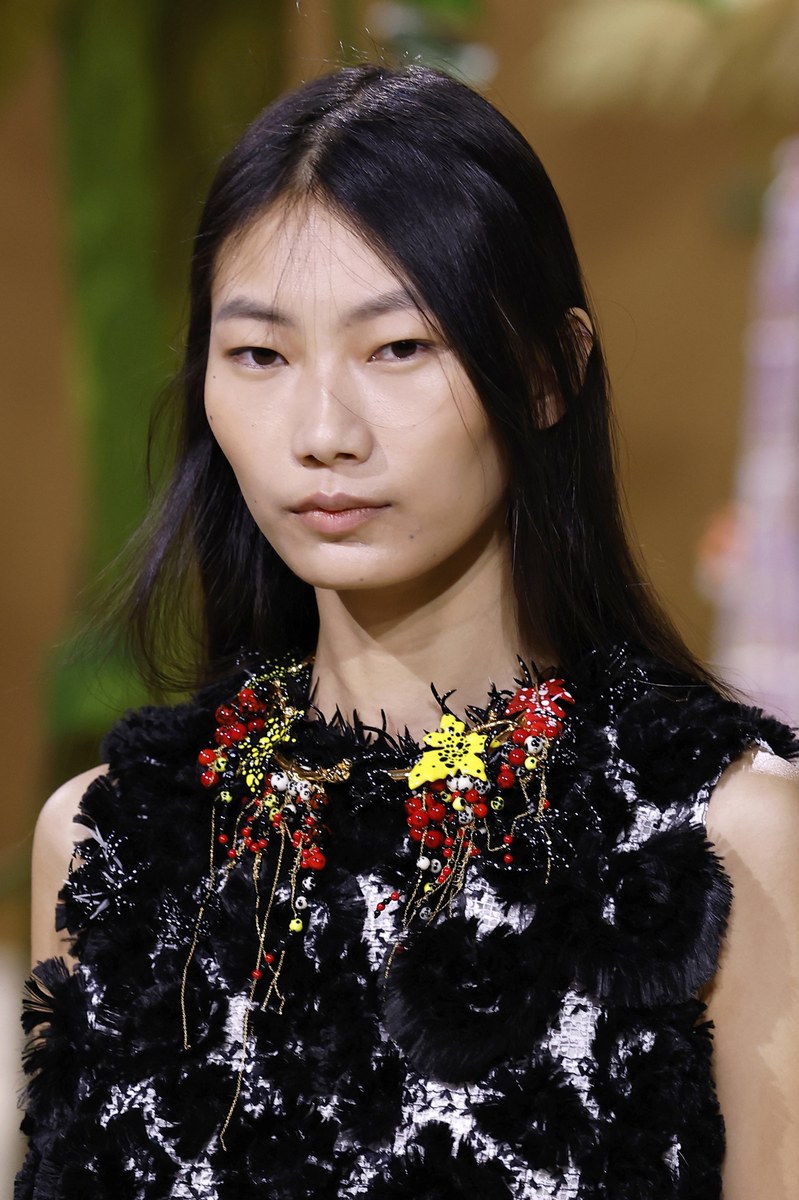
Richard Quinn FW26 builds its entire visual language around the binary contrast of black and white, punctuated by controlled bursts of blush pink and acid yellow, and anchors every look in the tension between architectural structure and extravagant volume. For buyers and style directors, this collection arrives at a moment when the market is actively seeking eveningwear with clear craft credentials and a strong red-carpet narrative.
Silhouette and Volume
Two dominant shapes drive the collection: the fitted bodice that releases into a dramatic floor-sweeping skirt, and the mermaid trumpet hem that forces volume to the floor rather than the hip. Ball gown proportions appear in both voluminous taffeta (Look 10) and layered tulle (Look 12), while sleeker column silhouettes in Look 2 and Look 11 provide commercial relief for buyers needing range depth. Look 4 runs short and architectural, with a strapless beaded bodice cut above tiered lace flounces, proving Quinn reads both the gala and the cocktail occasion. What makes the silhouette vocabulary so strong is its consistency and legibility across the range, which simplifies assortment planning considerably.
Color Palette
Black dominates as a base, appearing in velvet, tulle, and jet beading across the majority of looks. White functions as the primary contrast agent, applied to bodices, panels, and full skirts to create graphic, high-contrast compositions that read clearly at distance and in photography. Look 13 introduces a soft dusty rose against a full black tulle skirt, and Looks 14, 16, and 18 push into pale yellow, which reads as a considered shift for clients seeking evening color with restraint. Formal and controlled, the mood throughout remains consistent, with color used to direct the eye rather than to saturate the look.

Materials and Textures
Velvet carries significant weight in the collection, appearing as full skirts, bodice panels, long gloves, and structured off-shoulder sleeves, consistently delivering a dense, light-absorbing surface that anchors the drama. Pearl and crystal beading covers entire bodices in Looks 2, 8, 10, and 17, built up into dimensional textile surfaces with considerable hand-embroidery investment. Tulle layers in Looks 3, 4, 5, 12, and 13 provide lightweight volume with a fine, translucent quality that contrasts directly against the heavier velvet and beaded sections. Look 9 stands apart entirely, pairing a sheer nude base embroidered with white feather-motif threadwork against cascading black ostrich feathers at the hem, making it the highest-cost, highest-impact piece in the lineup.

Styling and Layering
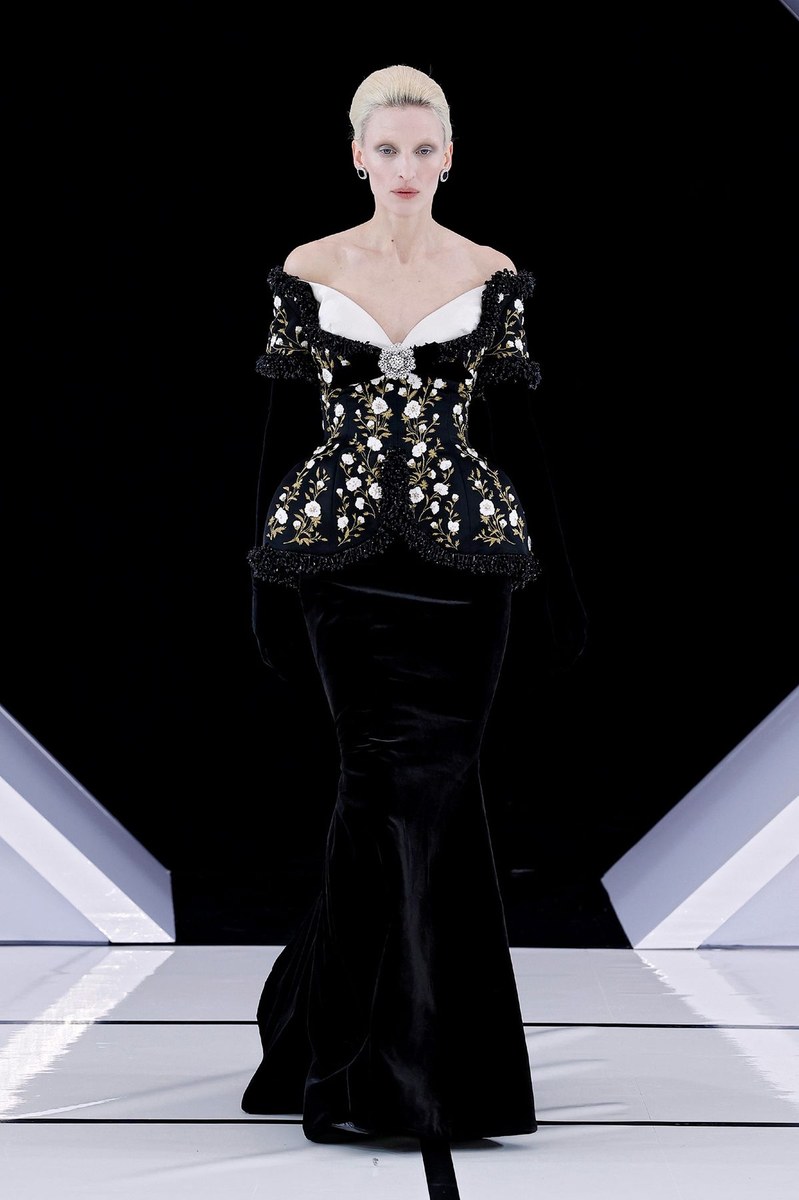
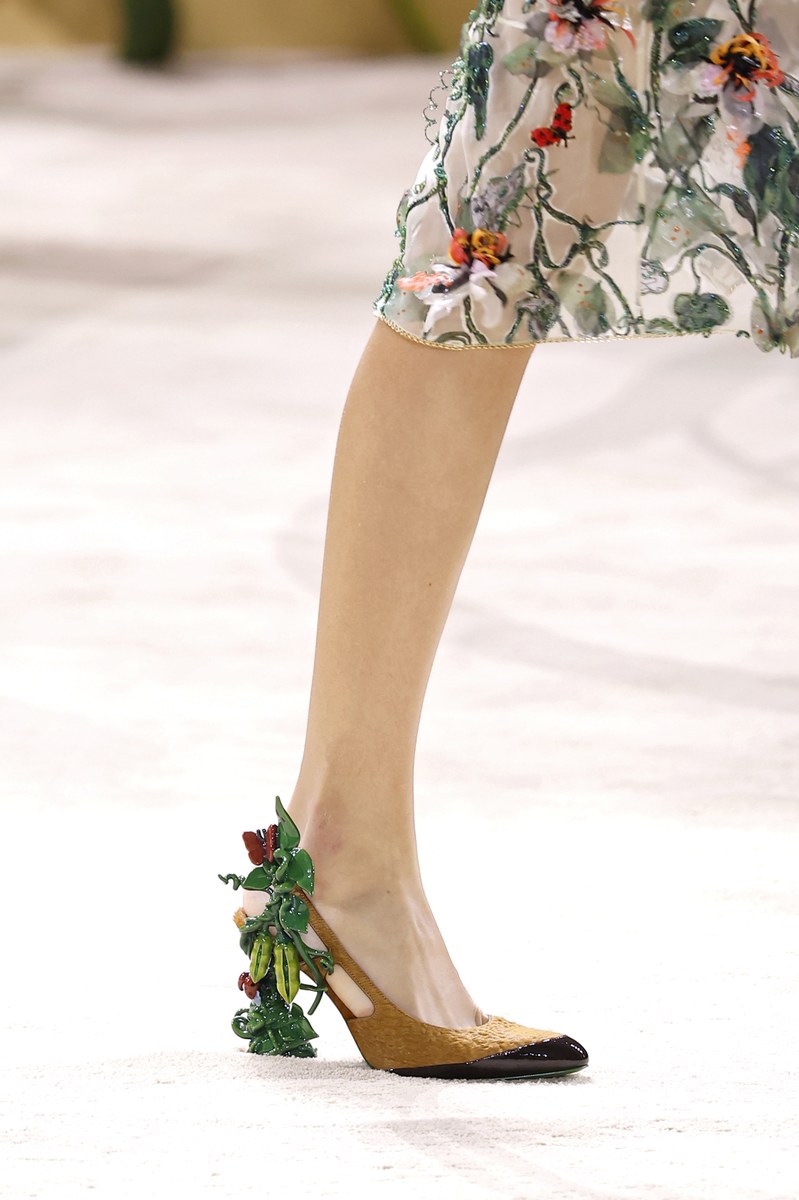
Long black velvet gloves appear in nearly every look and function as the collection's unifying accessory, extending the arm line and reinforcing the monochrome palette regardless of how colorful or ornate the gown itself becomes. Look 14 swaps the velvet glove for a black lacquered patent finish, and Look 16 matches patent gloves to patent ankle boots, introducing a harder surface contrast against the soft floral chiffon. Crystal floral brooches repeat across looks as a signature closure detail, appearing at the waist, neckline, and hip in Looks 1, 2, 3, 4, 5, 6, 7, 8, 10, 11, 12, 13, 15, and 18, establishing a SKU with strong standalone retail potential. Sharp-toed black patent boots maintain a consistent severity at the foot across the collection, grounding even the most voluminous skirts.

Look by Look Highlights
Look 1 opens on a black velvet mermaid column with a white satin revers neckline and an embroidered peplum bodice scattered with cream and gold floral sprigs, establishing the collection's craft ambitions immediately and setting production cost expectations high.

Look 4 delivers the collection's strongest cocktail proposition, pairing a strapless black beaded bustier with white tiered lace flounces and shoulder-baring velvet opera gloves, making it the most direct red-carpet short-dress option for wholesale buyers.

Look 7 resolves the tension between structure and volume by inserting a pearl-and-jet polka-dot column skirt beneath a voluminous black taffeta overskirt that parts at center front, producing two distinct looks in one construction and strong editorial pull.

Look 9 is the collection's production outlier and its most media-ready piece, building a sheer nude long-sleeve gown with white feather embroidery that dissolves into dense black ostrich feather trim from hip to floor, requiring specialist atelier sourcing and commanding a premium price point.
Look 12 presents the most commercially immediate ball gown, with a white boned corset bodice trimmed in jet beading meeting a full black tulle skirt with scattered crystal embellishment, structured clearly enough for bridal-adjacent buyers to consider.

Look 15 applies a repeat horizontal stripe of hand-applied blush roses against a black lace ground across a full tea-length skirt, creating a high-craft floral eveningwear option that sits at a different price architecture than the velvet and tulle gowns and widens the collection's buyer base.

Look 16 breaks entirely from the gown format, sending a voluminous floral chiffon cape dress printed with yellow roses and lavender wisteria against a white ground, making it the collection's only daywear-adjacent piece and a direct answer to demand for formal occasionwear that does not read as a traditional gown.

Look 18 closes the color story with a pale lemon yellow off-shoulder mermaid gown, its sheer ribbed bodice inset with vertical pearl stripes and its flared hem dense with dimensional floral embroidery, representing the strongest argument for Quinn's position in the luxury bridal and gala eveningwear market.

Operational Insights
Brooch as a standalone SKU: The crystal floral brooch appears in at least 15 looks and functions as the collection's signature hardware. Buyers should negotiate access to this accessory as a separate retail line, since its recognisability and relatively lower price point will drive basket conversion alongside gown purchases.
Glove sourcing: Long velvet gloves in black appear across virtually every look and represent a high-volume production requirement. Style directors should confirm whether Quinn produces these in-house or through a specialist supplier, as lead times and minimum order quantities will directly affect delivery scheduling.
Tiered tulle construction costs: Multiple looks, including Looks 3, 4, 5, 12, and 13, rely on voluminous tiered tulle skirts with fine internal boning or structure. Product managers should request construction sheets early, since the internal architecture of these silhouettes significantly affects landed cost and packaging logistics for wholesale accounts.
Color segmentation for range depth: The collection splits naturally into three color stories: black and white contrast, blush and black, and pale yellow and black. Buyers building a curated evening edit can select one color story per account type, avoiding full-collection duplication while maintaining visual coherence across the range.
Featherwork and regulatory compliance: Look 9 uses what appears to be ostrich feather trim at significant volume. Import buyers should verify species compliance and CITES documentation before placing orders, as feather-trimmed garments remain subject to material restrictions in several key markets including the EU and Australia.
Complete Collection


About the Designer
Richard Quinn's journey from the streets of South East London to the heights of international fashion began in the most unexpected places. The youngest of five children, he grew up in Eltham after being born in Lewisham hospital in 1990. His path into fashion was circuitous, starting with a fascination for Tim Walker's dramatic photography and the theatrical world-building in magazines like POP during his teenage years. Before committing fully to fashion, Quinn spent nearly a decade at Central Saint Martins, completing his foundation, BA in Fashion Print, and finally his MA in Fashion, where he earned the Stella McCartney Scholarship for his commitment to sustainable practices.
Quinn's entry into the industry was methodical and craft-focused. He interned at Christian Dior in Paris and Richard James on Savile Row, absorbing both French couture techniques and British tailoring traditions. After graduating in 2016, he opened his own print studio in Peckham rather than immediately launching a fashion brand, printing textiles for other designers and production companies. His own collections emerged organically from this foundation, with his first proper runway show taking place during London Fashion Week in 2018.
His aesthetic draws from an eclectic mix of references, combining 1960s artist Paul Harris's fabric-upholstered figures with the whimsical showmanship of John Galliano and Jean Paul Gaultier. Quinn sources vintage fabrics from Brick Lane markets, cuts through them and adds his own floral interpretations, creating what he calls "adaptions of old '60s prints." His design philosophy centers on the belief that textiles should inform shape rather than the reverse, with each print technically complex and produced in-house using both traditional screen-printing and digital methods.
Currently, Quinn serves as Creative Director of his own internationally successful label, operating from an expanded space after outgrowing his original Peckham studio. His business has diversified beyond womenswear to include bridal, homeware collaborations, and high-profile partnerships with brands like H&M, Liberty, and Royal Salute whisky.
"I wanted the excitement of fashion. Like back in the early days, with cut and color and texture and presenting an actual thing. I wanted people to get excited about that kind of world." "It's quite an old fashioned way of making prints, I love that kind of craft. Each print is quite technical, once we're happy we make them into repeat tiles and then print them in-house on our machines that we have."
✦ This report was generated with AI — combining human editorial vision with Claude by Anthropic. Because the future of fashion intelligence is already here.