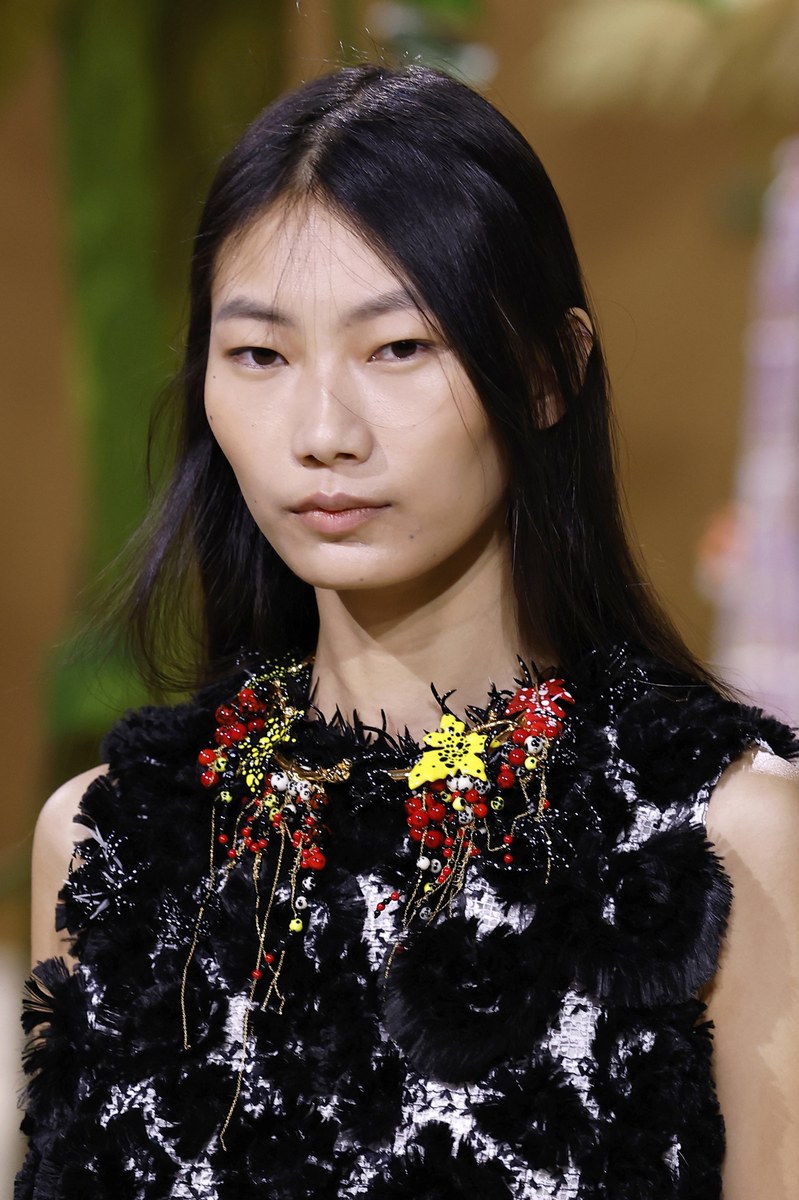
Roberto Cavalli FW26 Women Looks Report
Milan Fashion Week
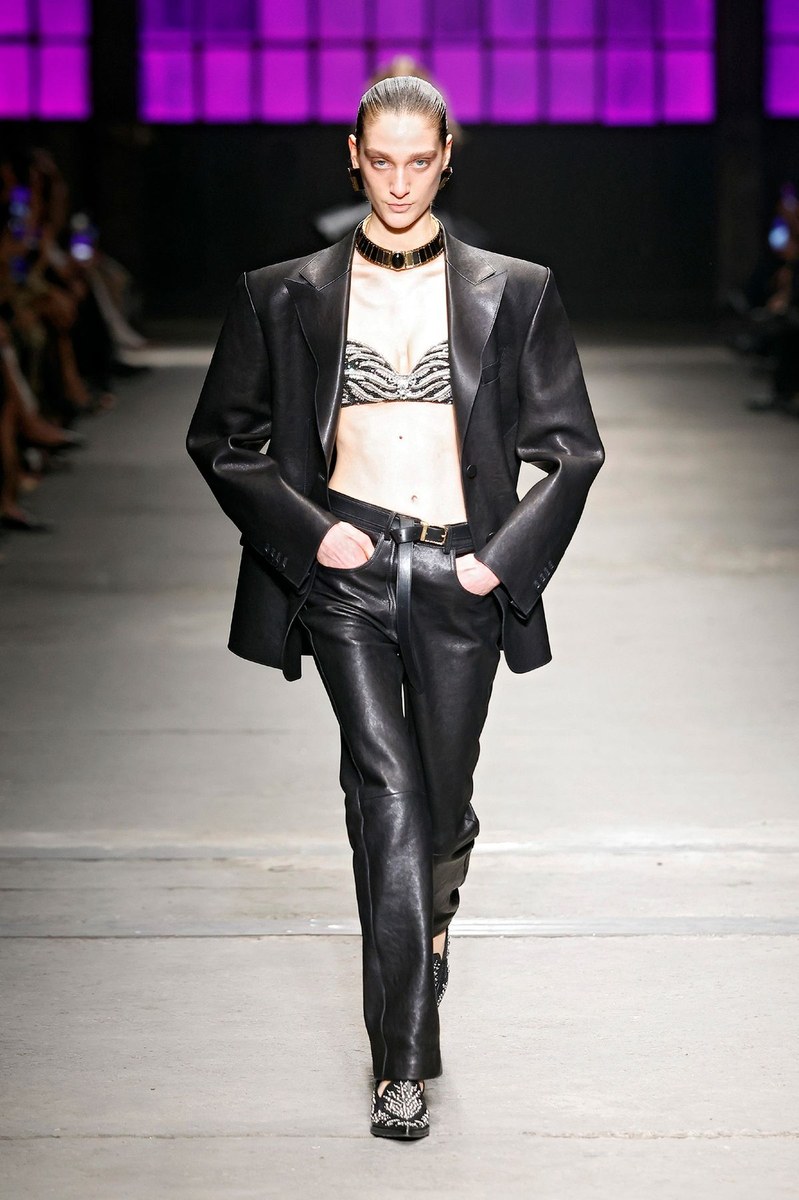
Roberto Cavalli FW26 positions the house squarely at the intersection of gothic maximalism and power dressing, channeling every look through an all-black filter that reads as deliberate restraint rather than creative limitation. For buyers, this monochromatic discipline makes the collection unusually shelf-ready, reducing colorway risk while letting material and texture carry the commercial differentiation.
Silhouette and Volume
Two opposing shapes drive the collection's energy: a sharp, padded-shoulder power silhouette in suiting and structured jackets, and a fluid, body-skimming line in slip dresses and sheer lace. Look 1 and Look 8 anchor the power end, with oversized blazers and wide-leg trousers that recall 1980s corporate drama filtered through a rock-and-roll sensibility. At the opposite extreme, Look 19 closes the arc by pairing a sheer lace blouse with a vast, floor-length feathered skirt that dominates the runway through sheer mass. Cropped jackets worn over exposed midriffs in Look 3 and Look 4 bridge the two poles and will likely drive the strongest sell-through in contemporary retail.
Color Palette
Every look is black. No accent colors. No tonal breaks. White relief doesn't arrive until the embroidered shoes in Look 1 and the white snake-print boots in Look 7 serve as deliberate punctuation. Within that singular palette, surface variation does the work that color would otherwise do: matte crepe, high-gloss patent vinyl, gunmetal sequins, and warm-toned amber hardware in Look 12 create enough visual temperature shifts to prevent monotony. A wardrobe like this speaks to a customer who treats color as negotiable but drama as non-negotiable.
Materials and Textures
Leather and leather alternatives in multiple finishes anchor the collection's material story, from sleek straight-leg trousers in Look 1, to the croc-embossed biker jacket in Look 4, to the high-gloss patent wide-legs appearing in Looks 16 and 4. Velvet surfaces as a secondary thread, appearing in the voluminous ruffled skirt of Look 9 and the floor-length slip in Look 14, where it carries enough weight to hold structure without tailoring. Lace operates in two distinct modes: as the primary surface in Look 13, where floral lace encases a sequined mini dress, and as a layering tool in Look 15, where it extends past the sleeve hem like a second skin. Two pieces showcase the collection's highest-tactility fabric story: the crinkled, astrakhan-style bouclé texture on the long coat in Look 6 and the jacket in Look 18.
Styling and Layering
A crystal-embellished underwire bralette functions as a central styling device, repeating across Looks 1, 2, 3, and 8 and reading as a signature rather than an afterthought. Layering logic flows from outerwear placed over that bralette with no additional top, which creates a deliberate flash of skin at the center of otherwise covered, structured looks. Footwear swings between embroidered flat loafers in Look 1, black pointed-toe pumps closing most of the evening looks, and tall leather boots in Looks 18 and 9 that harden the gothic register. Accessories remain architecturally spare, with choker-width necklaces, large statement earrings, and geometric black cuffs doing the majority of the work.
Look by Look Highlights
Look 1 An oversized black leather blazer over a crystal bralette and straight leather trousers establishes the collection's core commercial proposition in three separates that buyers can retail individually or as a set.
Look 2 The croc-embossed flared mini skirt stands as the collection's strongest single statement piece, combining volume, texture, and a belted waist into one high-margin SKU with broad editorial appeal.

Look 3 A croc-print cropped blazer paired with a high-slit midi pencil skirt delivers a power-dressing option that will translate directly into corporate and event wardrobing for contemporary and bridge retailers.

Look 8 An all-over croc-jacquard fabric cut into a cropped blazer and wide-leg trouser suit with crystal bralette represents the collection's clearest head-to-toe look for department store trunk-show buying.

Look 13 A sequined black mini dress with floral lace long sleeves and a lace turtleneck overlay compresses the collection's two major fabric stories into one cocktail-hour piece that reads as immediately shoppable.

Look 17 Crushed velvet forms a midi dress with cut-out chest detail and pleated chiffon hem panels, layering three distinct fabric weights in one garment and emerging as the collection's most technically demanding and storytelling-rich production piece.

Look 19 A sheer lace structured blouse over a black turtleneck ground, paired with a full-length shredded organza and feather-trimmed skirt, functions as the collection's closing statement and would serve a couture-adjacent special-order strategy.

Look 18 An astrakhan-textured mini dress with padded shoulders and thigh-high black leather boots condenses the gothic power-dressing theme into its most wearable and retail-scalable form.

Operational Insights
Bralette as hero SKU: The crystal-embellished underwire bralette repeats across at least four looks and functions as a standalone entry-level purchase. Treat it as a capsule anchor, not a styling prop, and negotiate minimum order quantities separately from outerwear.
Leather and patent vinyl depth: Patent vinyl wide-legs and croc-embossed leather appear across multiple silhouettes, signaling that the house is building a leather goods and leather-ready-to-wear story that warrants deep stock commitment from retailers with strong event and nightlife categories.
Texture-as-color strategy: Because the palette is entirely black, visual merchandising at retail must organize by surface finish rather than color. Request separate delivery streams for matte, glossy, and embossed SKUs to allow effective floor zoning.
Separates sell-through probability: Most looks build from three or fewer separates, which makes cross-selling straightforward. Style directors should build capsule plans around the blazer, trouser, and bralette trio, with skirts as add-on units in a second wave.
Feather and lace production lead times: Looks 19 and 17 involve hand-applied feather trim and multi-layer lace construction that carry longer production lead times and higher unit costs. Flag these as limited-allocation, high-ticket lines rather than volume buys, and confirm production capacity with the house before committing to floor dates.
Complete Collection


About the Designer
Fausto Puglisi was born in 1976 in Messina, a city on the northeastern tip of Sicily that has been destroyed and rebuilt more than once, carrying in its stones layers of Greek, Arab, Norman, Baroque, and seismic history. One of his first memories of fashion is walking with his grandfather through the streets of Messina to visit a tailor friend, choosing fabrics, looking at what could be made. The local tailors he grew up around were his first teachers, and the city's density of cultural collision, its long experience of conquest and survival, is something he has returned to repeatedly as the philosophical source of everything he designs. He completed his classical studies before leaving Sicily in 1999, arriving in New York with very little money and a visual imagination formed by equal parts Italian tradition and American television. He was, as he has described himself, a typical 1980s kid raised on private TV channels and American pop idols, absorbing contradictions that would become his method.
New York gave him his first decisive breaks. He encountered Patti Wilson, the stylist behind Whitney Houston, who commissioned a dress for the Grammy Awards, and then Arianne Phillips, the creative force behind Madonna's public image, who selected a fur-trimmed black coat that circulated globally and opened the doors of major department stores. Los Angeles followed. The influential boutique Maxfield carried his work. Celebrity dressing became his language, and when Madonna asked him to design the outfits for Nicki Minaj and M.I.A.'s Super Bowl halftime performance in 2012, his name reached an entirely new register of visibility. He returned to Italy in 2006, and in 2010 Domenico Dolce and Stefano Gabbana offered him space at their concept store on Via della Spiga, where his collection sold out. He launched his namesake label, showed at Milan Fashion Week from 2013, and was appointed artistic director of Emanuel Ungaro in Paris that same year, remaining until 2017.
In 2020 he was appointed creative director of Roberto Cavalli, a house whose appetite for animal prints, ancient Roman references, and unapologetic sensuality maps closely onto his own. The match has a deeper logic: both Puglisi and Roberto Cavalli the man drew their visual instincts from a Mediterranean world saturated with history, Cavalli from Florentine painting and his grandfather the Macchiaiolo, Puglisi from Messina's Baroque excess and the culture shock of Sicily meeting America. He has described his approach to the house as interpreting its DNA rather than replicating it, speaking what he calls "the future's language" through the existing codes.
"Sicily has been a cultural melting pot since antiquity. Think about the Greeks, Romans, Arabs, Byzantines, Normans, Spaniards and more. All that contrast is in my DNA and forges my aesthetic vision."
"I believe that only difficult places can generate a modern, bold vocabulary that breaks the patterns of boredom."
✦ This report was generated with AI — combining human editorial vision with Claude by Anthropic. Because the future of fashion intelligence is already here.