Simon Cracker FW26 Bags

Simon Cracker FW26 Bags
Simon Cracker FW26 Bags Report

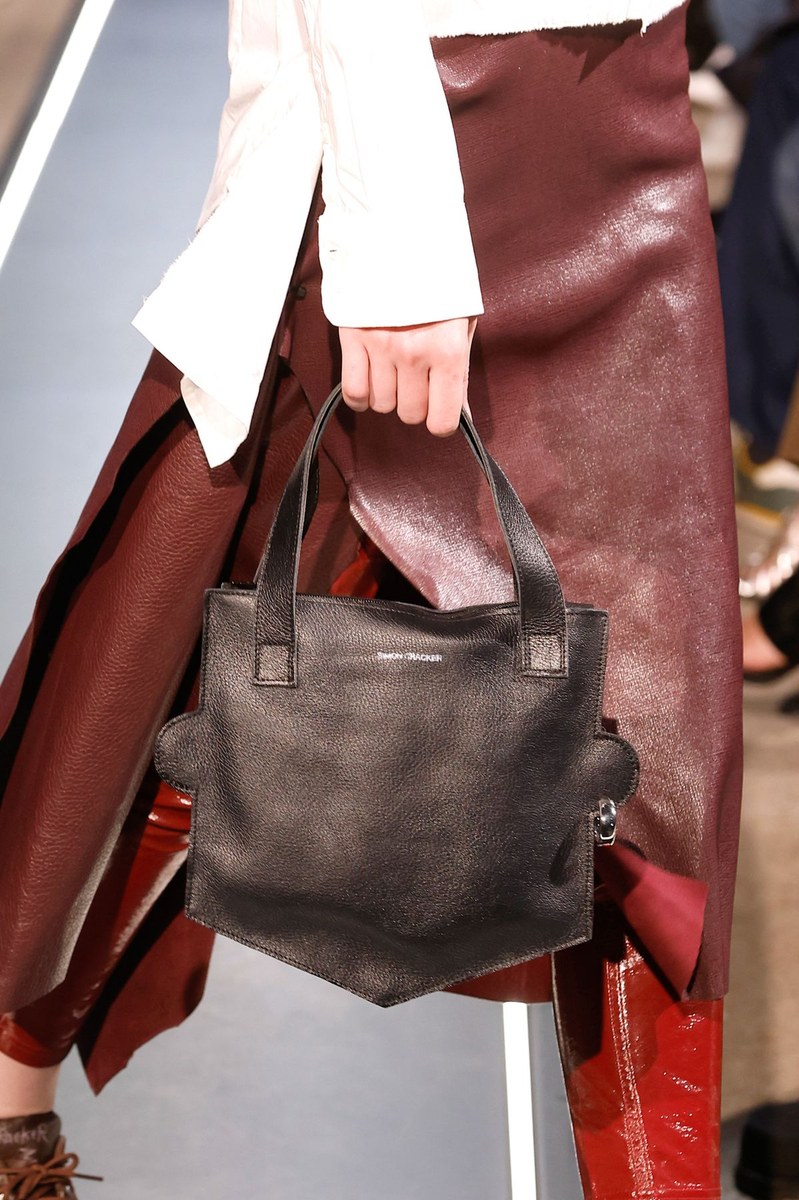
Simon Cracker FW26 plants its entire bag identity in two parallel tracks: a structured mini tote with scalloped lower edges and short top handles, and a loose, shapeless hobo or clutch that rejects all conventional construction. Buyers and product managers should note that the collection delivers a rare dual-entry opportunity, with a repeatable commercial core in the branded mini tote alongside disruptive one-off statement pieces that generate editorial and social traction without requiring deep stock commitment.

Silhouettes and Shapes

The scalloped-edge mini tote dominates the lineup, appearing across Bags 1, 2, 5, 7, 9, 10, 11, 13, 14, and 15 as the house's signature carry for the season. Small to medium, roughly 25 to 30 centimeters wide, it features dual short top handles sized for hand or elbow carry rather than shoulder wear. Against that structured base, Bags 4 and 8 introduce oversized soft hobos with no internal architecture, collapsed triangular volumes that read as deliberate anti-structure. Bag 6 goes furthest, presenting a folded wrist-wrap clutch so minimal it barely registers as a bag at all.
Materials and Hardware

A medium-grain pebbled leather in matte finish dominates the tote lineup, consistent enough across colorways to suggest a single tannery source and simpler production consolidation for buyers. Bag 8 and Bag 4 shift to smoother, more yielding leather and rubberized or coated fabric respectively, both without visible structure or stiffening. Bag 12 stands apart entirely, constructed from crumpled, heavily worked orange leather that reads almost sculptural, closer to a glove or hide fragment than a traditional bag body. Hardware is minimal and consistent: small silver-tone D-rings appear at the lower sides of the scalloped totes, visible on Bags 2, 7, 9, 11, and 15, carrying no decorative function beyond a subtle anchor point.

Color Direction

Black dominates the collection's bag palette, appearing across at least six tote iterations including Bags 1, 5, 9, 10, 14, and the wrist clutch in Bag 6 as the primary commercial volume color. Mustard yellow runs a close second and arguably stronger for editorial purposes, covering Bags 2, 4, 7, 8, 11, and 15 in a warm, saturated ochre that reads confidently against the season's earth-tone and print-heavy clothing. Pale blush pink appears exclusively on the illustrated bags, Bags 3 and 16, functioning as an accent tier rather than a volume play. Burnt orange in Bag 12 and stone grey in Bag 13 round out the palette as limited-run or capsule colorways.

Key Models and Details

The scalloped mini tote is the collection's bankable model. It carries a small embossed or printed logo at center front, visible on Bags 2, 5, 7, 9, and 15, placed low and horizontally in white or tone-on-tone lettering that reads as low-key branding rather than a logo-forward statement. No visible external closure suggests either an open-top construction or a minimal internal snap, positioning it functionally as a casual daily carry. Bags 3 and 16 represent an entirely different model direction: the scalloped silhouette is retained but the surface carries hand-drawn or hand-painted face motifs executed in purple and black, with safety pin hardware at the side that replaces the D-ring found on the leather totes.

Bag by Bag Highlights

Bag 1 The dark graphite mini tote appears slightly smaller than the rest of the scalloped tote family, making it a candidate for a micro-size extension in the product range.

Bag 1
Bag 1

Bag 3 The blush leather illustrated tote with a painted face and safety pin closure is the highest-risk, highest-reward piece in the collection, built for press and capsule drops rather than core replenishment.

Bag 3
Bag 3

Bag 4 The oversized yellow rubberized hobo with visible surface speckling is the most wearable volume piece outside the tote family, and its lightweight construction keeps material costs low relative to its perceived size.

Bag 4
Bag 4

Bag 6 The black folded wrist clutch tucked under a coat sleeve is a micro-accessory that demands almost no material investment and could retail as an entry price point or gift item.

Bag 6
Bag 6

Bag 8 The mustard yellow oversized soft leather hobo with a folded triangular base and generous interior volume is the strongest candidate for a premium leather carry option at a higher price tier.

Bag 8
Bag 8

Bag 12 The crumpled orange leather sculptural clutch, shaped and worn like a knuckle grip, has no direct commercial parallel in the lineup and reads as a limited-edition artist collaboration piece rather than a production style.

Bag 12
Bag 12

Bag 13 The stone grey pebbled tote is the most versatile colorway in the scalloped family for corporate and professional retail accounts, bridging the collection's youth-coded styling into a broader demographic.

Bag 13
Bag 13

Bag 16 The second illustrated pink tote with a safety pin detail shows enough variation from Bag 3 in painted composition to support two distinct SKUs within the same illustrated capsule, which benefits limited-edition sell-through strategy.

Bag 16
Bag 16

Operational Insights

Core SKU consolidation: The scalloped mini tote across black, mustard yellow, and stone grey constitutes a three-color core that shares identical construction and handles, allowing a single pattern and production run with colorway variation only, which directly reduces tooling and sampling costs.

Capsule tiering: The illustrated pink bags and the sculptural orange clutch belong in a separate limited capsule with a higher retail price and lower order depth, preventing them from cannibalizing the core tote's commercial performance.

Hardware standardization: The silver-tone D-ring appears consistently enough across the scalloped totes to source as a single hardware component at volume, reducing per-unit cost and simplifying reorder logistics.

Size extension opportunity: Visible size variation between Bags 1 and 15 within what appears to be the same silhouette suggests the brand is already testing a micro versus standard scale, and buyers should request both measurements before committing to orders to plan retail price architecture accordingly.

Material risk management: Bags 4 and 8 use soft, unstructured fabrications that are sensitive to quality control in production at scale, and product managers should request stress-test samples for handle attachment points and base seams before writing any volume orders on those styles.

Complete Collection

More Bags

More Bags

Bag 2
Bag 2
Bag 5
Bag 5
Bag 7
Bag 7
Bag 9
Bag 9
Bag 10
Bag 10
Bag 11
Bag 11
Bag 14
Bag 14
Bag 15
Bag 15

✦ This report was generated with AI — combining human editorial vision with Claude by Anthropic. Because the future of fashion intelligence is already here.