Simon Cracker FW26 Details

Simon Cracker FW26 Details
Simon Cracker FW26 Details Report

Simon Cracker FW26 positions deliberate degradation and material collision as its central accessories and garment-detail language, building a vocabulary around things that look found, altered, and structurally interrupted. For buyers and product managers, this is a direct signal that the "distressed luxury" conversation is shifting toward something rawer and more conceptually legible, with real implications for sourcing, embellishment, and eyewear development.

Category Overview

Two categories anchor this report: Dress Details (Details 1 through 8) and Eyewear (Details 9 and 10). A wide range of fabrications define the dress detail strategy, from sequined bralettes and shredded knitwear to moss-stained leather and hand-lettered cotton, communicating a collection built on layering incongruous references rather than resolving them. Sculptural, visibly hand-worked frames define the eyewear category (Details 9 and 10), functioning less as accessories and more as face-level art objects. Both categories argue for a consumer who reads garment and accessory construction as content in itself.
Material and Construction

Leather dominates in multiple states: patent black (Detail 1), moss-treated and mold-patinated outerwear (Detail 4), draped and pinned navy faux-leather (Detail 6), and bleach-mottled suiting fabric with a leather chest accent (Detail 7). Detail 2 pairs deliberate ladder-run destruction alongside pearl-bead appliqué and lace inserts in knitwear, forcing craft and damage into the same surface. A lilac sherpa panel connects to a black leather sleeve piece via rivet hardware in burnished silver finish in Detail 3. Frame construction in Details 9 and 10 appears hand-built, with visible wire stitching across the lens face and raw blue-painted resin along the brow bar, suggesting small-batch or atelier-level production rather than industrial manufacturing.

Detail 1
Detail 1

Color and Finish Direction

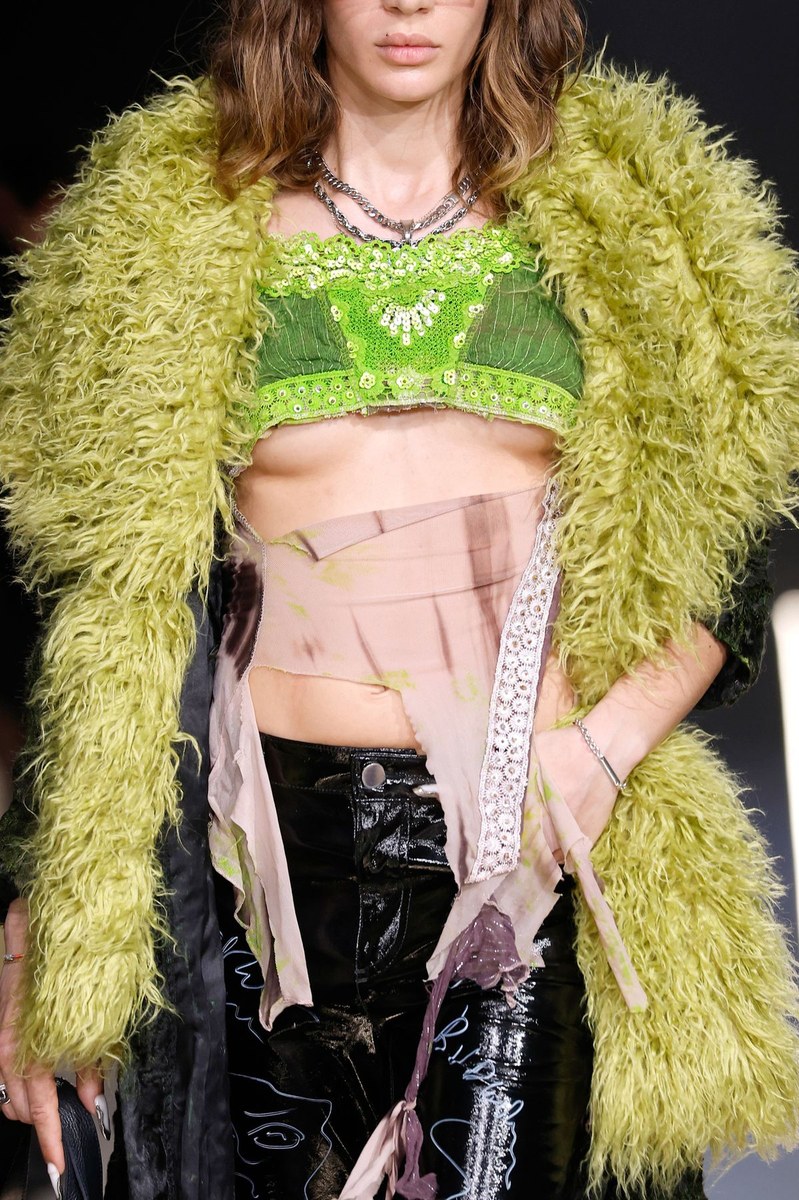
Ink navy and matte black dominate the palette, running through slate grey and bleached charcoal with tactical injections of acid green, neon yellow, lilac, and burnt orange. An acid-green sequined bralette in Detail 1 and neon yellow patent skirt in Detail 8 function as chromatic interruptions within an otherwise darkened collection. Burnt orange appears twice as a grounding accent: in the leather glove bag of Detail 4 and the chest-pocket insert of Detail 7, creating a loose connective thread across otherwise disparate looks. Matte, degraded, and worn surfaces dominate the finish direction, signaling a deliberate move away from high-shine luxury codes.

Key Pieces and Details

Most commercially disruptive is the moss and mold-treated leather jacket and shorts set in Detail 4. It signals a genuine dyeing and treatment process that buyers will need to interrogate at the sourcing level, as replicating this finish at scale requires specialist leather treatment facilities. A sculptural draped leather bodice in Detail 6, held with visible safety pins, translates directly into a corset-adjacent product category with strong commercial momentum. Hand-built eyewear frames in Details 9 and 10, though likely produced in very limited quantities, establish a design language for hardware embellishment and wire detailing that accessories directors can interpret into more producible SKUs.

Detail 4
Detail 4

Detail by Detail Highlights

Detail 1 (Dress Detail) Bright chartreuse sequined bralette with rhinestone trim sits above a sheer nude organza wrap panel printed with green paint marks, layered over patent black vinyl trousers, building a three-texture stack in one look.

Detail 2 (Dress Detail) A blush-grey ribbed cardigan uses intentional horizontal ladder runs across the bust, pearl-cluster appliqué at the neckline, and ivory satin-faced buttons down the front placket, combining destruction and decoration in a single knit surface.

Detail 2
Detail 2

Detail 3 (Dress Detail) A detachable shoulder piece pairs a lilac sherpa panel with a structured black leather tab fastened by two domed silver rivets, attached directly over a navy gathered blouse.

Detail 3
Detail 3

Detail 4 (Dress Detail) A double-breasted leather jacket and matching shorts carry a heavily oxidized surface treatment in forest green, mud brown, and pale moss yellow, paired with an orange leather ruched bag, creating the strongest archival-object reference in the collection.

Detail 6 (Dress Detail) Draped and gathered navy faux-leather forms a strapless bodice secured with visible safety pins along the center front boning channel, worn over a two-tone steel-blue and black leather skirt with unfinished raw panel edges.

Detail 6
Detail 6

Detail 7 (Dress Detail) A single-button blazer in bleach-splattered charcoal fabric carries a small burnt-orange leather square in the breast pocket, worn open over a pleated black satin skirt with a lacquered patent waistband.

Detail 7
Detail 7

Detail 8 (Dress Detail) An oversized white cotton long-sleeve sweatshirt with frayed neckline carries hand-lettered "REALLY DRTY" text in thick black marker strokes, tucked loosely into a neon yellow gathered patent leather skirt.

Detail 8
Detail 8

Detail 9 (Eyewear) Rectangular frameless lenses in a rose-gradient tint are held by a hand-painted cobalt blue resin brow bar with exposed silver wire threaded across both lenses in a grid pattern, worn low on the nose.

Detail 9
Detail 9

Operational Insights

Leather treatment sourcing: Detail 4 requires identification of specialist leather treatment vendors who work with botanical and chemical patination. Buyers should request material callout sheets and minimum order quantities before committing to this finish direction.

Embellishment pairing logic: Details 1 and 2 both combine damage or casualness with applied embellishment, sequins with torn organza, pearls with ladder-run knit. Product managers should consider this pairing as a development brief rather than a styling accident, as it speaks directly to the current dual-register consumer.

Eyewear production pathway: Details 9 and 10 suggest bespoke or micro-run frame production. Accessories directors evaluating this direction should assess wire-threading and resin-painting as hand-finishing steps, factoring labor cost and quality consistency into margin planning from the outset.

Hardware consistency: Dome-top rivets in silver appear across Detail 3 and the corset hardware in Detail 6. A standardized silver rivet specification across a full accessories range would create visual coherence without requiring design repetition.

Slogan and text placement: Detail 8 positions hand-lettered text as a primary design element, not a secondary graphic. Buyers in the casualwear or streetwear-adjacent segment should evaluate artist-collaboration or hand-finishing programs to achieve a similar non-mechanical quality at retail-viable scale.

More Details

Detail 5
Detail 5
Detail 10
Detail 10

✦ This report was generated with AI — combining human editorial vision with Claude by Anthropic. Because the future of fashion intelligence is already here.