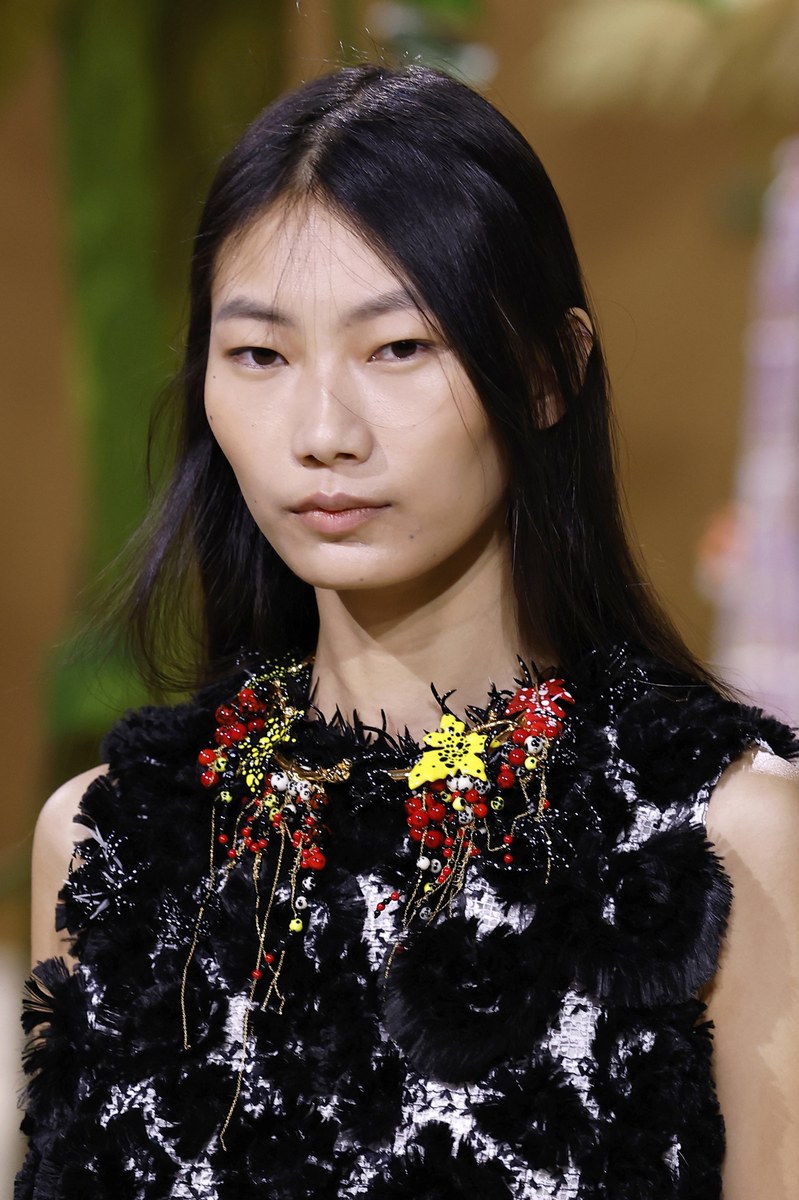
Simone Rocha FW26 Details
Simone Rocha FW26 Details Report
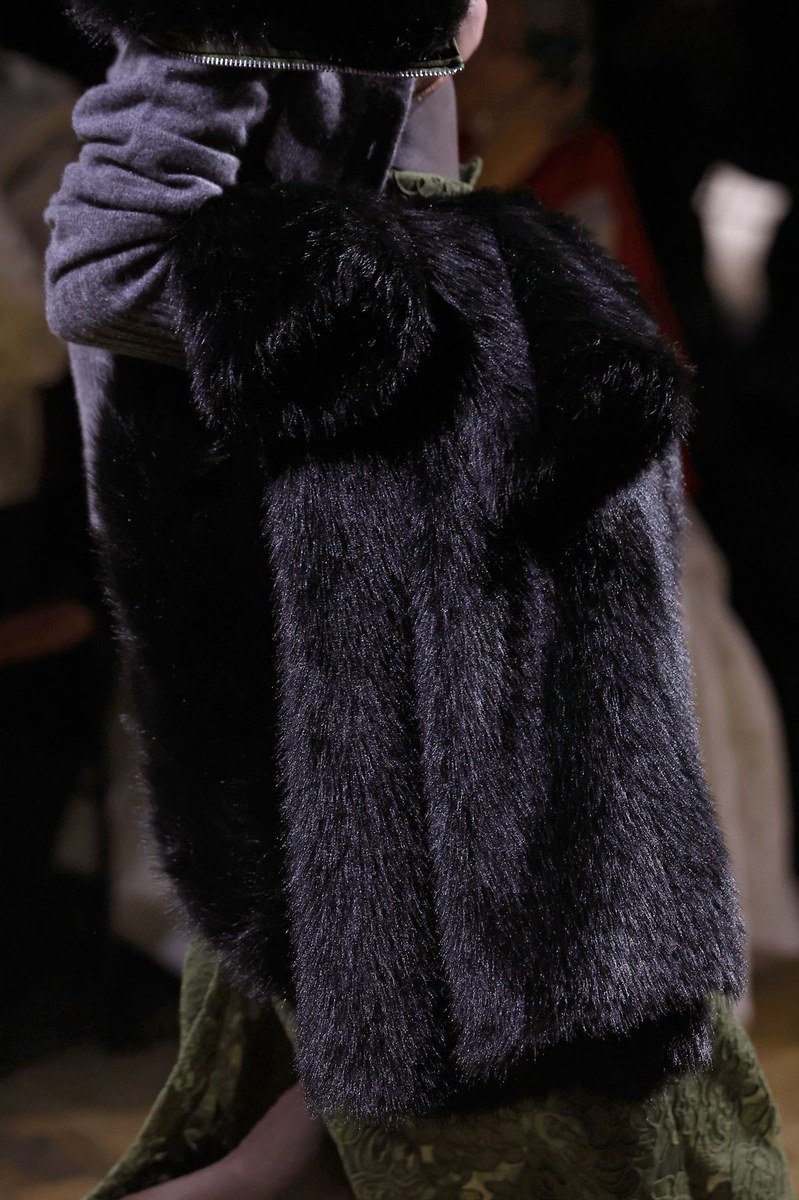
Simone Rocha FW26 builds its accessories and dress detail language around layered textile weight, hardware accumulation, and tactile contrast, moving between faux fur volume, satin ribbon construction, and structured wool with leather bondage rigging. Buyers and product managers need to register this now because the collection signals a strong commercial appetite for embellishment-as-architecture, where the detail is the product.
Category Overview
All five details fall within the dress detail category, yet they read as distinct product families. Details 1 and 5 develop a faux fur body piece with bag-like autonomy. Black patent leather harness hardware anchors the tailored wool suiting in Detail 2. Details 3 and 4 work pure embellishment, one through metal eyelet and ribbon corsetry, one through cascading multi-tonal satin ribbon construction. This strategy communicates a house committed to transforming surface decoration into structural intent, giving buyers clear product stories across outerwear adjacency, suiting, and occasion dressing.
Material and Construction
The faux fur visible in Details 1 and 5 carries a long, dense pile with a faint blue-black shimmer, suggesting a lurex or metallic filament woven through the base fiber. Mid-weight charcoal wool twill cuts into deep box pleats in Detail 2, anchored by a black patent leather harness system with silver-tone lobster clasp hardware. Heavy black cotton or technical taffeta sets the stage for Detail 3, which features rows of silver-tone D-ring eyelets, black satin ribbon lacing, and a brown marabou feather and black satin rosette appliqué at the hip pocket. Stacked satin ribbons in ivory, black, blush, and red construct Detail 4 entirely, layered over a floral-print slip base with rhinestone-centered fabric rosettes anchoring each cluster.
Color and Finish Direction
Black dominates across all five details, appearing in faux fur, wool, patent leather, cotton, and satin ribbon form. Ivory and blush satin in Detail 4 provide the primary contrast, while red ribbon accent reads as a sharp, deliberate punctuation within an otherwise tonal palette. Brown marabou in Detail 3 introduces a warm tertiary note that stops the all-black ground from reading as uniform. Silver-tone hardware in Details 2 and 3 keeps metal finishes cool and graphic rather than ornamental.

Key Pieces and Details
The faux fur body piece in Details 1 and 5 is commercially the most versatile piece, functioning as a vest, a cover-up, or a bag-adjacent accessory depending on styling. Patent leather harness in Detail 2 sits on top of pleated wool and operates as a separates-ready belt system, making it a strong standalone SKU for accessories buyers. Ribbonwork trim category opportunity emerges clearly from Detail 4, which reads as the editorial anchor of the collection and signals a category for product teams sourcing seasonal embellishment. Eyelet and D-ring detailing in Detail 3 points directly toward hardware-heavy accessory crossover, connecting dress construction to the current hardware belt and corset-exterior trend.
Detail by Detail Highlights
Detail 1 (Dress Detail) A deep black faux fur body piece with long pile and blue-black metallic shimmer sits against a grey ribbed knit base, reading as a fur stole or structured vest with enough volume to anchor the entire look.

Detail 2 (Dress Detail) A charcoal wool pleated skirt is harnessed with a black patent leather rig carrying silver lobster clasps and trailing satin ribbon ties, turning functional hardware into primary surface design.
Detail 3 (Dress Detail) Black cotton or taffeta runs vertical columns of silver D-ring eyelets with black satin ribbon lacing, and a brown marabou feather rosette at the hip pocket introduces warmth against the cold hardware grid.

Detail 4 (Dress Detail) Cascading satin ribbons in ivory, black, blush, and red build the entire silhouette from chest to hem, with rhinestone-centered fabric rosettes anchoring each ribbon cluster at the bust and shoulders.
Detail 5 (Dress Detail) A closer view of the faux fur piece confirms the metallic blue-black fiber content and the dense, uniform pile cut, with the green lace skirt beneath establishing a print and texture pairing that buyers should clock for styling direction.

Operational Insights
Faux fur sourcing: The faux fur in Details 1 and 5 requires a supplier capable of blending lurex or metallic yarn through long-pile base fabric. Buyers should brief textile mills on achieving the blue-black shimmer without compromising pile density or drape.
Hardware specification: The patent leather harness in Detail 2 requires silver-tone lobster clasps rated for repeated attachment and detachment. Product managers should confirm hardware weight and clasp gauge before committing to production minimums.
Ribbon construction lead time: Detail 4 relies on volume ribbon sourcing across at least five colorways including a specific red satin that reads as accent, not primary. Trimmings buyers should lock ribbon yardage early given seasonal satin ribbon demand across multiple houses this cycle.
Eyelet and D-ring application: Detail 3 places metal eyelets and D-rings in closely spaced vertical rows across a full dress body. Production teams need to assess whether this is a hand-applied or machine-applied process, as the answer directly affects cost per unit and minimum order quantities.
Cross-category merchandising: The harness system in Detail 2 and the corset-exterior hardware logic in Detail 3 both translate into standalone belt or body harness SKUs. Accessories directors should evaluate a capsule hardware belt range that extracts these details from their dress context and sells independently.
✦ This report was generated with AI — combining human editorial vision with Claude by Anthropic. Because the future of fashion intelligence is already here.