Situationist FW26 Women Looks Report

Situationist FW26 Women Looks Report
Situationist FW26 Women Looks Report

Paris Fashion Week

Situationist FW26 builds a wardrobe around controlled power, using structured tailoring, liquid leather, and extreme volume to position the body as an architectural object rather than a surface for decoration. Buyers should take note: this arrives at exactly the moment when clients are pulling back from quiet luxury minimalism and asking for clothes that make a physical statement without theatrical embellishment.

Silhouette and Volume

Two parallel lines run through the collection. The first is a blade-sharp, waist-suppressed silhouette visible in the asymmetric wrap blazers of Look 6 and Look 17, where the jacket hem cuts diagonally across the hip and the trouser falls wide and unbroken to the floor. Look 11 and Look 20 represent the second extreme: expansion at its most exaggerated, with an oversized trapeze panel sitting above the shoulders and extending the body's width by nearly forty percent. Look 8 sits between these two poles, a voluminous draped cape top paired with wide trousers and anchored by a deep oxblood leather corset belt that re-establishes the waist within all that fabric.
Look 6
Look 6

Color Palette

Black dominates, appearing across at least twelve of the twenty looks and functioning as a base for textural contrast rather than as a neutral. Oxblood and deep burgundy emerge as the collection's emotional accent, appearing in the full leather coordinates of Look 7, the corset belt in Look 8, the gloves in Look 10, and the heel flash in Looks 10 and 12. Charcoal and slate grey build a secondary palette in Looks 11, 12, 15, 17, and portions of Look 18. A final sequence in cream and off-white closes Looks 14, 16, 18, and 19, creating deliberate relief after the sustained darkness.

Look 7
Look 7

Materials and Textures

Leather is the collection's dominant material, appearing in at least four distinct treatments. Smooth, high-gloss black leather is used for the slip dress in Look 3 and the suit in Look 4. Matte croc-embossed leather covers the full coordinated suit in Look 2. A heavier, structured leather with visible seam lines builds the jacket in Look 12. Shearling and fur appear across multiple looks: a black lamb collar on a leather coat in Look 10, an ivory sculptural bouclé or shearling bomber in Look 14, a burgundy mink-style stole carried in Look 15, and a full floor-length fox-trim coat worn open in Look 18. Tailored wool and suiting fabric carries Looks 6, 11, 17, and 20, with a fine melange weave that holds the exaggerated shoulder construction without collapsing.

Look 3
Look 3

Styling and Layering

Layering at Situationist FW26 operates through contrasts of weight and rigidity rather than through volume on volume. A structured black leather blazer opens over a minimal bralette and wide grey flannel trousers in Look 12, with a voluminous fox fur collar providing the softness that the rest of the look deliberately refuses. Footwear is almost entirely pointed-toe, ankle-height or knee-height, in black leather or boot constructions, with zebra-print knee boots in Look 3 and embossed loafers in Looks 4 and 16 serving as the primary exceptions. Long leather gloves in Looks 1 and 7 appear as an extension of the sleeve rather than as an accessory, collapsing the boundary between garment and styling object.

Look 12
Look 12

Look by Look Highlights

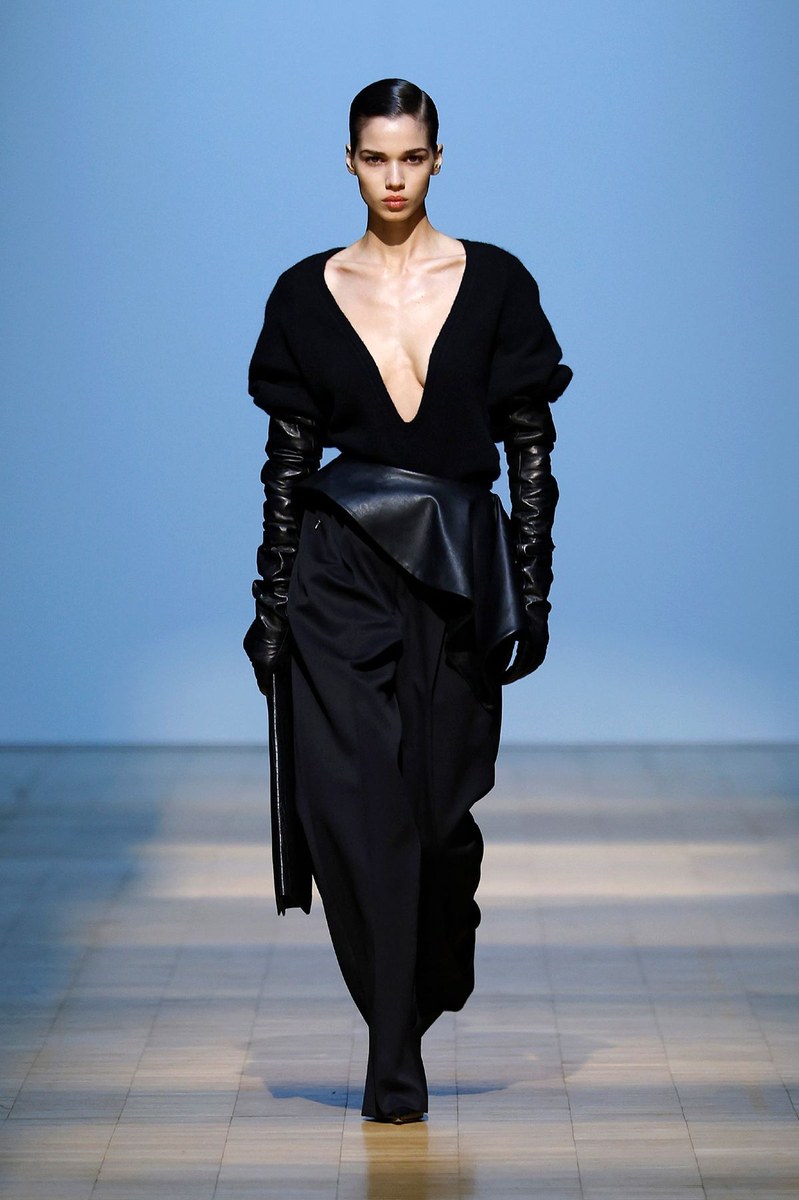
Look 1 The deep-V black knit top with elbow-to-wrist black leather gloves and an asymmetric draped leather peplum skirt delivers a high editorial impact combination that translates directly into a capsule hero piece for luxury multi-brand retailers.

Look 1
Look 1

Look 2 The full croc-embossed black leather suit, jacket and trouser cut in matching texture, is a commercial centerpiece for buyers targeting clients who want a singular statement in place of a coordinated wardrobe.

Look 2
Look 2

Look 7 The complete oxblood leather look, shirt, leather peplum belt, wide trousers and matching leather gloves, is the collection's strongest color story and a direct buying signal for stores that need a non-black leather option this season.

Look 8 The oversized draped black caftan top cinched by a wide oxblood leather corset belt over wide trousers reads as the collection's most wearable volume statement, with the belt functioning as a standalone accessory buy.

Look 8
Look 8

Look 11 The sculpted trapeze outerwear panel in grey suiting that frames the shoulders above a double-breasted blazer and wide trousers is what buyers will need to assess for production feasibility, given the internal structure required to hold that shape.

Look 11
Look 11

Look 14 The ivory shearling or high-pile boucle bomber with dramatically curved sleeves and black leather peplum waist detail pairs with wide black trousers to produce a coat buy that works across both womenswear and unisex floors.

Look 14
Look 14

Look 19 The ivory short-sleeve leather boxy top over wide black leather trousers with a burgundy leather asymmetric panel at the hip is the collection's most approachable entry point, a three-piece leather story priced below full look investment.

Look 19
Look 19

Look 20 The black exaggerated trapeze blazer over a single-button suit jacket and wide trousers, with white toe-cap boots just visible at the hem, is the closing power statement and will generate the most press visibility, making it a priority for editorial loan lists.

Look 20
Look 20

Operational Insights

Leather depth: Buyers need to commit to leather across multiple price tiers. Identify whether your supplier base can deliver croc-emboss, smooth high-gloss, and matte finish leathers in the same production cycle, since mixing these across a capsule requires parallel sourcing pipelines.

Oxblood as a key accent: Burgundy and oxblood appear across accessories, belts, gloves, and full looks. Style directors should treat this as a cross-category color story rather than a single SKU decision, coordinating buys across footwear, outerwear, and ready-to-wear to maximize outfit sell-through.

Structural outerwear production cost: Looks 11 and 20 depend on internal boning or rigid interfacing to maintain the trapeze shoulder extension. Product managers should build a 20 to 30 percent cost premium into margin models for these styles before presenting them to buying committees.

Fur and shearling compliance: Looks 10, 12, 14, 15, and 18 all incorporate fur or shearling in some form. Buyers operating in markets with strict fur retail restrictions, including California and parts of the EU, will need confirmed fabric provenance documentation and faux alternatives developed in parallel.

Glove and belt accessory opportunity: Long leather gloves in Look 1 and Look 7, and the wide oxblood corset belt in Look 8, function as standalone styling pieces that could be bought independently of full look investment. These accessories carry the collection's visual signature at a lower price point and represent a high-margin fill opportunity for stores not ready to commit to full leather coordinated sets.

Complete Collection

Look 4
Look 4
Look 5
Look 5
Look 9
Look 9
Look 10
Look 10
Look 13
Look 13
Look 15
Look 15
Look 16
Look 16
Look 17
Look 17
Look 18
Look 18
Look 21
Look 21
Look 22
Look 22
Look 23
Look 23
Look 24
Look 24
Look 25
Look 25
Look 26
Look 26
Look 27
Look 27
Look 28
Look 28
Look 29
Look 29
Look 30
Look 30
Look 31
Look 31
Look 32
Look 32
Look 33
Look 33
Look 34
Look 34
Look 35
Look 35
Look 36
Look 36
Look 37
Look 37
Look 38
Look 38
Look 39
Look 39
Look 40
Look 40

About the Designer

Irakli Rusadze was born in Tbilisi in 1991 and grew up inside the long aftermath of the Soviet collapse, a childhood marked by inflation, food shortages, and the particular resourcefulness that emerges when very little is available and everything must be made or improvised. The city itself was his classroom: he started making his own sketches and patterns at thirteen, working out of his apartment, drawn not by any institutional path but by what he saw around him in Tbilisi's streets and in the women who had raised themselves through difficult decades and dressed with a particular fortitude. By fifteen he was working as an assistant to local designers and tailors, learning construction and sewing from older Georgian craftsmen who had spent their lives in the trade, absorbing their knowledge through proximity rather than formal study. One of his most important early collaborators was Guara, a seamstress in her sixties from a suburb of Tbilisi, who supervised his pattern making for years. He has described arriving at her home with a nervousness that still hadn't left him.

Before founding Situationist, he worked as a creative and construction director for multiple Georgian fashion houses, building a technical fluency rare among designers of his generation: he still cuts his own patterns, sews, and tailors, handling the physical work rather than delegating it upward. The label was co-founded in 2015 with artist and photographer Davit Giorgadze, who oversaw the visual identity in the early years. Rusadze had his first major showing at Mercedes-Benz Fashion Week Tbilisi at twenty-five. The international break came two years later when Bella Hadid, who had found the brand through Vogue.com, wrote to him directly, not through a stylist, to request five looks. Shortly after, White Milano invited him to show, and the trajectory shifted. The brand's name draws on the 1960s Situationist International, the movement of avant-garde artists and political theorists who refused to separate art from the transformation of everyday life. The name is a philosophical position as much as a brand identity.

His references are grounded in Georgian history and in resistance: the tulip as a symbol of freedom tied to the 1989 Tbilisi Massacre, the archival suit-wearing fathers and grandfathers of an earlier Georgia that had no access to Western fashion and dressed from what was passed down through families, the underground techno venue Bassiani, which became both a creative touchstone and a site of political protest. He staged a show there in 2018. When Georgia's government passed anti-LGBTQ legislation and a foreign agents bill that threatened its path toward the EU, Rusadze crocheted a blanket from 183 pairs of handmade shoe soles in the shape of the European flag and brought it to the collection, insisting that clothing made in political times should carry the weight of those times. He is now on the official Paris Fashion Week calendar.

"I believe each of us should use the platforms at our disposal to defend the values we believe in. Engaging through cultural means gives our work a deeper purpose. The clothes we wear define the person we present to society, in an era where every choice reflects a stance."

"I have always believed that creating collections can serve as a bridge to share and export Georgian culture beyond our borders. Georgian history, along with contemporary Georgia, is my main source of inspiration. Our strong symbolism continues to convey messages that are still relevant."

✦ This report was generated with AI — combining human editorial vision with Claude by Anthropic. Because the future of fashion intelligence is already here.