Stella McCartney FW26 Women Looks Report

Stella McCartney FW26 Women Looks Report
Did you know? Stella McCartney pioneered the use of mylo, a lab-grown mushroom-based leather alternative, partnering with Bolt Threads to debut the material in her 2021 collection before it became available to other luxury brands. This move positioned her label as a technical innovator in bioengineered materials rather than simply a luxury ethics brand relying on existing alternatives.

Stella McCartney FW26 Women Looks Report

Paris Fashion Week

Stella McCartney FW26 builds a wardrobe around the tension between restraint and extravagance, pairing architectural tailoring with fur trims, shearling masses, and embellished denim within a single coherent vocabulary. For buyers navigating a market where customers want investment pieces that read as both practical and aspirational, the lineup delivers a clear commercial framework.

Silhouette and Volume

Two distinct silhouettes anchor the collection. A fitted, belted torso shape moves through Looks 2, 5, 11, and 18, while an enveloping, volume-forward overcoat dominates Looks 1, 3, 7, and 10. Shoulders remain consistently strong and structured, even when the body relaxes. Look 6 breaks both patterns entirely with a short peplum dress over thigh-high boots, landing the only truly mini proportion in the lineup. Wide-leg trousers appear in Looks 8, 9, 13, and 15 with a high-waisted, pleated cut that reads clean from the front and generous in movement.
Look 6
Look 6

Color Palette

Chocolate brown and ivory form the spine, appearing together in Look 7 and separately across nearly every category from outerwear to knitwear. Matte black runs as a constant through tailoring and eveningwear, reaching its most graphic expression in Look 4 and most formal in Look 19. Camel sits as a warm middle register in Looks 3, 8, 10, and 12 in tones ranging from golden tan to biscuit. One deliberate disruption arrives via red in Looks 14 and 17, a poppy, saturated accent that signals intentional energy shift rather than palette extension.

Look 7
Look 7

Materials and Textures

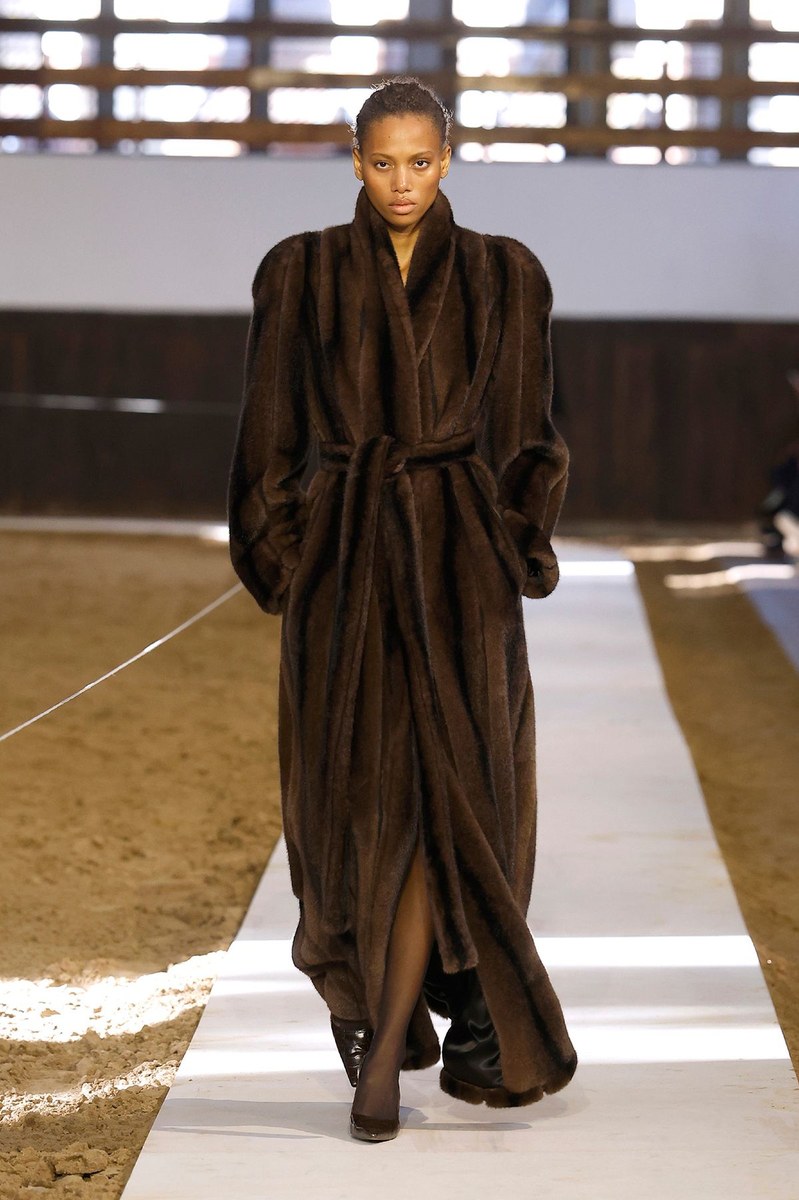
Fur trim, presented here as faux in keeping with the brand's position, edges the hem of Looks 2, 4, 5, 11, and 18 in a short, dense cut that reads almost like a cuff. Look 1 features the heaviest piece: full-length faux mink with a draped shawl collar and belted waist that create interior structure within exterior volume. Look 17 stands as the textural outlier, a shaggy, looped-yarn sweater dress with multiple fringe tiers that mimics the weight and movement of shearling without replicating it. A camel wool coat in Look 3 has a clean face finish with sharp lapel, contrasting with an oversized faux fur scarf draped across it that reads as a separate accessory rather than an integrated design element.

Look 1
Look 1

Styling and Layering

Belts do considerable organizational work across the collection, cinching knit tops over skirts in Looks 2, 5, and 18, and nipping in blazer-weight jackets in Look 11. Rarely decorative, the belt functions structurally, redirecting volume and defining the waist against generous proportions above and below. Footwear splits sharply between pointed-toe pumps, used in tailored looks to maintain a lean line, and knee-high or thigh-high leather boots appearing in Looks 6 and 10 to add graphic weight to shorter or looser upper proportions. Bags lean triangular and sculptural in dark green, burgundy, and tobacco leather, which ties back to the brown and camel palette without duplicating any garment color exactly.

Look 11
Look 11

Look by Look Highlights

Look 1 Arrives as an immediate statement in full-length chocolate faux mink with a self-belt and padded shoulders, making it the clearest hero outerwear piece for buyers seeking a single high-impact SKU.

Look 4 Pairs a structured black frock coat with faux fur hem trim and slim black trousers, a combination that reads as equestrian-coded without being costume, and likely sits well at the intersection of outerwear and occasion dressing.

Look 4
Look 4

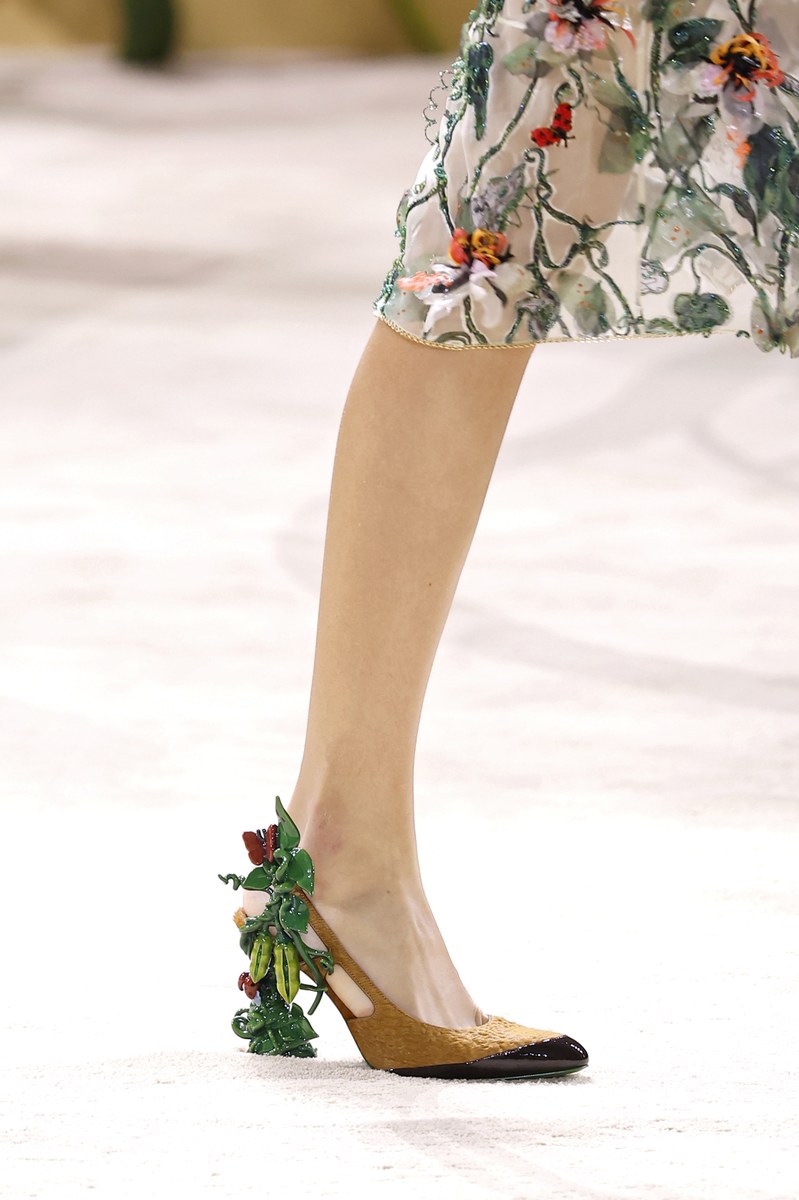
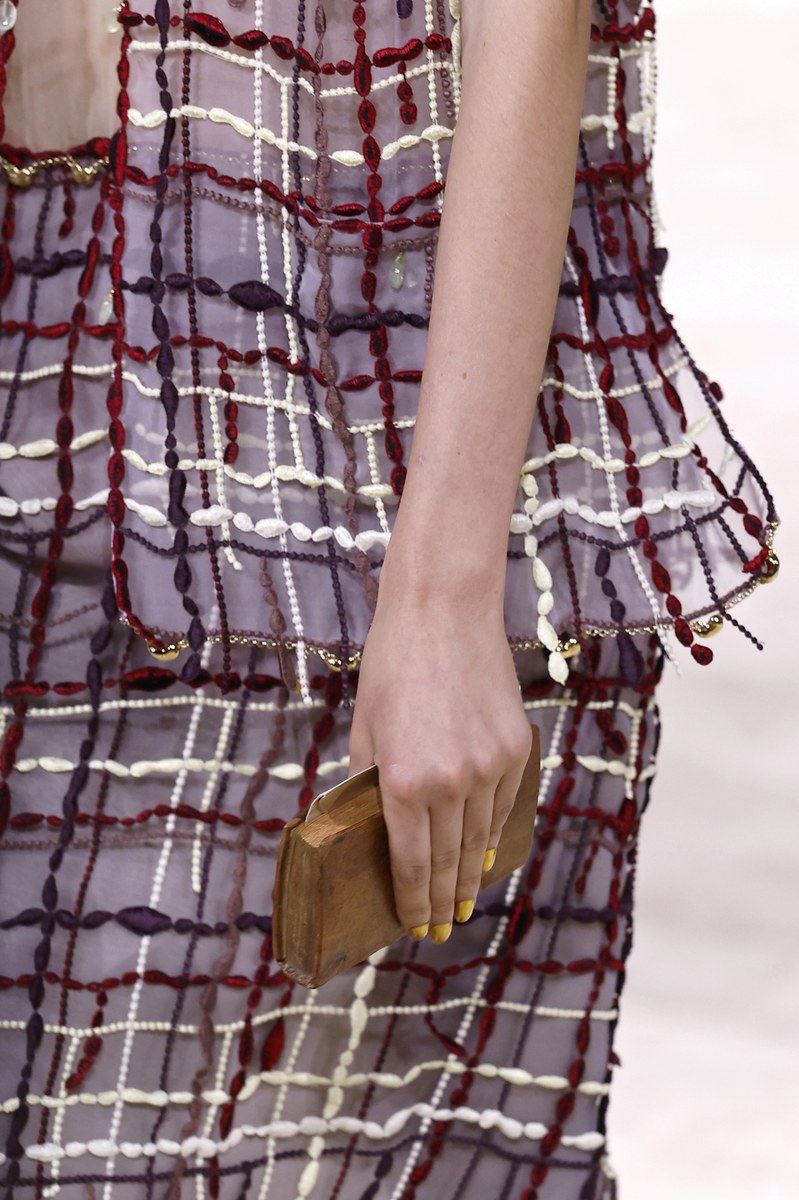
Look 6 Strips back to a short black peplum dress with thigh-high black leather boots, delivering the most directional proportional play in the collection and a strong candidate for editorial and capsule production.

Look 12 Presents a honey-tan leather patchwork jacket with tie details and wide ivory trousers, the most technically complex construction in the lineup and a signal of where the brand is pushing leather goods fabrication beyond bags.

Look 12
Look 12

Look 13 Wraps a dark brown wool suit in a granny-square crochet scarf that trails to the ankle, a craft-meets-tailoring combination that speaks directly to the handcraft premium market without sacrificing wearability.

Look 13
Look 13

Look 19 Closes with a black velvet strapless column gown with multicolored gemstone-encrusted bodice and dramatic hip bow, the clearest eveningwear anchor and the piece most likely to carry press imagery.

Look 19
Look 19

Look 20 Opens with intentional casualness, pairing a white tank reading "MY DAD IS A ROCK STAR" with heavily jewel-embellished dark jeans, a high-low contrast that will polarize buyers but signals a younger customer acquisition strategy.

Look 20
Look 20

Look 17 Delivers a looped-fringe multicolor knit dress as a standalone texture story, compact enough in silhouette to be commercially viable but distinctive enough to justify sampling ahead of the full buy.

Look 17
Look 17

Operational Insights

Fur trim as a modular detail: Repeated use of faux fur hem trim across five distinct garment types, blouses, jackets, and coats, suggests McCartney is building a trim language that buyers can apply selectively. Style directors should evaluate whether this detail translates across their own private label or licensed categories.

Outerwear as entry point: Looks 1, 3, 7, and 10 represent a coherent outerwear story across faux mink, shearling, and wool with faux fur scarves. Buyers with strong coat categories should prioritize these four for early delivery windows, as the silhouette lead time will be significant.

Belted separates as a repeatable commercial formula: The belted top-over-skirt formula appears in Looks 2, 5, and 18 in black, white, and gray, meaning it can be produced as a color-run story with minimal pattern change cost. Product managers should flag this for replenishment planning.

The red accent as a controlled pop strategy: Red appears only twice, in the fringed bag of Look 14 and the bag and fringe of Look 17, which tells buyers that red functions as an accessory color rather than a ready-to-wear category. Accessory buyers should test red leather goods as a reactive buy against the brown and camel ground goods.

Look 14
Look 14

Craft fabrication signals a price tier shift: Crochet scarves in Look 13 and looped-yarn dresses in Look 17 indicate a deliberate move toward handcraft-adjacent fabrication that supports higher retail price points. Style directors building premium assortments should evaluate whether their customer base will support the margin structure these constructions require.

Complete Collection

Look 2
Look 2
Look 3
Look 3
Look 5
Look 5
Look 8
Look 8
Look 9
Look 9
Look 10
Look 10
Look 15
Look 15
Look 16
Look 16
Look 18
Look 18
Look 21
Look 21
Look 22
Look 22
Look 23
Look 23
Look 24
Look 24
Look 25
Look 25
Look 26
Look 26
Look 27
Look 27
Look 28
Look 28
Look 29
Look 29
Look 30
Look 30
Look 31
Look 31
Look 32
Look 32
Look 33
Look 33
Look 34
Look 34
Look 35
Look 35
Look 36
Look 36
Look 37
Look 37
Look 38
Look 38
Look 39
Look 39
Look 40
Look 40
Look 41
Look 41
Look 42
Look 42
Look 43
Look 43
Look 44
Look 44
Look 45
Look 45
Look 46
Look 46
Look 47
Look 47
Look 48
Look 48
Look 49
Look 49
Look 50
Look 50
Look 51
Look 51

About the Designer

Stella McCartney was born in London in 1971 and grew up between the city and the English countryside, the daughter of Paul McCartney and Linda McCartney. The combination of those two people shaped her more than any institution: a father who helped define the cultural rupture of the 1960s and a mother who was a photographer, animal rights campaigner, and vegetarian activist whose convictions were non-negotiable household facts. The closet in their home, with its mix of vintage rock-and-roll pieces and her parents' particular offbeat taste, was where Stella spent hours as a child building outfits. She made her first garment at twelve and designed her first jacket at thirteen. At fifteen, a PR friend of her parents handed her a note at her birthday party with work experience placements at Saint Laurent, Ungaro, and Christian Lacroix. She later interned at British Vogue before enrolling at Central Saint Martins, where she trained under Edward Sexton, her father's Savile Row tailor, learning the structural language of British tailoring from someone who had built suits for the Beatles.

Her graduation show at Central Saint Martins in 1995 caused an immediate commotion. Kate Moss, Naomi Campbell, and Yasmin Le Bon walked the collection. Her father wrote a song for the occasion. The front row included Twiggy and Jude Law, and the collection was immediately picked up by Neiman Marcus, Bergdorf Goodman, and Browns. Two years later, at twenty-five, she was appointed creative director of Chloé in Paris, replacing Karl Lagerfeld, who made his contempt public and lost the argument. Working alongside her classmate Phoebe Philo, McCartney pulled the French house toward a harder, more urban femininity, with low-slung trousers, body-conscious knits, and a generation of women who had not previously considered Chloé. She left in 2001 to launch her own label in partnership with the Gucci Group, later Kering, presenting her first collection in Paris that October.

From the start she refused leather and fur across the entire range of products, a position she took before the fashion industry treated sustainability as a commercial category. The Falabella bag, made in recycled and synthetic materials, became one of the most copied accessories of the 2010s. She has collaborated with Adidas on sustainable activewear for over two decades, designed Meghan Markle's evening dress for her 2018 wedding reception, dressed Team GB for the London Olympics, and co-founded a $200 million climate solutions fund. In 2018 she bought back the stake Kering had held in the company for seventeen years, then partnered with LVMH in 2019. She remains creative director of Stella McCartney, now a global brand with more than fifty freestanding stores.

"I've sacrificed massively financially as a business. Why does it cost me 70 percent more to make a non-leather bag? When is policy going to change to actually incentivise a business like mine?"

"I knew I always had financial stability, I always had a family unit. I have more admiration for people who didn't have my background, who didn't have the insight I got from looking at the world through their parents' eyes."

✦ This report was generated with AI — combining human editorial vision with Claude by Anthropic. Because the future of fashion intelligence is already here.