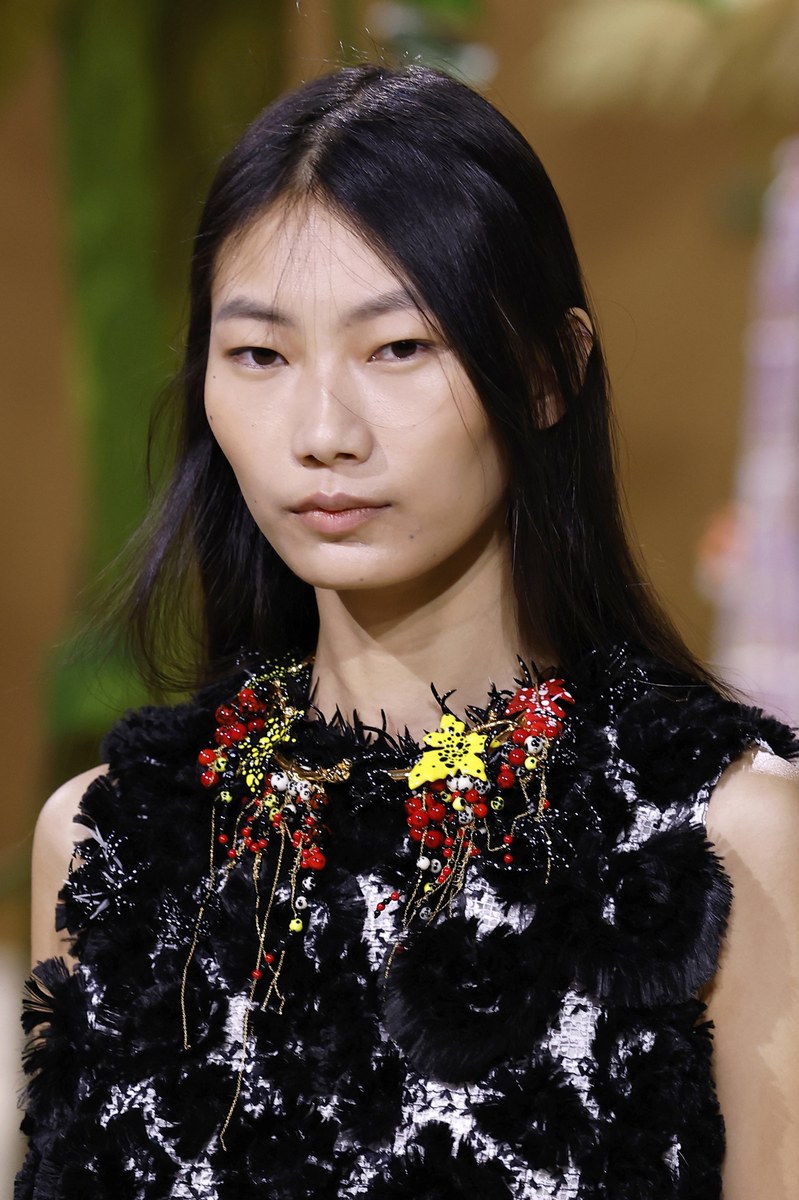
Tell the Truth FW26 Women Looks Report
Milan Fashion Week
Built on a deliberate collision of subcultural references, Tell the Truth FW26 pulls from biker, workwear, and early-2000s streetwear archives and resolves them into oversized, gender-fluid silhouettes with consistent commercial anchors. Right now, the market actively seeks product that reads unisex on the floor without sacrificing construction investment, and this collection lands squarely in that territory.
Silhouette and Volume
Extreme volume dominates the upper body throughout. Jackets balloon at the shoulder and taper minimally at the hem, sitting above or at the hip, while trousers drop low and pool wide at the ankle. Look 1 deploys a full-length fur-trimmed column that reads more editorial than floor-ready, but Looks 7, 15, and 19 prove that oversized-on-oversized proportions can work in wearable territory when fabrication stays controlled. A coherent buy around three to four key outerwear shapes becomes entirely feasible here.
Color Palette
Warm earth tones anchor everything: cognac tan (Looks 9, 11, 15), chocolate brown (Looks 10, 13, 18), and a distressed bronze that reads almost metallic in Look 20. Forest green runs through Looks 4, 5, 6, 7, and 11, functioning as a neutral connector across the collection. Burnt orange appears in Looks 1, 8, 14, and 17, preventing the palette from feeling too sombre. Look 16 delivers the singular bright moment, a yellow and white plaid coat over pink python-print trousers, signaling that pattern-mixing is possible without abandoning tonal logic.

Materials and Textures
Leather dominates, appearing in at least twelve looks and ranging from matte black (Looks 1, 3, 4) to a heavily distressed, almost crackled cognac finish (Looks 11, 15) to quilted diamond-stitch treatment in Look 12. Satin-finish nylon appears in Looks 8, 17, and 18, delivering volume without leather's weight penalty, which matters for both price architecture and international shipping. Most commercially transferable is the chunky black shag boot cover worn in Looks 1, 7, 12, and 15, built to slide over white flatform sneakers and functioning as a standalone accessory unit. Ribbed knit in forest green (Look 7) and an oversized turtleneck in the same tone (Look 6) provide a knitwear entry point that broadens buyer range options considerably.

Styling and Layering
Every look builds outward from a base of wide-leg trousers or, in women-coded looks, sheer tights with minimal bottom coverage, then adds at least two upper-body layers. Scarves appear in at least six looks, worn loose and looped rather than knotted, and consistently carry plaid or logo-tape detail, making them a high-margin accessory anchor. Footwear resolves almost universally in the same white flatform low-top sneaker, which standardizes the look across the collection and points to a clear hero SKU. A studded western belt recurs in Looks 3, 5, 6, 8, 10, and 14, acting as a waist anchor that also reads as a collectible piece for style directors building editorial pulls.
Look by Look Highlights
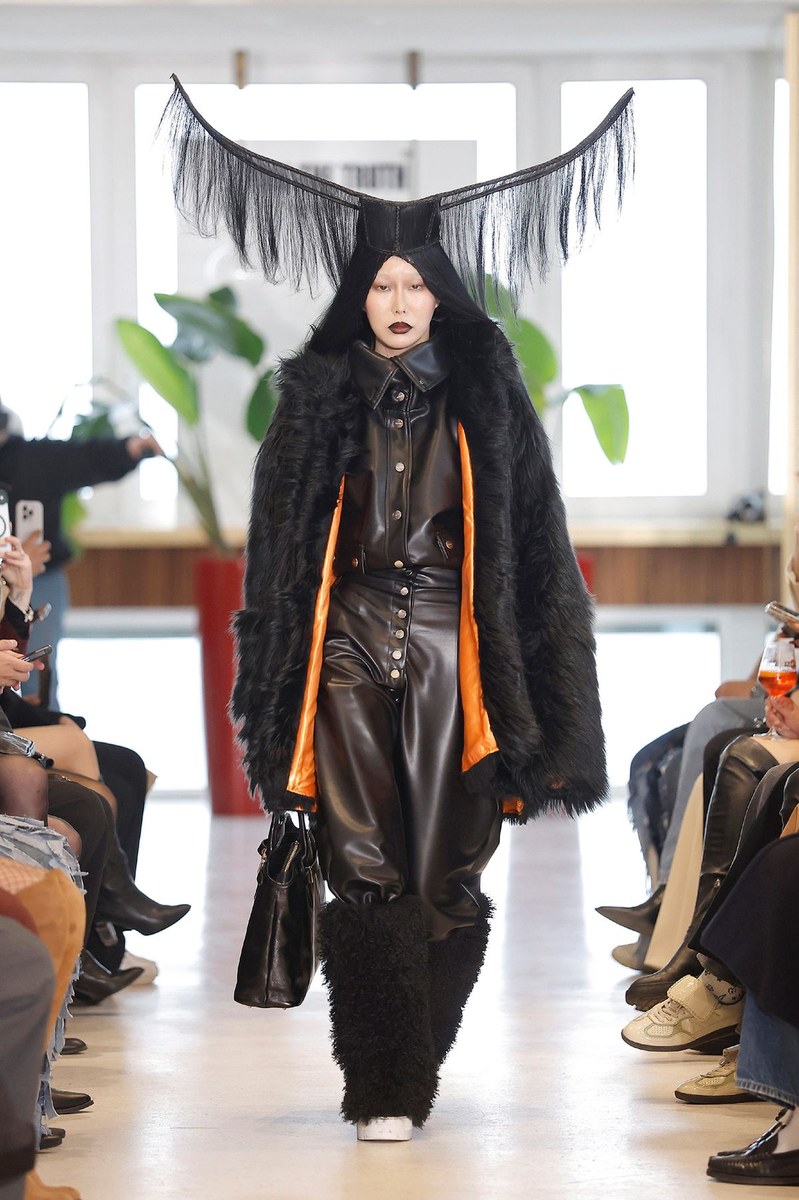
Look 1 Opens with maximum spectacle. A horned fringe headpiece pairs with a full-length black fur coat over a matte leather button-front suit, establishing the brand's willingness to lead with costume-level drama before grounding the rest of the collection in wearable separates.
Look 7 Delivers the clearest women's commercial argument, a head-to-toe forest green ribbed knit set with a crossover lapel jacket and cargo-pocket trousers, finished with black shag boot covers. It reads as a complete, buyable outfit with a single footwear SKU.

Look 12 Pairs the quilted cognac leather bomber, the strongest single outerwear piece in the collection, with forest green ribbed shorts, sheer black tights, and black shag boot covers, creating a proportion that works for editorial and breaks apart cleanly for multi-category buying.
Look 15 Presents the distressed cognac leather as a matched suit, blazer and wide-leg trousers in the same crackled finish, with black knit cuffs and the shag boot cover completing the look. It's the strongest candidate for a capsule anchor piece.

Look 16 Breaks from the tonal logic with a yellow, white, and black oversized plaid wool coat over pink snake-print trousers, signaling pattern-mixing capability that style directors can use for statement buys without committing to the full earth-tone aesthetic.

Look 18 Uses a color-blocked satin and leather bomber in white, brown, and red, with plaid lining at the collar and a studded belt cinching wide brown trousers. Among all the looks, this one translates most directly to a commercial retail environment.

Look 19 Closes the women's narrative cleanly with a white cropped overshirt trimmed in natural mink at the hood and cuffs, worn over white wide-leg trousers. It carries the strongest luxury signal of any look that does not rely on editorial styling to land its point.

Look 20 Sends the designer out in a gold, red, and black color-blocked leather varsity-style jacket over wide light-wash denim, confirming the brand's streetwear fluency and pointing to a commercial price entry that could sit alongside the leather-forward hero pieces.
Operational Insights
Outerwear architecture: A focused buy of three to four jacket silhouettes works here: the oversized bomber, the belted moto, the blazer-cut leather coat, and the boxy color-blocked satin hybrid. Each can carry a season without relying on full-look coordination.
Accessory margin opportunity: Black shag boot covers, studded western belts, and logo-tape plaid scarves each function as standalone units with strong margin potential and low production complexity relative to the leather outerwear, making them priority additions to any accessory buy.
Gender-neutral floor placement: With the exception of Looks 1, 12, and 19, every piece can be merchandised on a unisex floor without resizing or repositioning, which reduces SKU duplication and supports a streamlined buying strategy across men's and women's departments.
Fabric tiering: Satin nylon pieces (Looks 8, 17, 18) offer a lower-cost entry into the collection's volume silhouette without sacrificing visual impact. Prioritize these for markets where leather price points create accessibility barriers.
Footwear dependency: The white flatform low-top sneaker appears in nearly every look and acts as a visual reset that keeps the maximalist layering from reading as costume. Buyers coordinating with footwear departments should treat this silhouette as a companion SKU to drive sell-through on the wider apparel range.
Complete Collection


About the Designer
Rainy Womack grew up immersed in sport. Basketball and tennis occupied the center of his world from childhood, with fashion operating quietly in the margins: he helped his mother put together outfits, had an instinct for colour, noticed what people wore and why, but did not think of it as something he would ever build a life around. After high school he attended college in Scottsdale, Arizona, then transferred to Minnesota to pursue his real goal, a professional basketball career. He played with full commitment through his college years, but the NBA draft never came. The pivot that followed was not a gentle one. He had invested not just time but his entire sense of direction in the sport, and when it was over, he had to build from somewhere else entirely.
He launched Tell the Truth during the Covid pandemic, funding it with his own savings, with no formal design training and no industry contacts. The name came from who he was: the phrase stood for his beliefs, his experiences, and the refusal to present a version of himself that wasn't real. Working from Los Angeles, he taught himself cut-and-sew construction, sourced premium fabrics, and built a production model grounded in small batch runs and Italian artisan manufacturing. The brand found early traction through a combination of community roots and unexpected exposure. When his Paris Bag appeared on Netflix's Selling Sunset, a wider audience arrived without the brand having sought it. The pieces he made, structured and emotionally charged, attracted figures including Dove Cameron, Avril Lavigne, Jay Shetty, and members of Zendaya's family.
His reference points are as much cinematic and lunar as they are sartorial. The Blood Moon collection, which debuted at London Fashion Week in September 2024 in the underground Crypt of St Martin-in-the-Fields on Trafalgar Square, drew from the emotional effects of the moon on human psychology, from the relationship between environment and anxiety, between nature and creative output. By AW26 he had built enough runway to show the Raven Collection at Milan Fashion Week on the official calendar, his first Italian showing, with the collection adding the Verita Bag and the brand's debut footwear line. A portion of weekly earnings goes to supporting the homeless in Los Angeles. He describes the brand as being for people who want their clothes to say something, without having to shout.
"Being part of London Fashion Week is a monumental chapter for our brand. It is truly humbling to connect with a diverse audience in such a dynamic city."
"I wanted to provide timeless pieces crafted from the highest quality fabrics, so that customers cherish their purchases and recognize the value in each creation."
✦ This report was generated with AI — combining human editorial vision with Claude by Anthropic. Because the future of fashion intelligence is already here.