Time FW26 Women Looks Report
Paris Fashion Week
Time FW26 builds its entire proposition around layered volume and the deliberate tension between structured tailoring and unresolved, trailing fabric, treating incompleteness as a design principle rather than an accident. For buyers navigating a market where customers are moving away from fitted minimalism, this delivers a commercially legible version of that shift without sacrificing wearability.
Silhouette and Volume
An oversized, relaxed silhouette anchors the collection throughout, though the calibration shifts from piece to piece. Wide-leg trousers with deep pleats anchor the bottom half in Looks 1, 11, and 5, while cocoon coats and cape-like wraps dominate the outerwear in Looks 6 and 12. Cropped jackets paired with long skirts in Looks 4 and 16 introduce contrast proportions that give the eye a clear focal point. Nothing here is tight. Every garment allows for movement, and that consistency across 20 looks reads as a coherent brand position rather than a series of individual experiments.
Color Palette
Warm, earthy neutrals form the backbone: tobacco brown, khaki, oat, and off-white appear across at least twelve looks. Gray arrives in multiple weights, from pale dove in Look 9 to deep charcoal in Looks 2 and 8, providing cooler counterpoint to the warmth. Look 19 is the single most saturated moment, delivering a head-to-toe deep burgundy that reads as a deliberate punctuation mark. Powder blue in Look 7 and pale yellow in Looks 2 and 6 function as quiet, wearable accent notes rather than bold color statements.

Materials and Textures
Wool is the primary material language, appearing as bouclé tweed in Look 1, soft double-face in Looks 6 and 12, and a heavy plaid in Looks 8 and 17. Leather and leather-look fabrications carry real commercial weight here, moving from the sculptural brown trench in Look 14 to the black biker jacket in Look 11 and the shearling-trimmed aviator in Look 16. Faux fur appears in two distinct registers: a long, plush brown coat in Look 3 and a shorter, textured gray jacket in Look 10. A velvet gathered top in Look 15 introduces a softer, high-pile surface that contrasts well against the dense denim beneath it.

Styling and Layering
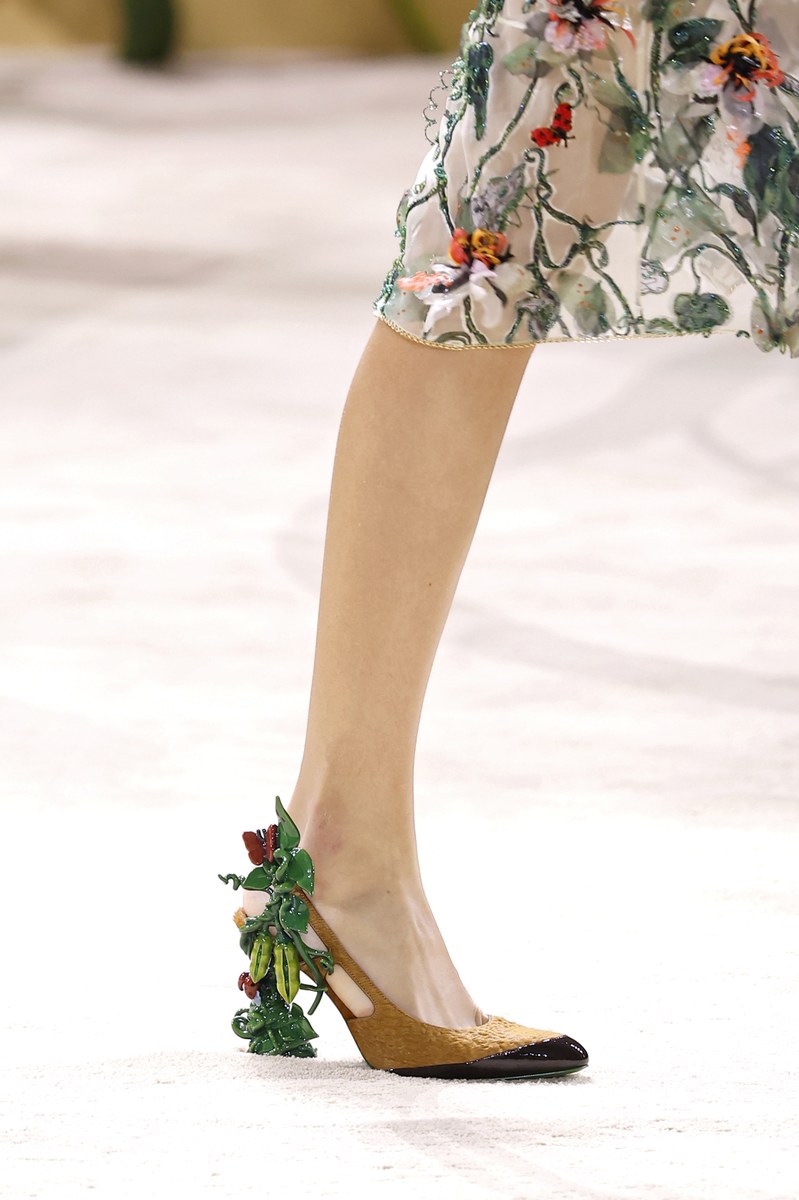
Garments layer in a way that suggests accumulation rather than coordination, building looks from a base turtleneck outward through shirt, jacket, and draped outer layer. The turtleneck, in white, ivory, or a contrasting accent color, functions as a recurring internal anchor across at least ten looks. Footwear splits between white block-heeled ankle boots, which appear in Looks 3, 10, and 20 and carry a strong retail signal, and low-heeled loafers or mules in teal and brown, which ground the more tailored looks. Bags are structured and architectural, with top-handle and flap silhouettes in dark brown, black, and burgundy leather appearing consistently enough to read as a coordinated accessories program.
Look by Look Highlights
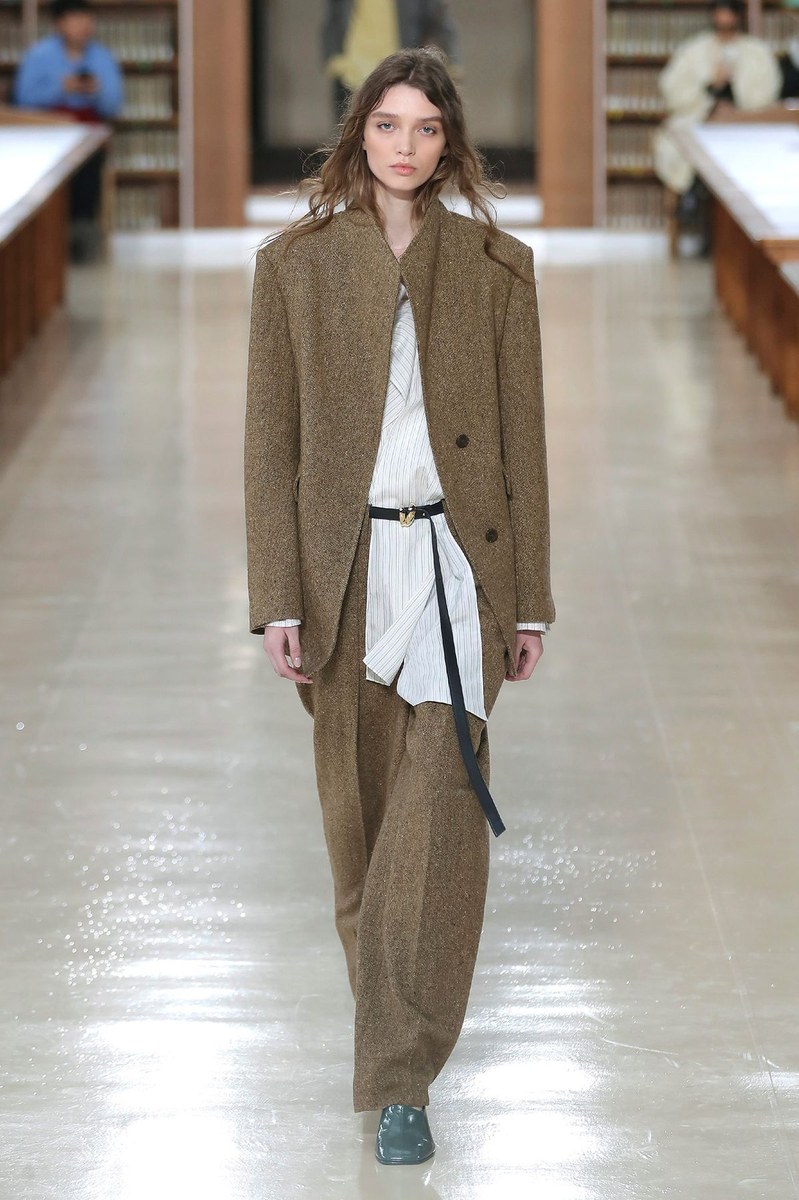
Look 1 The tobacco bouclé suit with a white striped shirt left deliberately untucked and cinched by a thin black belt with gold hardware is the clearest distillation of the collection's tailoring-versus-softness thesis, and it has strong sell-through potential as a separates buy.
Look 3 The long, plush brown faux-fur coat with contrasting tan lapels over a black dress and white turtleneck is the outerwear hero of the collection, with the two-tone collar construction offering a differentiating production detail at a mid-to-premium retail price point.

Look 6 A coat in ivory double-face wool with its wide, sculptural shawl collar that folds down over the shoulders creates an architectural silhouette that photographs exceptionally well, making it a strong candidate for editorial and campaign placement.

Look 14 The belted brown leather trench with a high-zip gray knit collar visible at the neck is a versatile outerwear piece that bridges the gap between softer and harder material signatures, and the belted waist gives it commercial accessibility that the more draped looks lack.

Look 17 The brown plaid double-breasted coat dress belted with a slim black hardware belt is the most directly wearable look in the collection, requiring minimal styling effort from the customer and translating cleanly across multiple retail contexts.

Look 19 An all-burgundy tonal look combining a heavy ribbed turtleneck sweater with a wrapped scarf detail and a paneled leather midi skirt is the collection's strongest color story and the piece most likely to perform as a statement buy for style directors building a focused autumn floor set.

Look 11 The black leather oversized bomber layered over a gray double-breasted blazer and ivory wide-leg trousers executes the layering logic of the collection in its most commercially direct form, with each component workable as a standalone buy.

Look 16 Black leather aviator jacket with shearling collar and cuffs worn over a brown draped midi skirt and white shirt cuff introduces an irreverent luxury tension that positions well for buyers targeting a fashion-forward customer who still wants recognizable outerwear codes.

Operational Insights
Outerwear depth: At least eight distinct outerwear silhouettes span faux fur, leather, wool tweed, plaid coating, and double-face wool, giving buyers the range to build a full autumn outerwear assortment from a single brand with a coherent visual identity.
Separates strategy: Wide-leg trousers paired consistently with oversized jackets and coats, visible in Looks 1, 2, 11, and 13, signal that these are intended as buyable separates rather than look-specific pairings, which supports a higher average transaction value on the retail floor.
Color blocking by zone: Two distinct clusters emerge: one warm in brown and khaki, another cool in gray and black, with ivory bridging both. Product managers can build two separate floor zones from this palette without the assortment reading as fragmented.
Accessories as a parallel revenue stream: Structured bags in Looks 2, 7, 8, 11, and 17 carry enough design consistency across silhouette and hardware to suggest a coherent accessories program worth evaluating for standalone buying, particularly the saddle-adjacent flap bags in burgundy and dark brown.
White footwear as a trend signal: The recurring white block-heeled ankle boot in Looks 3, 10, and 20 is a deliberate styling choice that aligns with a broader market movement toward pale footwear as a statement contrast piece, and style directors should factor this into footwear assortment planning for the autumn floor.
Complete Collection


Fashion Designer

About the Designer
Choi Jung In is one of the few women leading creative direction at a major Korean fashion house, a distinction that carries weight in an industry where such positions remain rare. She works within a studio system, which means her vision operates collectively, yet it is her sensibility that anchors Time's aesthetic and the language with which the brand communicates. Little of her personal biography has been made public, which is itself consistent with a design philosophy rooted in restraint and in letting the clothes speak rather than the designer.
Time was founded in Seoul in 1993 and spent three decades building its position as one of Korea's most commercially significant womenswear brands, backed by Handsome Corp., a subsidiary of the Hyundai Department Store Group. Under Choi's creative direction, the brand has made a deliberate pivot toward the international market, debuting at Paris Fashion Week in 2024 with a collection that drew on 1990s minimalism, precise tailoring, and the kind of considered femininity associated with the brand's thirty-year conversation with Korean women. References have included David Lynch's Lost Highway and the particular quality of Patricia Arquette's presence in that film, signaling an interest in cinema's way of constructing an ideal rather than following the industry's seasonal rhythm.
Her stated design philosophy resists novelty for its own sake. She is interested in accumulation rather than disruption, in the idea that a brand's value is built like sediment over time, and in clothes that respect the actual life of the person wearing them. Choi Jung In is currently creative director of Time, which opened its first European retail space at the Samaritaine in Paris in late 2025 and continues to show on the official Paris Fashion Week calendar.
"Newness doesn't come from something grand or external, but from the moment you recognize your value, knowing your worth. Fashion, therefore, should be a thoughtful proposal that respects the life of the person who wears it."
"A brand's heritage and identity must be firmly grounded, like sand compacted over time. True strength lies in what remains consistent through change."
✦ This report was generated with AI — combining human editorial vision with Claude by Anthropic. Because the future of fashion intelligence is already here.