Tod's FW26 Women Looks Report
Milan Fashion Week
Tod's FW26 builds its identity around structured outerwear, leather as a primary fabric rather than an accent, and a color story that runs from raw cream through dark chocolate without ever reaching black as a finale. For buyers navigating a market where luxury casualwear has peaked and clients are returning to considered investment dressing, this arrives with clear commercial logic and strong repeat-category potential.
Silhouette and Volume
A mid-length, broad-shouldered silhouette that tapers at the waist through narrow belts or internal seaming dominates across Looks 1, 3, and 5. Capes and ponchos in Looks 6 and 8 introduce a second volume language, geometric and self-supporting, folding into sharp diagonal points at the center front. Trouser legs are consistently wide and floor-grazing in the tailored looks, while Looks 2 and 4 rely on draped asymmetry and wrapped edges rather than cut. Nothing reads as body-conscious.
Color Palette
Dark chocolate brown, raw ecru, charcoal, and warm mustard ochre anchor the palette, recurring across garment categories rather than being assigned to specific looks. Look 10 and Look 16 pair mustard directly against dark brown and black, a combination that reads as utilitarian but lands as intentional. Yellow breaks through in Look 12 as a high-impact lacquered leather coat, the single chromatic outlier in the collection, which makes it both the most photographed piece and the most difficult to translate into volume buying. An autumnal and grounded mood prevails here, positioned squarely in the earth register that the luxury market has absorbed for several seasons without abandoning.

Materials and Textures
Leather defines the collection, appearing not as trim or detail but as full garments in Looks 11, 12, 13, 16, and the mixed-panel dresses of Looks 2 and 4. Weight varies from a stiff lacquered shell in Look 12 to a softer, perforated surface in Looks 11 and 13 that reads closer to a heavy woven. Wool splits between chunky hand-knit turtlenecks in Looks 7, 9, 15, and 17, and structured coating fabric in Looks 1, 3, 6, and 8. Look 18 stands alone as a textural exception, a patched shearling coat in black and ivory curls that carries the highest tactile complexity of any piece in the collection.

Styling and Layering
A turtleneck or fitted shirt acts as the base, a knitwear mid-layer adds weight, and outerwear closes the look without hiding the layers beneath at the sleeve or collar. Gloves appear in Looks 6 and 8 as structural accessories rather than afterthoughts, in heavy black leather that matches the boot shaft. Knee-high boots in black or dark chocolate leather run through approximately half the looks and anchor the collection's footwear identity firmly within Tod's core competency. Wood-bangle bracelets and small belted bags carried in hand, visible across Looks 2, 4, 7, 9, and 17, signal that accessories are being treated as part of the compositional logic rather than commercial add-ons.
Look by Look Highlights
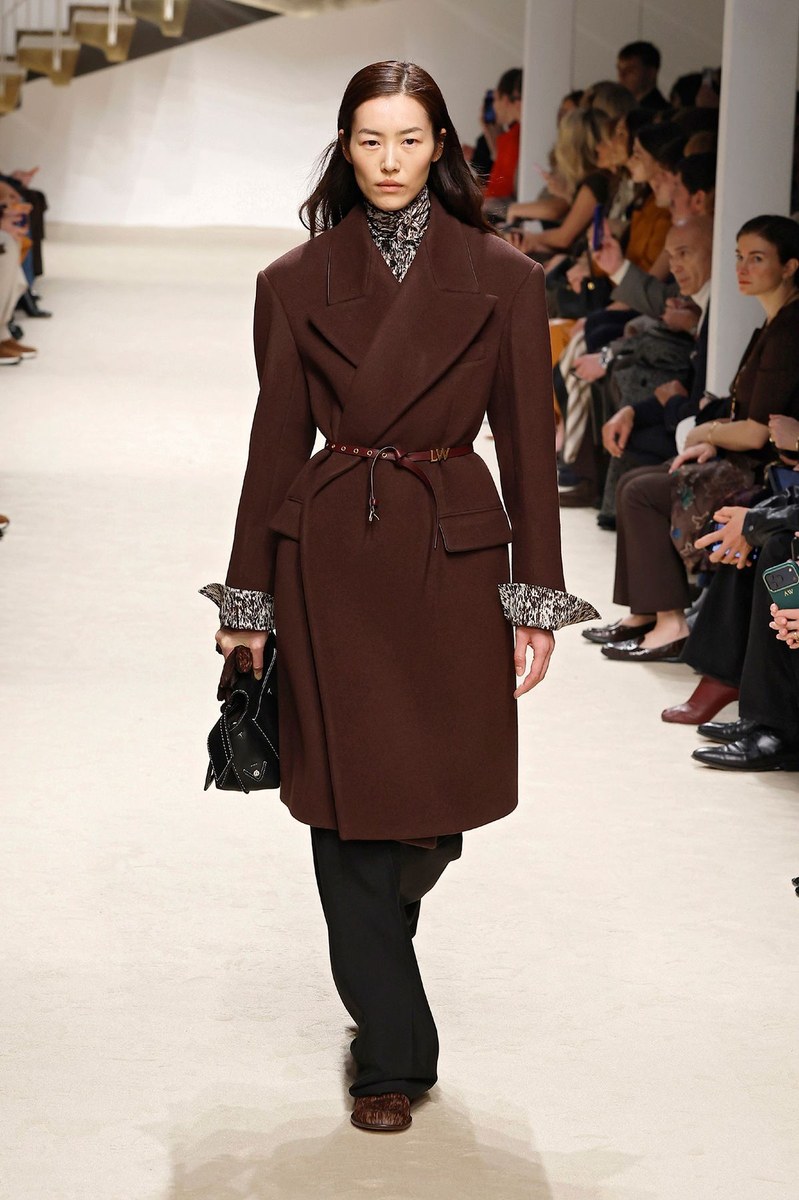
Look 1 Dark chocolate double-faced wool coat with a thin burgundy belt and printed cuff extension makes the case for tonal dressing with a single point of contrast, a strong reorder candidate for coat-heavy markets.

Look 3 Charcoal flecked tweed in the same coat silhouette with white contrast cuffs and an MCM-style logo belt establishes that the house intends this shape as a seasonal signature across fabrications.

Look 6 All-black structured wool poncho with a sharp geometric point at center front, worn over a midi dress with leather gloves and a bucket bag, is the most architecturally resolved look in the collection and the strongest argument for cape outerwear as a category.

Look 8 Ivory version of Look 6 shifts the poncho from severity to quiet authority and will read more broadly across commercial markets than its black counterpart.

Look 12 Oversized yellow lacquered leather cape coat with zipper closure and extreme draping is a calculated editorial statement that will drive press coverage but requires careful positioning and a committed buying strategy given its volume and color intensity.
Look 13 Perforated black leather tunic dress over full-length leather leggings with a yellow glove carried in hand represents the most directional leather-on-leather proposition in the collection and targets a narrow but high-spending client segment.

Look 18 Patched curly shearling in black and ivory worn over a cream cable knit with dark trousers and loafers is the collection's most tactile and likely most commercially transferable statement coat for colder-climate markets.

Look 19 Black power suit with wide peak lapels, a printed scarf at the neck, and a patterned waistcoat underneath mirrors Look 5 in its tailoring architecture and confirms that Tod's is building a suit offer across genders with genuine volume potential.

Operational Insights
Coat as hero category: The belted wrap coat in Looks 1 and 3 reads as the collection's most commercially scalable piece. Buyers should plan two-fabric minimum buys, one in a solid wool and one in a textured or bouclé weave, to capture the full breadth of the client base without over-indexing on one fabrication.
Leather investment: Full-garment leather constructions appear across at least seven looks. Assessment of current leather allocation is essential here, with consideration given to shifting budget from leather accessories into leather ready-to-wear, where the margin potential is higher and the differentiation from competitor assortments is stronger.
Cape and poncho risk management: The geometric ponchos in Looks 6 and 8 will photograph well and drive traffic, but the silhouette requires fit education at retail. Style directors should brief floor teams specifically on how to style and present the pieces to clients unfamiliar with wearing structured volume at the shoulder.
Color strategy for yellow: Look 12 and the yellow glove in Look 13 position yellow as an accent color the brand controls deliberately. Product managers should consider pulling the yellow into accessories, specifically gloves and small leather goods, rather than committing to full-coat production in that colorway unless their market has demonstrated appetite for statement outerwear.
Layering as a retail narrative: Consistent base-mid-outer layering logic across Looks 10, 15, 16, and 17 gives style directors a clear visual merchandising framework. Displaying the knitwear, shirt, and coat together as a curated stack rather than separating them by category will increase units-per-transaction and communicate the collection's sensibility more effectively than single-item presentation.
Complete Collection


About the Designer
Matteo Tamburini was born in 1982 in Urbino, the ancient hilltop city in the Marche region of central Italy, and grew up in nearby Pesaro. His parents ran a theatrical costume atelier, and he spent his childhood inside it, watching fabric become character, seeing how a garment could carry a story before anyone had spoken a line. The experience was formative in a specific way: it taught him that clothes are not surfaces but constructions that carry meaning, and that the making itself is where that meaning takes shape. He pursued an artistic education, moving from liceo artistico into fashion and design studies, and entered the industry in the mid-2000s, accumulating experience across houses of very different registers.
The decisive turn came in 2011, when he began working with designer Marco Zanini, first at Rochas in Milan and then at Schiaparelli in Paris. Those four years gave him his foundation in womenswear, in the language of construction and silhouette that French couture culture prizes above surface. He went on to Emilio Pucci in Florence for three years, working on ready-to-wear and accessories, and then in 2017 joined Bottega Veneta in Milan as head designer of leather garments, outerwear, and men's and women's tailoring. He worked through three successive creative directors there: Tomas Maier, Daniel Lee, and Matthieu Blazy. Each spoke a different design language, and Tamburini absorbed all three without flattening into any of them. The leather work he did at Bottega was not incidental preparation for Tod's. It was the exact skill set the job required.
He was appointed creative director of Tod's in late 2023, debuting his first collection at Milan Fashion Week in February 2024 in the main depot of the city's historic tram system, an opening gesture that signalled both movement and rootedness. For his AW25 collection he worked from the history of the Padiglione d'Arte Contemporanea, a Milan museum destroyed by a Mafia bombing in 1993 and rebuilt, drawing on the Italian painters Lucio Fontana, Alberto Burri, and Carla Accardi as a way of thinking about resilience and continuity. Tod's, a brand from the same Marche region where he grew up, is the most autobiographical job of his career. His parents wore its shoes for special occasions.
"I grew up in an atelier where my mother created theatrical costumes. I learned how clothes can actually create a character, how they can tell a story beyond mere fabric and stitching."
"Keeping an eye on the past, and at the same time trying to build something new."
✦ This report was generated with AI — combining human editorial vision with Claude by Anthropic. Because the future of fashion intelligence is already here.