Toga FW26 Women Looks Report

Toga FW26 Women Looks Report
Toga FW26 Women Looks Report

London Fashion Week

Toga FW26 deconstructs the wardrobe itself, treating garments as raw material to be layered, knotted, wrapped and pinned into new configurations rather than worn in their intended form. For buyers, this approach signals a commercial pivot point where investment pieces must carry enough construction complexity to justify full-price positioning in a market increasingly skeptical of minimalism.

Silhouette and Volume

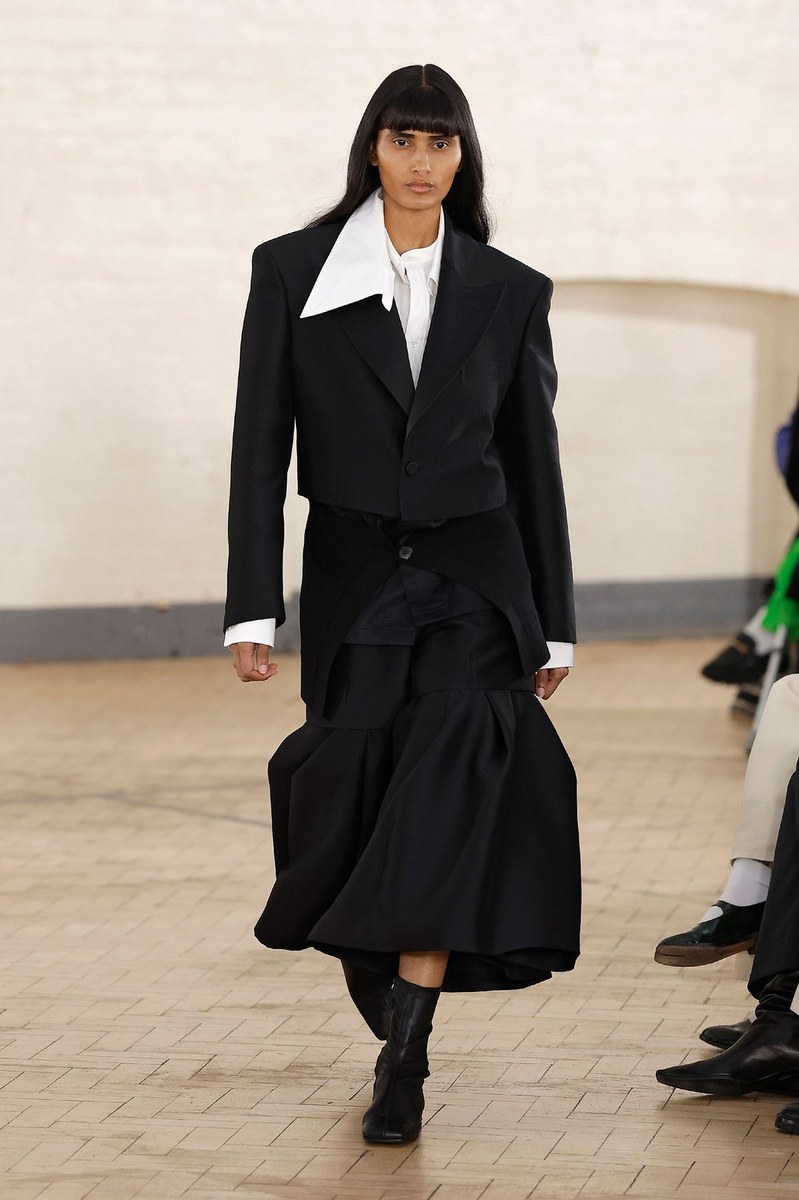
Two dominant shapes run through the collection simultaneously. Extreme volume pools at the hem in Look 1, where a cropped black blazer sits above a dramatically gathered wool skirt that expands toward the floor. Look 11 counters with a long, lean black sparkle coat that flattens and elongates the body to near-architectural severity. Wide-leg trousers anchor the bottom half of most tailored looks, carrying mass below the hip in Look 10, Look 16 and Look 19. Wrapped and knotted midriff constructions, particularly in Looks 3, 9 and 10, interrupt the waistline entirely and create a stacked horizontal volume that reads as a third silhouette category on its own.
Look 1
Look 1

Color Palette

Black and off-white form the collection's spine, appearing in near-equal measure across suiting, knitwear and shirting. Camel and tobacco brown move through the fur-adjacent pieces in Looks 4, 14, 17 and 18, creating a warm secondary palette that reads as deliberately vintage without tipping into costume. Cobalt blue and periwinkle appear as deliberate injections of color in Looks 9, 10 and 16, always used as an accent layer rather than a base. This keeps the mood controlled and edited. Rust-orange plaid in Look 17 and amber leopard-spot mohair in Look 14 act as single-look statements rather than recurring threads.

Look 17
Look 17

Materials and Textures

Wool suiting carries the structural looks, appearing in tailored-weight iterations in Looks 1, 3, 11 and 15 with a surface that holds shape without stiffness. Faux fur and mohair-blend fabrics supply the tactile contrast, ranging from the cropped brown faux fur jacket in Look 4 to the spotted shaggy mohair coat in Look 14 that moves heavily on the body and creates significant visual mass. Cotton shirting in pale blue and white serves as the layering base in multiple looks, cut with oversized pointed collars that remain visible even when buried under outerwear. Sheer organza panels trail through Look 19, adding a weightless counterpoint to the denim and structured knitwear sitting above them.

Look 4
Look 4

Styling and Layering

Garments function as accessories throughout. Shirt collars emerge from beneath blazers, blazer panels wrap around the waist as sashes, and knotted obi-style bands constructed from jacket bodies appear in Looks 2, 3 and 10 as the primary waist definition device. Footwear stays functional and grounded, with black leather ankle boots, lace-up combat styles and square-toed heeled boots appearing across both the womenswear and gender-neutral looks, never competing with the complexity above. Structured tote bags in canvas, patent leather and graphic-printed resin panels recur consistently enough to read as a serious accessory commercial category within the collection.

Look by Look Highlights

Look 1 establishes the collection's tonal rigor immediately, pairing a structured black peak-lapel crop blazer with a voluminous floor-grazing black gathered skirt that creates the season's most dramatic hem silhouette.

Look 3 presents the monochromatic charcoal grey layering argument most clearly, with a cropped boxy jacket over a polo shirt anchored by a knotted obi waistband and paired with wide-leg trousers, all in near-identical grey tones.

Look 3
Look 3

Look 9 delivers the collection's most complex construction, stacking a grey tailored top over a navy double-breasted panel, a periwinkle blue collar-tied sash and a white pleated hem that falls in three separate fabric layers.

Look 9
Look 9

Look 14 is the single strongest outerwear commercial piece, a tobacco orange shaggy mohair coat with black spot markings and a separate cropped jacket layer worn over it, pinned at the chest with a large oval brooch.

Look 14
Look 14

Look 15 addresses the gender-neutral tailoring market directly with a bold brown and navy oversized plaid blazer worn over a matching plaid kilt length skirt, a white shirt and a black leather structured bucket bag.

Look 15
Look 15

Look 16 pairs a fitted black turtleneck with wide-leg black tailored trousers and a cross-strap leather belt system with cobalt blue feather trim at the hip, demonstrating how a single accessory can reframe an otherwise straightforward base.

Look 16
Look 16

Look 19 is the womenswear commercial peak, combining raw denim wide-leg trousers with a black knit vest, layered white shirting that knots at the shoulder and trails in sheer black organza panels, all anchored by a red embroidered patch detail.

Look 19
Look 19

Look 8 reads as the strongest lifestyle entry point for contemporary accounts, built on a simple camel fitted long-sleeve knit with white shaggy faux fur cuff extensions, a cross-belt harness and ivory wide-leg trousers, with a red floral-print structured bag as the color note.

Look 8
Look 8

Operational Insights

Outerwear assortment: Buyers should prioritize Look 14 and Look 18 as the two strongest standalone outerwear buys, both in camel-range faux fur or mohair-blend fabrications with enough volume and texture to carry a floor display independently.

Obi and wrap belt program: The knotted waistband construction appearing in Looks 2, 3 and 10 is production-ready as a separates accessory category, and style directors should evaluate it as an add-on SKU that can reactivate existing shirting and blazer inventory.

Tote bag category: Structured canvas and resin-panel totes carried across Looks 3, 10, 12, 13 and 16 represent a high-visibility accessories program with strong gifting and entry-price potential for accounts that cannot commit to full look builds.

Plaid allocation: Brown and navy plaid in Look 15 and Look 17 is a fabric story with clear multi-category application across suiting, skirts and outerwear, and product managers should request yardage options early given the expected demand for heritage check across Fall 26 markets.

Footwear compatibility: The entire collection resolves onto black leather ankle and knee boots with square or block heels, which aligns with what mid-tier and premium retailers are already projecting for Fall 26 footwear, making cross-department buy-ins with existing footwear vendors straightforward.

Complete Collection

Look 2
Look 2
Look 5
Look 5
Look 6
Look 6
Look 7
Look 7
Look 10
Look 10
Look 11
Look 11
Look 12
Look 12
Look 13
Look 13
Look 18
Look 18
Look 20
Look 20
Look 21
Look 21
Look 22
Look 22
Look 23
Look 23
Look 24
Look 24
Look 25
Look 25
Look 26
Look 26
Look 27
Look 27
Look 28
Look 28
Look 29
Look 29
Look 30
Look 30
Look 31
Look 31
Look 32
Look 32
Look 33
Look 33
Look 34
Look 34
Look 35
Look 35
Look 36
Look 36
Look 37
Look 37
Look 38
Look 38
Look 39
Look 39

About the Designer

Yasuko Furuta discovered fashion at eight years old when her mother complimented her outfit choice, setting the course for a lifelong calling. Growing up in Gifu, a small city between Tokyo and Kyoto, she learned traditional techniques from her grandmother who made kimonos for a living, spending hours watching her tailor and creating doll-sized versions from fabric scraps. This early exposure to draping and the careful marriage of materials would later inform her signature hybrid aesthetic.

Before fully committing to fashion, Furuta briefly worked as a pattern cutter at Comme des Garçons after returning from Paris, but found the studio culture oppressive rather than inspiring. Her true education came at ESMOD, first in Tokyo and then in Paris, where she encountered an entirely different world that forced her to confront her Japanese identity. Surrounded by "sharp-edged kids" with strong personalities, she initially struggled to connect but eventually formed lasting friendships. The exposure to Vivienne Westwood's cultural background and visits to Comme des Garçons' flagship store sparked her interest in creating clothes that challenged conventions rather than simply pursuing beauty.

Her aesthetic draws from this fundamental tension between opposites. She cites the contrast between Japanese fashion's tendency to conceal and stoke imagination, versus European fashion's direct visual appeal, seeking to balance both approaches. Her work combines Western subcultural elements with refined femininity, incorporating clever cutouts, textural clashes, and deconstructed silhouettes that blur traditional gender boundaries. The name TOGA itself references both Roman drapery and sacred Japanese clothing, embodying her philosophy of creating something new from contrasting origins.

Since establishing TOGA in Tokyo in 1997, Furuta has built the label from a solo venture into a team of over 50, presenting collections in Paris from 2005 and London from 2014. Her accomplishments include the prestigious ANDAM Award in 2007 and the Mainichi Fashion Grand Prize in 2009. Today, she operates more than 30 boutiques worldwide while maintaining her headquarters in Tokyo's Shibuya district.

"The world is composed of opposites. I want to make clothes that do not always represent beauty and happiness. Perhaps it is because I am looking for a new perspective that appears when two opposites meet."

"In Japan, fashion is sometimes used to conceal and stoke the other's imagination. In Europe, fashion is an expression that appeals directly to the eye. I'm interested in both and want to strike a balance between the two."

✦ This report was generated with AI — combining human editorial vision with Claude by Anthropic. Because the future of fashion intelligence is already here.