Tokyo James FW26 Bags
Tokyo James FW26 Bags Report
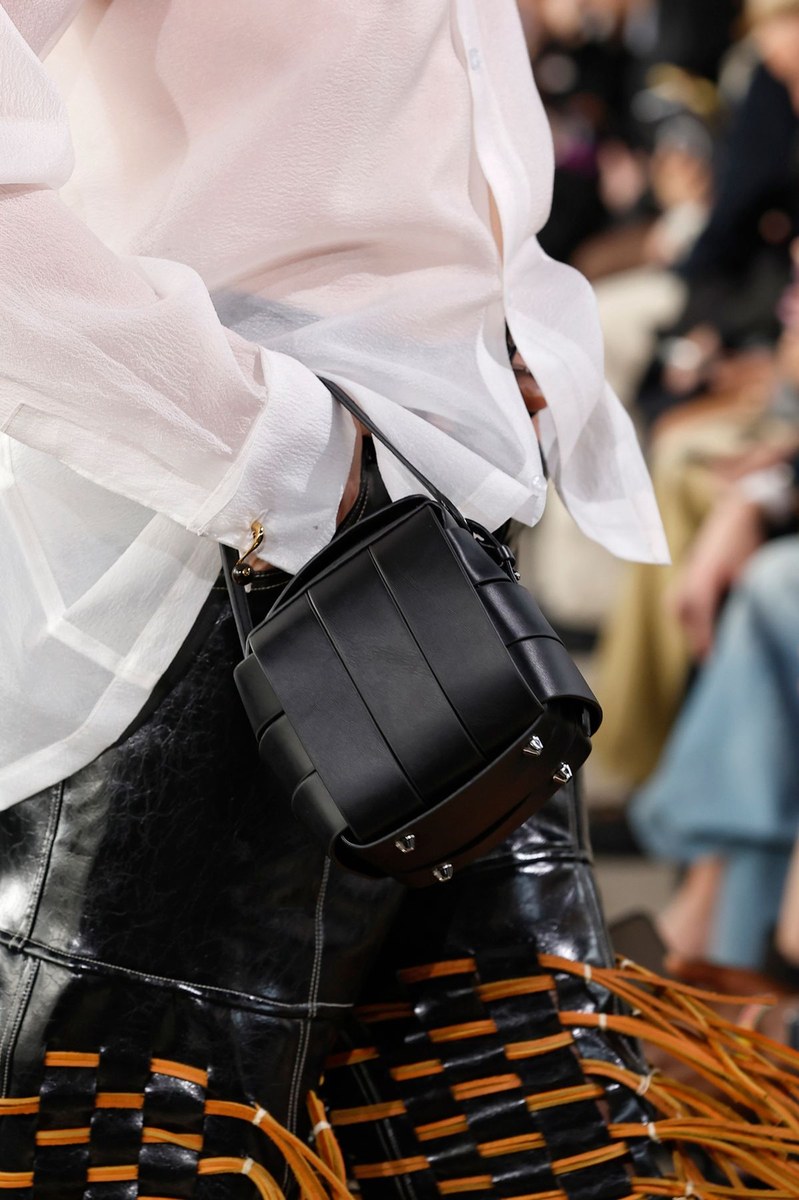
Tokyo James built his FW26 accessories range around a single recurring silhouette: a compact, boxy barrel-bucket hybrid constructed from woven and paneled leather strips held together with exposed corner hardware studs. For buyers and product managers, this signals a deliberate pivot toward structured micro-bags with an architectural construction story, a category that continues to outperform at the mid-to-luxury independent label tier.
Silhouettes and Shapes
Every bag in this collection occupies the micro to mini size category, sitting comfortably in one hand or worn on a short single-top handle at hip or wrist level. The dominant silhouette is a squat cylindrical-box hybrid, wider than it is tall, with a rounded base and rigid paneled walls. There are no slouchy or unstructured options here. What emerges is a tight capsule built around one core shape executed in multiple colorways and materials rather than multiple silhouettes.
Materials and Hardware
Bags 1, 3, 4, and 5 use smooth full-grain leather cut into wide horizontal and vertical strips, assembled in a basket-weave or grid-panel construction that creates a three-dimensional surface texture without embossing or tooling. Bag 2 and Bag 6 use crinkled metallic gold leather, likely a foil-coated lambskin or nappa, which adds a second material story to the range. Hardware across Bags 1, 3, and 4 consists of polished silver dome studs at the base corners and a circular ring buckle at the strap attachment point. Bag 5 introduces a contrasting two-tone leather construction pairing warm camel panels with off-white strips and a tan strap, pointing to a color-blocked hardware-free surface variation.

Color Direction
The palette divides cleanly into two groups. Tonal neutrals anchor the first: matte black (Bag 1), bright optical white (Bag 4), and warm cognac tan (Bag 3) will all function as core carry-over SKUs season to season. Metallic gold appears in Bags 2 and 6, a high-gloss statement finish that positions those units as occasion or gifting pieces rather than everyday carry. Only Bag 5 ventures into multi-tone territory, combining off-white and camel, which broadens the collection's commercial range without requiring an entirely new silhouette.

Key Models and Details
The hero model is the woven barrel-box bag, seen most clearly in Bags 1, 3, and 4. It closes with a single flat leather strap that threads through a circular ring buckle, a clean and minimal closure system that avoids logos entirely and keeps the construction itself as the design statement. The strap is a short single top-handle format, too short for shoulder wear, which locks the bag into a handheld or wrist-carry position. At each base corner, exposed silver dome studs function as structural feet and as a decorative signature that a production team could use as a brand identifier across future seasonal variations.
Bag by Bag Highlights
Bag 1 The matte black version of the woven barrel-box in what appears to be smooth calf leather with polished silver corner studs is the clearest commercial anchor for a department store buy, as the colorway neutralizes the structural novelty for a broader customer.
Bag 2 The mini crinkled gold metallic version held front-facing against the pearl-embellished look reads as an occasion clutch alternative, with a buckle-front flap closure that differentiates its construction from the open-top barrel bodies in the rest of the range.
Bag 3 The cognac tan woven barrel-box, carried by the ring-buckle top handle in polished silver, is the strongest candidate for a core buy given its versatility across both casual and dressed contexts.

Bag 4 The white leather version against the gray suede look demonstrates that the silhouette holds at full-grain smooth leather without the woven surface treatment, which signals a simplified production variation that could reduce per-unit cost without losing the silhouette's identity.

Bag 5 The color-blocked camel and off-white version, gripped through the open strap as a knuckle-duster style carry, is the most editorial unit and the most difficult to convert commercially but the most valuable for press and window display investment.

Bag 6 The larger crinkled gold metallic version worn on the wrist at chest height against the same pearl look as Bag 2 confirms the metallic style ships in at least two sizes, which gives buyers a size-run option for a gifting or holiday drop.

Operational Insights
Silhouette exclusivity: The single-shape strategy makes this a tight, covetable capsule but limits SKU depth. Buyers should negotiate for a minimum of three colorways per door to give the capsule visual range on shelf without fragmenting the story.
Construction complexity: The woven leather panel construction requires precise cutting and consistent panel width to maintain the grid pattern. Product managers should request a factory quality control report and inspect sample stitching at the panel joins before committing to full production volume.
Hardware as brand signature: The dome stud corner hardware and circular ring buckle appear consistently across the woven styles. Accessories directors should secure these as proprietary components in any co-development or exclusive colorway conversation with the brand.
Size tiering: The presence of at least two sizes in the metallic gold style (Bags 2 and 6) suggests a size architecture exists within the range. Buyers should confirm whether the woven styles also ship in a larger size, as a two-size offering significantly improves the average transaction value at point of sale.
Colorway sequencing: The neutral trio of black, white, and cognac should anchor the initial buy, with metallic gold positioned as a smaller-quantity impact order. The color-blocked camel and white unit warrants a minimal test buy to measure editorial response before any reorder commitment.
✦ This report was generated with AI — combining human editorial vision with Claude by Anthropic. Because the future of fashion intelligence is already here.