Tolu Coker FW26 Women Looks Report
London Fashion Week
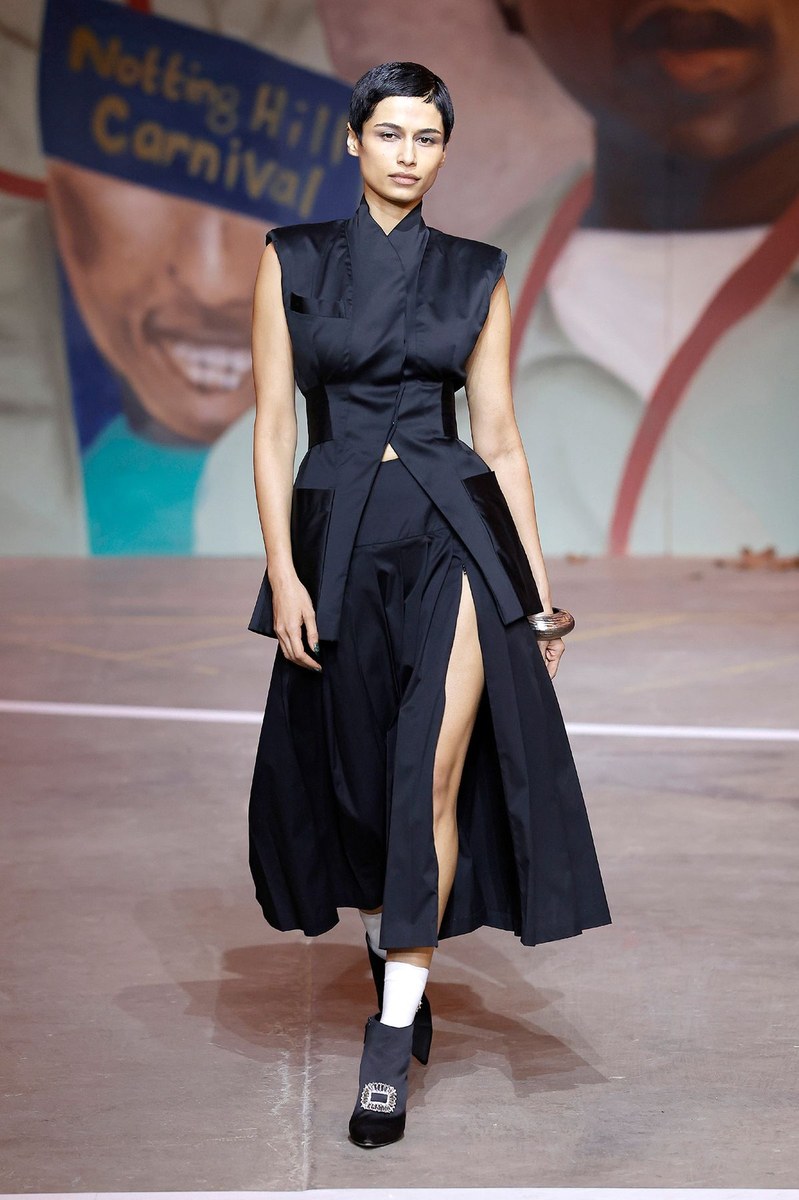
Tolu Coker anchors this collection in the visual and cultural memory of the Notting Hill Carnival, channeling its raw energy into structured, body-conscious tailoring played against full, swinging volumes. Buyers will recognize the timing immediately. The market is primed for culturally rooted product with genuine point of view, and this collection delivers exactly that without veering into costume or pastiche.
Silhouette and Volume
The silhouettes work in two distinct directions. Fitted corset-structured bodices with sharp, padded shoulders drive Looks 1 and 16, anchoring the upper body. Full pleated skirts, tiered ruffles, and wide-leg trousers create dramatic lower-body volume in Looks 5, 7, 9, and 19. Midi and maxi lengths dominate outerwear and skirt proportions, while cropped and boxy jackets in Looks 2 and 6 pull focus upward and prevent silhouettes from reading as purely retro.
Color Palette
Black opens strong across Looks 1, 2, and 3, establishing a sober, commercial anchor. From there, the palette splinters into saturated single-color stories: fire-engine red in Looks 5, 6, and 10, cobalt blue in Looks 12, 13, and 17, and chartreuse yellow-green in Look 19. Burgundy and chocolate brown appear in Looks 4 and 9, grounding the warmer end of the spectrum. Look 18 features a yellow-and-indigo denim pairing that stands as the collection's most striking color clash and its most direct nod to carnival vibrancy.

Materials and Textures
Cotton poplin carries significant weight throughout, appearing in crisp shirt-dresses and blouses in Looks 12 and 17 with enough body to hold pleats and structure without stiffening. Wool-blend suiting cloth gives Look 16 its houndstooth density and Look 7 its clean grey peplum geometry. Raw-edge denim, used in both dark indigo and blush rose-tan in Looks 8, 14, and 18, features visible contrast topstitching that reads as deliberate construction detail rather than casual workwear borrowing. A lightweight taffeta-adjacent fabric in the tiered skirt of Look 9 catches movement beautifully, while the burgundy leather-look coat layered over it adds surface contrast and commercial weight to the outfit.

Styling and Layering
White ankle socks worn with pointed-toe heels, logo mules, or strappy kitten heels appear across nearly every look and function as the collection's most consistent styling signature. They signal generational, subcultural reference without disrupting the tailoring and will translate directly into accessories buying decisions. Neckwear is architectural: oversized ties in Look 5 and Look 12, bow details in Look 3, and a knotted shirt-as-tie in Look 9 all treat the neck as a focal point for print or contrast fabric. Large silver cuff bracelets in Looks 1, 3, and 13 and gold bangles in Looks 10 and 19 add weight and ceremony without overloading the silhouette.

Look by Look Highlights
Look 1 The black satin wrap-structured gown with padded shoulders and a high front slit establishes the collection's tension between formal tailoring and sensual exposure, making it a strong candidate for eveningwear buying.

Look 5 A saturated red cotton poplin shirt paired with a kaleidoscopic plaid midi skirt and matching plaid neck-tie delivers the collection's loudest print story and its clearest reference to carnival color.
Look 7 Slate grey strapless peplum top with a dramatic fluted hem over wide-leg trousers is structurally precise and commercially versatile, sitting equally at home in occasion-wear and premium separates categories.

Look 10 An all-orange cotton off-shoulder top with origami-folded collar panels and wide-leg trousers in the same fabric creates a monochromatic statement that photographs powerfully and requires minimal styling effort from end consumers.

Look 13 A cobalt blue houndstooth halter-neck maxi dress with a balloon-hem skirt and subtle waist cutouts combines print, volume, and skin exposure in a single garment that competes directly with the occasion-dress market.

Look 16 Navy houndstooth double-breasted blazer dress with sculpted bust seaming and strong shoulders reads as the collection's most immediately retail-ready piece, cross-applicable to both workwear and nighttime dressing.
Look 18 Dark indigo denim outerwear with white contrast topstitching layered over a chrome yellow shirt-dress with a wide silver belt is a high-impact formula that translates directly into a capsule or head-to-toe denim story for buyers.

Look 19 A chartreuse yellow-green longline coat with kimono-influenced front panels worn over matching wide trousers functions as the collection's closing power look and signals clear direction for tailored outerwear in non-neutral color.
Operational Insights
White sock styling: The ankle-sock-with-heel combination appears in over 80 percent of looks and is not incidental. Style directors and footwear buyers should plan coordinated sock programs alongside any shoe orders drawn from this collection.
Print architecture: Two distinct print languages, carnival-inspired plaid and geometric diamond checks, develop across Looks 5, 15, and 16. Both prints feature enough repeat scale to be viable for cut-and-sew production without excessive fabric waste, which reduces minimum-order risk for smaller buyers.
Denim as elevated fabric: Raw selvedge-style denim appears in three distinct colorways across Looks 8, 14, and 18, each treated with visible contrast stitching. Product managers should note that this positions denim as a suiting alternative rather than a casualwear fabric, which expands margin potential and opens department-store placement outside of denim-specific floors.
Monochromatic capsule potential: Looks 1, 10, and 19 each operate as complete monochromatic outfits. Buyers can extract these colorways, all-black, all-orange, and all-chartreuse, as standalone capsule drops with low styling complexity and high visual impact for e-commerce and editorial.
Tailoring construction detail: Corset boning, peplum seaming, and sculpted bust work visible in Looks 7 and 16 signal a higher production cost per unit. Style directors considering these pieces should plan pricing architecture accordingly and position them in premium or contemporary segments rather than volume categories.
Complete Collection


About the Designer
Growing up on a council estate in North Kensington, Tolu Coker's world was shaped by the duality of Nigerian heritage and British reality. Her parents, both born in Lagos, filled their home with cousins and extended family arriving from Nigeria, creating a bustling household where conversations shifted between English and Yoruba, where Nigerian "hall parties" offered her first glimpses of community celebration. Her father, Kayode Coker, worked as a photographer and community organizer, documenting everything from local protests to the shifting politics of their neighborhood. He co-founded Saturday reading schools for children on their estate and taught driving lessons to neighbors. This spirit of community service ran deep through the household, even as they faced profound loss when Coker's 12-year-old sister died suddenly in her sleep when Tolu was just nine. Four years later, her father also passed away.
Before fashion claimed her fully, Coker found herself working in retail, first as an advanced sales advisor where she handled everything from tills to visual merchandising. Yet her trajectory was always creative. At Central Saint Martins, where she studied fashion design and textile print, she landed internships at Phoebe Philo-era Celine, JW Anderson, and Maison Margiela. After graduating in 2017, a stint at a fast-fashion retailer in Spain left her feeling ethically conflicted and creatively unfulfilled. It was this experience that crystallized her desire to build something meaningful from the ground up. Her brand launched officially in 2021, though she had been developing her voice since 2018.
Coker's aesthetic draws heavily from her father's photographs of 1960s London house parties, where Nigerian immigrants "dressed to the nines" in three-piece suits and traditional buba and iro ensembles. Her collections merge sharp tailoring with Yoruba silhouettes, incorporating deadstock fabrics and upcycled materials as both an aesthetic choice and ethical imperative. She finds inspiration in the everyday moments, in Nigerian "aunties" at church, in the sonic landscapes of Afrobeat and contemporary artists like Tiwa Savage. Her workspace at 180 Studios, filled with bell hooks books alongside family photo albums, reflects this multidisciplinary approach where fashion intersects with documentary, illustration, and social activism.
Now holding the position of Creative Director at her eponymous brand, Coker has established herself as one of British fashion's most compelling voices. Her work has been worn by Rihanna, Naomi Campbell, and Ariana Grande, while her collections have garnered recognition through the British Fashion Council's NewGen scheme and features on British Vogue's sustainability cover. Yet she remains rooted in her North Kensington community, manufacturing everything in the UK and maintaining intimate relationships with her seamstresses.
"I consider myself more of a multidisciplinary artist, with clothing being just one of the many forms through which I have conversations," she reflects. "Clothing is the embodiment of a larger narrative. My parents are Yoruba and most of our histories are oral."
✦ This report was generated with AI — combining human editorial vision with Claude by Anthropic. Because the future of fashion intelligence is already here.