Ujoh FW26 Details
Ujoh FW26 Details Report
Ujoh FW26 builds its accessories and construction language almost entirely around deconstruction hardware, strap systems, and layered tailoring details rather than standalone statement pieces. For buyers and product managers, this signals a market appetite for garment-integrated detail work, where closures, belts, and structural elements become the product, not an afterthought.
Category Overview
One belt category and twelve dress detail entries tell the story immediately. Ujoh is placing its commercial energy into garment-integrated accessory function, not discrete add-ons. Zip systems, buckle hardware, strap loops, and ribbon ties activate across every silhouette. Buyers and style directors need to evaluate these pieces as total design units rather than separable components.
Material and Construction
Tailoring fabrics dominate across the dress details. Wool-blend suiting in pinstripe, houndstooth, and plain weave constructions appear in Details 4, 5, 8, 12, and 13. A fluid satin-backed crepe or gabardine with structured front chest pockets and exposed silver zip closures at both the neckline and cropped hem surfaces in Details 6 and 10, creating a transformable hem length through double-zip construction. Details 2 and 9 layer quilted shell panels over suiting or knitwear, with matte black buckle hardware and wide grosgrain or twill strapping used as functional wrap closures. Detail 11 pairs a long-pile faux or real shearling vest in taupe-grey over a zip-front jacket, where the zip hardware becomes a visible design line against the texture contrast.

Color and Finish Direction
Chalk and ecru pinstripe flow through mid taupe, sage grey-green, tobacco brown, and deep charcoal to full black. Details 6 and 7 sit at opposite ends of the muted warm spectrum, sage versus sand, paired deliberately in the same runway sequence to signal a tonal coordinate story. Black anchors the collection, appearing across Details 2, 3, 4, 9, and 12 in both matte suiting and quilted shell. Silver zip hardware provides the only metallic accent, appearing in Details 6, 10, 11, and 12 in a polished nickel rather than antique or brushed finish.
Key Pieces and Details
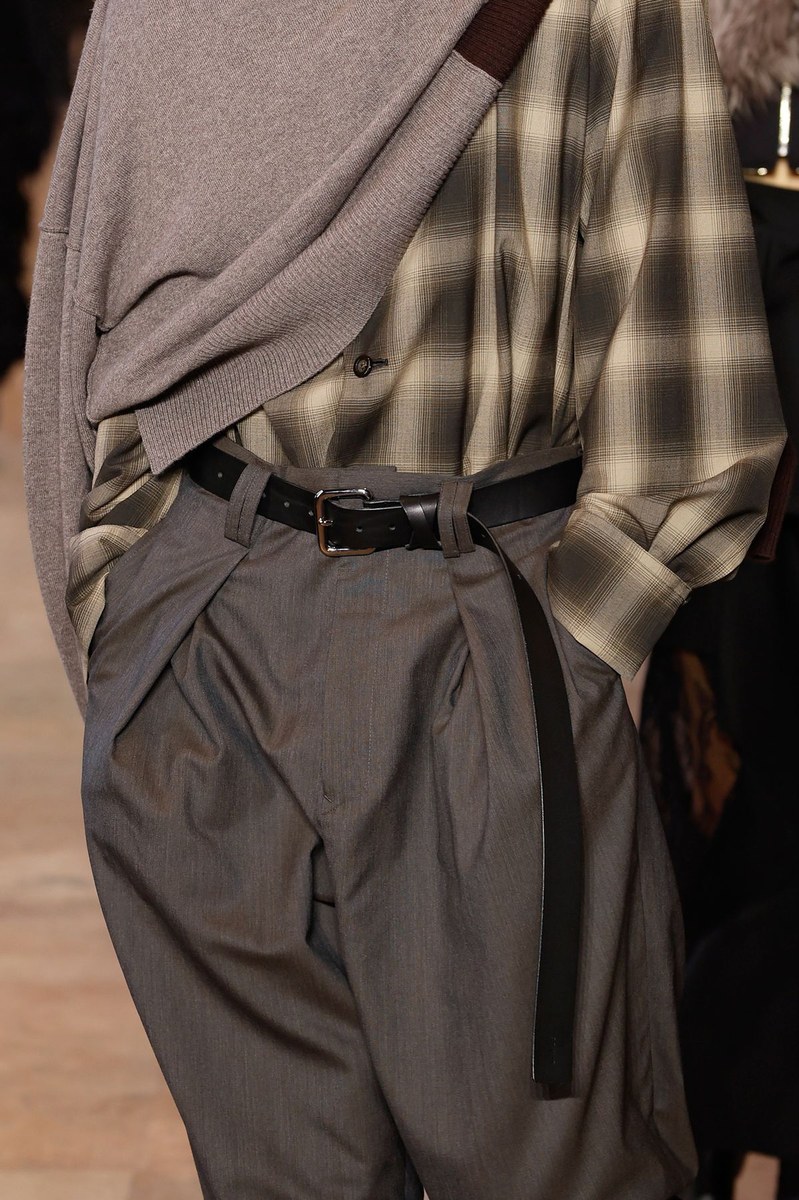
Detail 6 and Detail 10 stand out as the most commercially transferable pieces. The double-zip jacket construction creates a cropped-to-peplum silhouette shift that generates two distinct retail reads from one SKU. Detail 12 is the highest-risk, highest-reward piece: an open pinstripe blazer with zippers running diagonally from the lapel seams downward, creating raw-edge triangular openings that expose a lavender shirt underneath. A slim black leather strap with a square brass-tone roller buckle worn over a plaid shirt and beneath a draped grey knit demonstrates the brand's layering code in Detail 1. This belt will translate directly into a single-SKU accessories buy.

Detail by Detail Highlights
Detail 1 (Belt) A slim, approximately 2.5 cm wide black leather belt with a square brass roller buckle anchors a three-layer outfit by threading through tailored trouser loops over a plaid shirt, making the belt the structural center of the look rather than a finishing touch.

Detail 2 (Dress Detail) A quilted black shell vest layered over a grey-collar dress uses two matte black rectangular buckles at the chest and wide twill strapping wrapped around the torso as the primary closure system, replacing buttons entirely.

Detail 4 (Dress Detail) A black-and-ivory large-scale houndstooth coat in what reads as a bouclé or loopback wool construction drapes open over a coordinating houndstooth inner layer, demonstrating a same-fabric layering strategy that multiplies selling potential within one textile order.

Detail 6 (Dress Detail) The sage gabardine zip jacket with dual chest flap pockets and a silver cropped-hem zip opening sits over a complementary sage skirt with drawstring tie waist, making this a full co-ordinate unit priced as separates.
Detail 9 (Dress Detail) A sleeveless black wrap vest with matte black buckle, wide flat strap panels, and long ribbon ties at the hem layers over a pinstripe shirt and chunky-knit fringed cardigan, building a four-piece outfit from one garment silhouette.

Detail 12 (Dress Detail) The dark navy pinstripe blazer uses two exposed silver zippers cut diagonally through the front panels from lapel to hem, creating intentional raw openings that function as structural slits and signal a direct influence from suiting deconstruction seen across menswear in recent cycles.

Detail 5 (Dress Detail) An oversized double-breasted pinstripe vest in cream with cap-style cut sleeves over a long lace-cuffed shirt reads as a gender-neutral suiting proposition with layering built into the silhouette.

Detail 10 (Dress Detail) The tobacco brown double-zip jacket with wide flap pockets, satin cuff bands, and a drawstring-tie peplum hem over a burgundy embellished skirt positions brown as a primary season tone rather than a supporting neutral.

Operational Insights
Zip hardware sourcing: The double-zip construction visible in Details 6, 10, and 12 requires polished nickel separating zippers rated for medium-weight wool and crepe. Confirm zip tooth size and tape color matches across fabric weights before sampling.
Strap and buckle systems: Details 2 and 9 use matte black rectangular buckles on wide grosgrain or twill straps. Spec buckle interior width at a minimum of 3 cm to accommodate the flat strap volume shown and prevent hardware slippage.
Coordinate potential: Details 6 and 7 in sage and sand, and Details 5 and 13 in cream pinstripe, each read as two-piece co-ordinate units. Negotiate fabric minimums as shared across the jacket and bottom SKUs to reduce per-unit cost.
Textile risk on houndstooth: Detail 4 uses a large-scale bouclé or loopback houndstooth that requires pattern matching at seams across both the coat and the layered inner piece. Production teams should build a minimum 15 percent fabric wastage allowance into costing.
Belt as entry price point: Detail 1 presents the slim black leather belt as the lowest barrier-to-entry piece in the lineup. Consider it a standalone buy for department store accessories floors, where the Ujoh customer may engage at belt price before committing to tailoring.
More Details


✦ This report was generated with AI — combining human editorial vision with Claude by Anthropic. Because the future of fashion intelligence is already here.