Ujoh FW26 Women Looks Report
Paris Fashion Week
Ujoh's FW26 collection, designed by the Tokyo-based duo Kiyohara Tae and Yamazaki Yusuke, builds a wardrobe around deliberate deconstruction, treating garment structure as a variable rather than a given. For buyers navigating a market tired of clean minimalism, this collection offers a precise, commercially grounded alternative rooted in layering logic and tactile contrast.
Silhouette and Volume
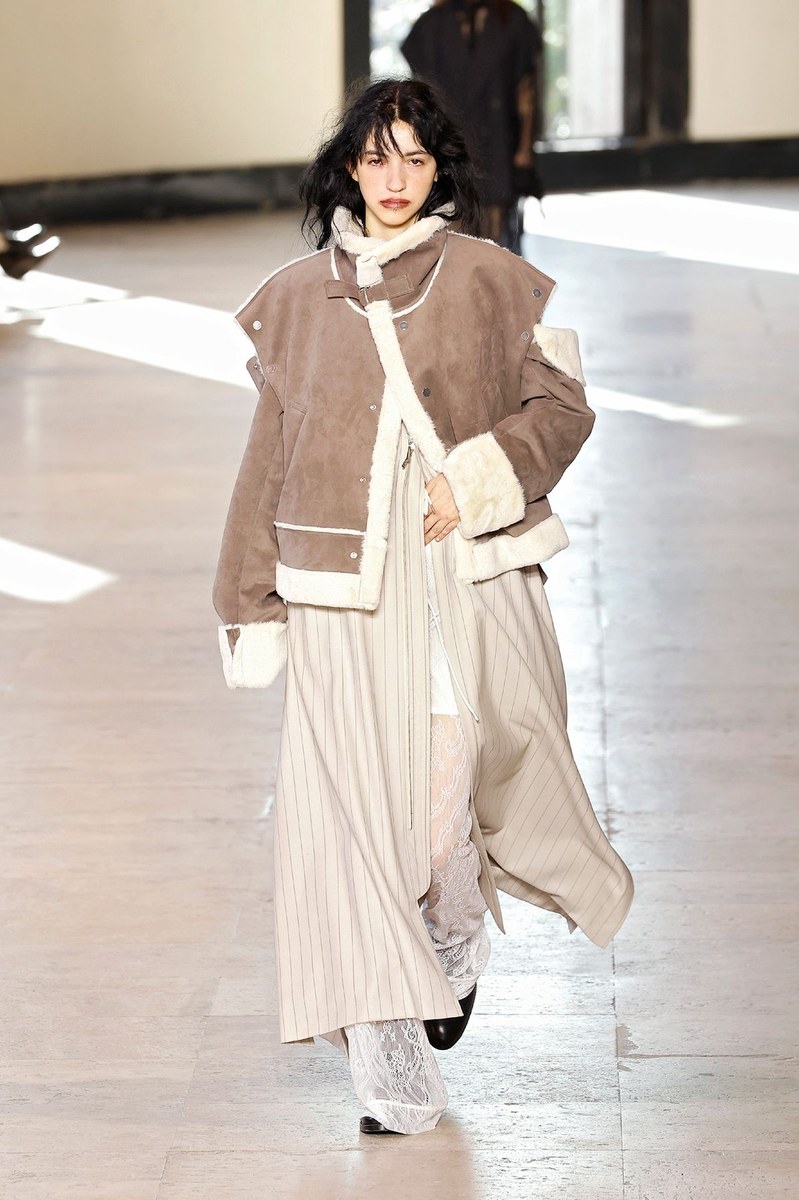
Oversized proportions dominate, but the collection avoids shapelessness by anchoring volume through strategic closures, belts, and visible zip hardware that cinch or redirect mass. Coats and jackets sit wide at the shoulder and drop well below the hip, often worn over equally voluminous trousers, creating a stacked, floor-grazing silhouette that reads as intentional rather than excessive. Looks 10, 11, and 14 push this furthest, with long deconstructed blazers and coats that incorporate dangling strap and tab details, breaking the outline without collapsing it. Short cropped outerwear in Looks 1 and 3 provides a clear counterpoint, pairing with wide-leg floor-length skirts to preserve the overall vertical weight.
Color Palette
The collection opens in a muted taupe and off-white register with Looks 1 and 2, then shifts decisively into an all-black block through Looks 3, 6, 7, and 19 that reads as a commercial anchor for the range. A warm earthy mid-tone, best described as ash taupe or greyed umber, runs through the menswear-adjacent looks from Look 8 through Look 14, giving that portion a cohesive, unisex-ready identity. Burgundy and deep claret appear in Looks 16, 18, and 9 as the primary accent hue, always paired against neutral grounds like khaki dogtooth, oyster, or dark charcoal. Navy surfaces in Looks 4, 5, 7, and 9 as the secondary neutral, most memorably in the violet-toned faux fur of Look 5.

Materials and Textures
Faux fur carries significant weight here. Look 5 uses a dense, long-pile violet-navy faux fur worn as an open cape with leather belt cinching, Look 15 brings a black shredded-texture faux fur coat over chocolate satin, and Look 17 plays a taupe mid-length faux fur against dark charcoal fluid trousers. Lace appears as a recurring structural layer rather than a trim detail, visible in Look 1 as a full-length undergarment peeking below the hemline, in Look 2 as sheer black panels that replace sleeves and skirt panels entirely, and in Look 6 as lace-trimmed boots and visible underlayer beneath a long black coat. Fluid satin in Look 15, suede in Looks 1 and 3, checked wool in Looks 16 and 20, houndstooth tweed in Look 20, and ribbed knit in Looks 4, 5, and 18 complete a material vocabulary that prioritizes surface tension and weight contrast over any single fabrication story.

Styling and Layering
Each garment functions as a component in a modular system, with zips, snaps, and straps left visibly functional so that individual pieces could theoretically recombine. Heavy black lace-up combat boots appear across the men's and unisex section, while knee-high black leather boots ground the women's looks, and flat black leather loafers or derbies provide cleaner moments. Look 12 takes layering to its most editorial extreme, combining a black long coat, an oversized plaid shirt, a long taupe ribbed scarf worn as a hood, and wide-leg trousers, with a structured black tote as the bag. Bags appear sparingly, but Look 7 introduces a clean black leather structured shoulder bag with a long strap that grounds an otherwise directional coat look in a saleable, wearable accessory.

Look by Look Highlights
Look 1 pairs a cropped taupe suede shearling jacket with a floor-length pinstripe skirt and lace underlayer, creating a strong mix-and-match buying opportunity across three separate SKUs that each work independently.

Look 2 builds an all-black look from a pinstripe double-breasted oversized vest over a full-length black lace dress, a combination that gives buyers a strong eveningwear-adjacent option without requiring a formal category.

Look 5 delivers the most commercially immediate outerwear moment of the collection, a violet-navy long-pile faux fur cape with a black leather belt closure worn over a navy zip-front ribbed knit, a silhouette with direct retail pull.
Look 9 layers a belted navy wool coat over a burgundy ribbed knit and dark burgundy fringe-trimmed wide-leg trousers, with the fringe treatment on the trousers acting as the key differentiator worth tracking for production lead time.

Look 15 combines a black shredded faux fur coat with a chocolate brown satin oversized dress and fluid wide-leg trousers in the same tone, a tonal monochrome approach in chocolate that reads as directional for the coming season.

Look 16 constructs a full look from khaki dogtooth check, using the fabric across both a deconstructed vest and a voluminous skirt, with a deep burgundy ribbed half-zip sweater as the only tonal break, a strong proposition for buyers building check-driven capsules.

Look 18 layers a deep burgundy ribbed turtleneck under a dark aubergine shredded-texture faux fur long coat over a layered oyster and burgundy skirt construction, the most complex color mix in the collection and the one with the highest editorial placement potential.

Look 20 closes the womenswear sequence with a large-scale houndstooth and windowpane check coat layered over a smaller-scale plaid coat underneath, a pattern-on-pattern move that reads as a direct production brief for two coordinating outerwear pieces in the same check family.

Operational Insights
Faux fur outerwear priority: Three distinct faux fur silhouettes appear across Looks 5, 15, and 17, each in a different color and length, making this the clearest category to develop first for wholesale. Buyers should confirm fabric source and pile depth early given lead time on long-pile constructions.
Lace as a structural garment layer: Lace in this collection functions as a full garment layer in Looks 1, 2, and 6, not as trim. Style directors should consider this a separates story, a lace underlayer dress that builds across multiple outerwear looks, which improves per-look sell-through by increasing outfit building options.
Unisex buying potential: Looks 8 through 14 present a continuous grey-taupe palette with proportions and construction details that cross gender categories without modification. Product managers should evaluate these as a standalone unisex capsule rather than folding them into either a men's or women's buy in isolation.
Zip and strap hardware as a design system: Visible metal zips and fabric straps appear across Looks 1, 6, 9, 10, 14, 15, and 20 as both closure and ornamental detail. Buyers sourcing production should establish hardware specifications early, as variation in zipper gauge or strap width will materially affect the look.
Footwear coherence as a merchandising signal: Heavy black boots throughout, both lace-up combat and knee-high riding formats, signal that the brand intends this collection to merchandise as a complete wardrobe system. Style directors building floor sets or lookbook shoots should resist substituting lighter footwear, as the boot weight is load-bearing to the proportion logic of each look.
Complete Collection


Fashion Designer

About the Designer
Mitsuru Nishizaki was born in Fukui Prefecture, a coastal region on the Sea of Japan known more for its fishing industry and centuries-old textile production than for fashion. He studied at Tokyo Mode Gakuen before entering the professional world, and his formation as a designer came not through conceptual exercises in school but through seven years of direct technical work inside the studios of Y's and Yohji Yamamoto, where he served as a pattern cutter. That particular apprenticeship, learning design from the inside of a garment rather than from a sketch, became the structural logic behind everything he would later make on his own. He carries from those years the Yamamoto approach to creative process: beginning without a fixed inspiration, keeping the mind open, and letting the work find its own direction. Aco Nishizaki, his partner in life and work, was likewise trained as a patternmaker before joining the brand.
They founded Ujoh together in 2009 in Tokyo, with an atelier in Shibuya. The name is resolutely Japanese and opaque to outsiders, which was deliberate. The brand began showing at Tokyo Fashion Week in 2014, and from the outset Nishizaki's collections distinguished themselves through a particular logic: every seam, fold, and asymmetry arrived from the same technical intelligence that had spent years inside a master cutter's studio, so that even the most unexpected detail carried structural weight. His 2016 Milan debut, staged in a venue made available by Giorgio Armani, brought the brand its first international wave of attention. A Vogue dispatch declared it the way cool girls were dressing. In 2021, Ujoh moved to the official Paris Fashion Week calendar, where it has shown consistently since, earning a place on the Fédération de la Haute Couture et de la Mode schedule.
His references are drawn from daily Japanese life and its imposed codes: the school uniform and the particular ways students of the 1990s subverted it with leg warmers, loose socks, and layered cardigans; the oppressive summer heat of Tokyo that demands a rethinking of what a tailored garment even means in that climate; vintage resort poster graphics and sailor collars. The work runs consistently along lines of convertibility and layering, pieces engineered to transform, shirts that button at both front and back, jackets whose collars detach to become something else entirely. Everything is made in Japan. Today, Mitsuru and Aco Nishizaki serve as co-creative directors of Ujoh, presenting their collections in Paris each season.
"Cutting is also about connecting the dots efficiently and functionally. The search to find new ways of cutting gives birth to distinctive shapes, which combine organic curves with sharpness, transposed directly onto the patterns."
"I work in the style to which I became accustomed at Yamamoto: having an open mind and designing freely without pre-selecting a particular inspiration."
✦ This report was generated with AI — combining human editorial vision with Claude by Anthropic. Because the future of fashion intelligence is already here.