Uma Wang FW26 Women Looks Report
Paris Fashion Week
Uma Wang FW26 builds a wardrobe around deliberate weight, drape and architectural volume, pulling from tailoring, wrapped silhouettes and tactile fabrication to construct a deeply personal vision of autumn dressing. Buyers should take note: customers are moving away from minimalist restraint and toward clothing that carries physical presence and emotional density.
Silhouette and Volume
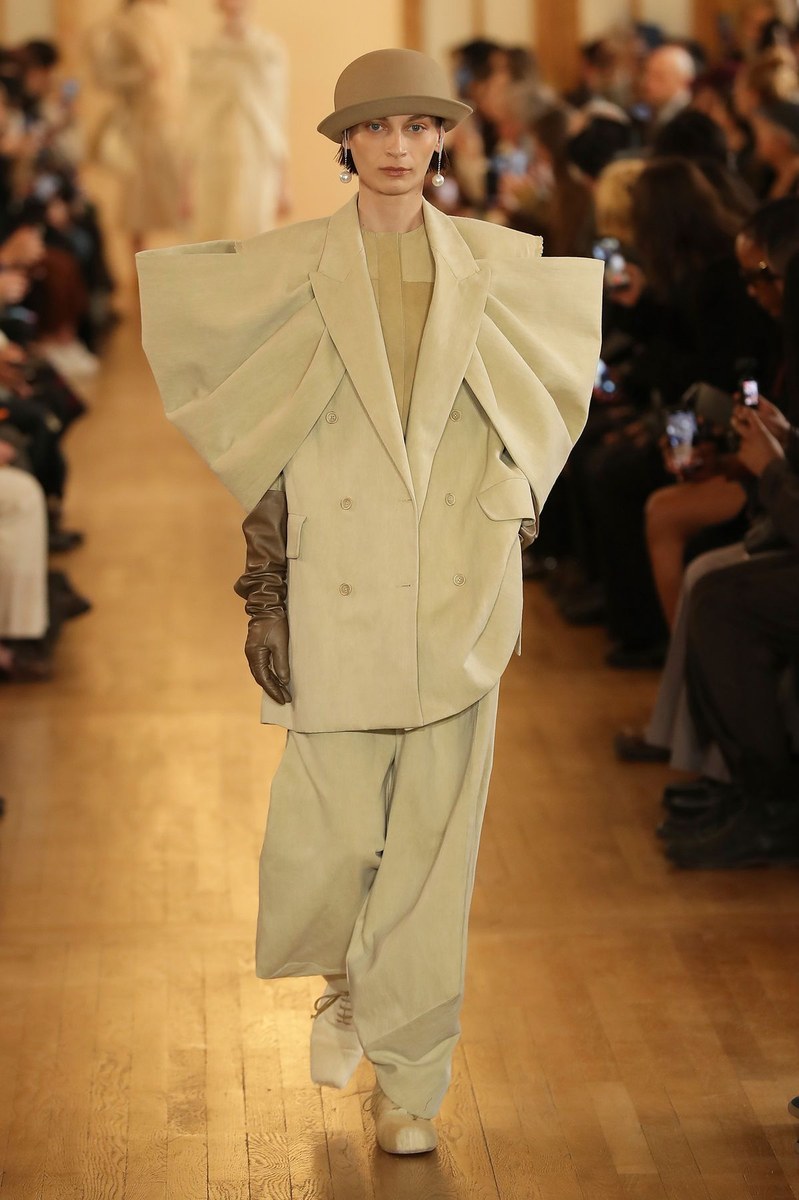
Oversized, body-obscuring forms dominate the collection. Cocoon shapes, ballooned harem-style trousers, trapeze coats and draped wraps recur across every color chapter. Look 1 sets the architectural tone with its exploded shoulder construction on a sage double-breasted blazer, while Look 14 takes the logic to its most reductive extreme with a single floor-length camel-grey wool cocoon. Volume carries structural weight and resolve. It's never decorative.
Color Palette
Three distinct chapters move through the collection: sage, sand and ivory in the opening looks; deep black as a mid-collection anchor; and earthy khaki, tobacco brown and slate grey closing the show. The teal and caramel checkerboard pattern in Looks 17 and 18 cuts through as the lone contrasting moment, preventing the palette from reading as purely somber. Brown and grey mix most consistently throughout, creating a mood that sits between monastic and militaristic.
Materials and Textures
Crushed velvet, patent leather, washed silk jacquard, boiled wool, brushed cashmere and heavyweight linen-adjacent cloth all appear across the 20 looks. Deep black crushed velvet with pronounced sleeve volume shows up in Look 4, while a high-shine dark chocolate patent leather cropped jacket counters in Look 8. The camouflage jacquard in Looks 6 and 7 reads as washed and slightly distorted, giving it an aged rather than military quality. Wool scarves in Looks 10, 11 and 15 feature fringe edges that soften the otherwise dense fabrication story.

Styling and Layering
Long leather gloves in chocolate brown and black function as a consistent styling anchor, appearing in Looks 1, 5, 9, 17 and 19 and always extending past the sleeve hem. Footwear splits between two directions: suede or fabric platform loafers with sculptural bow knots, and low block-heeled patent pumps. Bucket bags and structured tote bags, all in muted leathers, accompany most looks without competing with the clothing. Oversized fringed scarves in Looks 10, 11 and 15 function almost as a third outerwear layer rather than as accessories.
Look by Look Highlights
Look 1 The sage exploded-shoulder blazer worn over wide-leg trousers with elbow-length brown leather gloves and a tan felt bowler hat establishes the collection's sculptural tailoring signature immediately and reads as the strongest commercial anchor for a specialty retailer.
Look 2 A cream-and-gold floral jacquard draped wrap dress gathered at a central knot, paired with bow-knotted platform heels, demonstrates how Wang translates ceremonial dressing into something with genuine retail velocity for occasion and bridal adjacency categories.

Look 6 The camouflage jacquard draped and knotted into an asymmetric top with matching gathered trousers is the most editorial look in the collection, with strong potential for press placement and targeted luxury streetwear buying.

Look 8 A cropped dark chocolate patent leather jacket with structured puffed shoulders worn over a high-waisted tobacco wool trouser creates a two-piece that can be bought and merchandised as separates, with the jacket functioning as a statement driver on its own.

Look 14 A single floor-length camel-grey wool cocoon dress with gathered sleeves and no ornamentation whatsoever is a production-ready proposition for buyers focused on quiet luxury, requiring minimal styling investment at retail.

Look 17 The teal and caramel large-scale checkerboard silk draped gown knotted at the shoulder with long brown leather gloves is the collection's highest-impact single garment and will perform as a hero editorial piece in any fashion market presentation.

Look 19 A black jacquard column dress anchored by a voluminous black velvet bow capelet, long black leather gloves and a black bowler hat delivers total-look coherence and targets an evening and black-tie customer without relying on embellishment.

Look 20 The black oversized geometric-shoulder double-breasted blazer, worn by Irina Shayk as the closing look, translates the show's opening tailoring language into its darkest and most directional form and signals where Wang sees the collection's commercial center of gravity.

Operational Insights
Silhouette risk calibration: The dominant cocoon and wrap volumes require fit and sizing notes for retail teams. Buyers should plan for customer education at point of sale, particularly for the draped knot constructions in Looks 2, 6 and 17 where the silhouette depends entirely on how the garment is tied.
Separates potential: Looks 8, 10, 11, 12 and 15 all present components that function independently. Style directors should prioritize separates buying across the brown and grey chapters, where the trousers and outerwear have the strongest cross-merchandising range.
Accessories as margin drivers: Bucket bags, structured totes and long leather gloves repeat across nearly every look. If Uma Wang produces these as retail accessories, they represent high-margin add-on purchases that are deeply integrated into the visual logic rather than afterthoughts.
Pattern investment: The teal and caramel checkerboard appears across two distinct silhouettes in Looks 17 and 18, which suggests the fabric was developed as a signature print for the season. Buyers with access to fabric allocation should consider requesting yardage data, as the pattern has strong potential for licensed or capsule production.
Occasion versus everyday split: The collection divides cleanly into daywear, Looks 8 through 16, and elevated occasion dressing in Looks 2, 17, 18, 19 and 20. Product managers building seasonal assortments should treat these two groups as separate buy decisions rather than attempting to blend them into a single floor presentation.
Complete Collection


About the Designer
Uma Wang, whose Chinese name is Wang Zhi, was born in the early 1970s in Hebei, a northern Chinese province, into a family of traditional medicine practitioners. Growing up surrounded by the visual and sensory culture of Chinese medicine, she absorbed its specific color world, the ochres and deep browns of dried herbs, the blacks of ink, and the philosophical patience that runs through practices built around what is not immediately visible. Her father read esoteric texts, and she has described herself as someone drawn from childhood toward things without standard answers. Fashion was not an obvious path from that landscape, but its underlying logic proved entirely consistent with who she was becoming: someone more interested in texture, weight, and suggestion than in surface decoration.
She moved to Shanghai to study at China Textile University, where she completed a degree in fashion design in the early 1990s and joined the knitting department of a local company afterward. For nearly a decade she worked as an in-house designer for Chinese labels, a period she credits with building a real technical fluency in textiles and pattern construction, even as she grew restless. In 2002 she made the decision that changed her trajectory: she left her stable position and enrolled at Central Saint Martins in London. There, the generation of Japanese designers who had based themselves in Europe, Yohji Yamamoto, Issey Miyake, and Rei Kawakubo, became central to her understanding of what fashion could do: that a garment's power lived in how it moved, where it touched the body, and what it withheld as much as what it showed.
After graduating she stayed in London, working as a freelance designer for international clients before registering her own label there in 2005, initially under the name UMA Studio before insisting, despite industry advice to the contrary, on renaming it Uma Wang. The brand launched properly in 2009 and was built outward through knitwear before expanding into full ready-to-wear collections, with production transferred entirely to Italy to meet quality requirements. She became the first Chinese designer on the official European fashion calendar when she entered Milan Fashion Week, and moved to the Paris calendar in 2017. In 2022 she was accepted as a permanent member of the Fédération de la Haute Couture et de la Mode. Her design intelligence runs on a concept she has drawn from Chinese aesthetics: "blank-leaving," the idea that restraint and negative space carry as much meaning as what is present, a principle she has translated into the way she develops fabric with Italian mills, pulling them back from their instinct toward ornate fullness toward something more withheld.
"I used to read some esoteric books with my father. I found myself good at imagination, especially things without standard answers."
"When the fabric is done right, you don't need to try hard to create silhouettes. I suggested to Italian fabric manufacturers to stop at a certain point, because in China we have this blank-leaving aesthetics. They actually thanked me for passing on an Eastern spirit as we work together."
✦ This report was generated with AI — combining human editorial vision with Claude by Anthropic. Because the future of fashion intelligence is already here.