Vaquera FW26 Women Looks Report
Paris Fashion Week
Vaquera FW26 collides bridal innocence, schoolgirl structure, and deliberate undress into a single provocative system built around cutouts, oval silhouettes, and the recurring symbol of the bow. Buyers and style directors operating in a market hungry for high-concept runway product that photographs aggressively on social platforms will find a commercially legible visual language wrapped inside a genuinely transgressive framework.
Silhouette and Volume
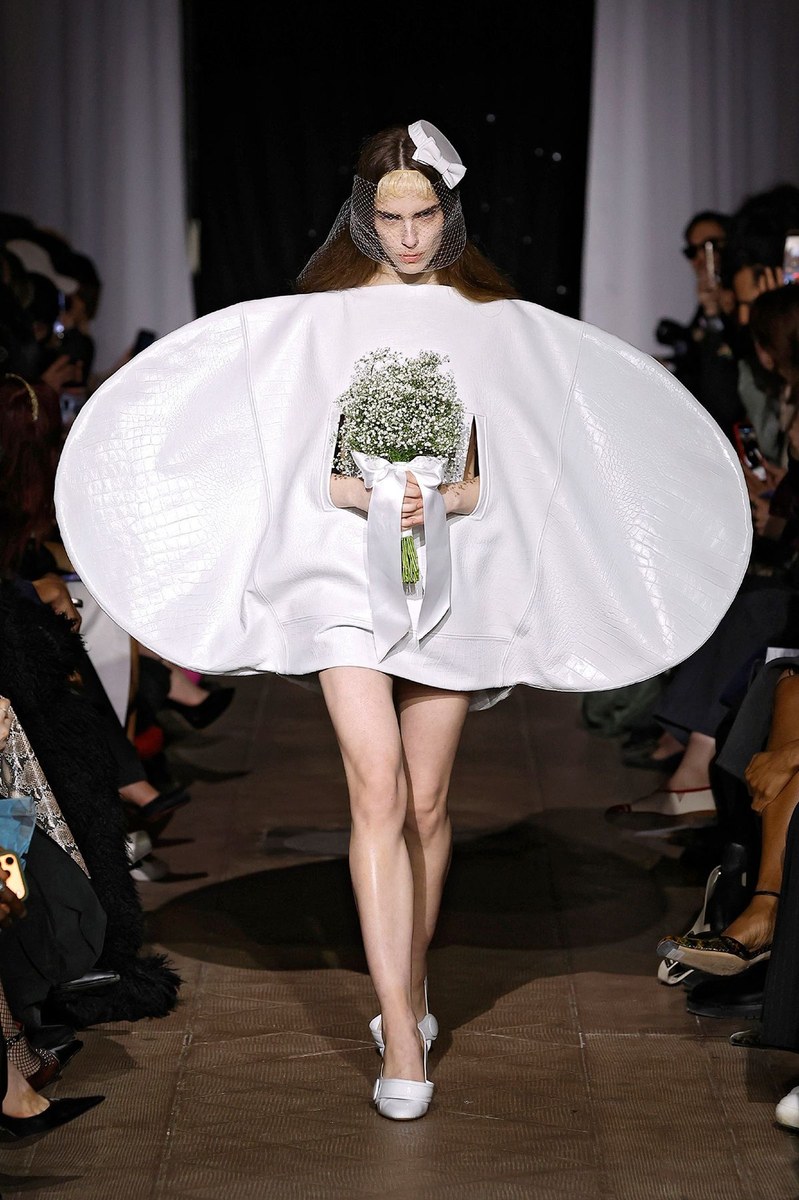
The oval is the collection's governing shape. Look 1 opens with a white croc-embossed structured disc that radiates from the torso like a satellite dish, while Look 20 closes the show with its dark mirror: a black fishnet oval of identical geometry worn over a sequined column. Between those two bookends, volume moves through cropped and flared proportions, pleated micro-skirts in Looks 8 and 11, and the squared-off padded shoulders of Looks 13 and 14, which read less like suiting and more like architectural armor. Cutouts at the waist appear in at least seven looks, functioning as a structural signature rather than a decorative afterthought.
Color Palette
Three distinct zones organize the color story. White and black anchor the opening and closing movements, with white carrying a bridal or medical cleanliness and black reading as both monastic severity and fetish-adjacent drama. Pink satin saturates the middle section in Looks 13, 14, 15, and 16, a neon coral that photographs as hot red under certain lights, followed by a cool mint in Looks 17 and 18. Gray windowpane wool appears in Looks 6, 7, 8, and 9, grounding the more theatrical pieces in something that gestures toward tailoring.
Materials and Textures
Satin functions as the collection's workhorse fabric across Looks 10 through 17, a medium-weight duchess-style weave with a high sheen and enough body to hold sculptural folds without internal boning. The gray windowpane cloth in the suiting group reads as a mid-weight wool or wool blend, structured enough for cropped jackets but with enough drape to fall into ruffled skirt hems. Croc-embossed white material in Look 1 and black fishnet in Look 20 introduce textural contrast at the collection's poles. Patent vinyl thigh-high boots in Looks 2, 8, and 19 add a lacquered surface that amplifies the tension between prim and transgressive built into the concept.
Styling and Layering
Footwear is deliberately anti-climactic. Flat or low block-heeled mules and Mary Janes in white, black, pink, and neon yellow appear repeatedly, pulling attention upward toward garment volume. Masks and veils recur as face coverings, from the birdcage veil of Look 1 to the lace-eye balaclava of Look 3 and the white net riding hat of Looks 11 and 17, collapsing the distance between bridal accessory and anonymizing headgear. Look 18 introduces a moment of warm layering through an ivory cardigan and fur shoulder piece, reading almost domestic against the surrounding artifice. Bows appear on garments, headpieces, and bags with enough frequency to function as a brand-level motif rather than a single-season flourish.
Look by Look Highlights
Look 1 The white croc-embossed disc silhouette with birdcage veil and baby's breath bouquet is the collection's clearest commercial image and the one most likely to drive press coverage and editorial requests.
Look 2 A double-breasted black wool cape with hood over a black bikini bottom, green feather pubic ornament, and thigh-high patent boots functions as a direct provocation. This look will define the collection's critical conversation and polarize buyers along exactly those lines.

Look 7 The gray windowpane double-breasted cropped jacket with matching ruffled drop-waist skirt and large silver buttons is the most retailer-accessible look in the collection, a structured separates set a specialty retailer could sell as individual pieces.

Look 8 Windowpane blazer layered over a tulle-hemmed ruffled mini with thigh-high black leather boots demonstrates how Vaquera constructs tension between prep and aggressive sexuality within a single coherent look.

Look 13 Squared padded-shoulder pink satin top with matching high-waist cropped trousers and a miniature kiss-lock bag carried in cupped hands reads as Vaquera's answer to the coordinated set trend, executed with enough structural distortion to separate it from anything currently on the floor.

Look 15 The hot pink satin shift dress with cutout waist and black grosgrain tie belt is the strongest single-piece buy from the color-saturated middle section, wearable enough for a confident retail customer but photographically potent for campaign use.

Look 17 Mint satin balloon-sleeve mini with oversized self-fabric bow at center front, worn with a white fishnet riding helmet and black platform Mary Janes, is the look most likely to travel directly from runway to costume and entertainment industry budgets.

Look 20 The closing black fishnet oval over a sequined column and a large black satin bow at the crown is a production-intensive statement piece that functions primarily as brand equity rather than a volume buy, but its image value justifies its place in any presentation strategy.

Operational Insights
Silhouette investment: The oval disc structure in Looks 1 and 20 requires rigid internal architecture, likely bonded interfacing or a resin-stiffened frame. Confirm with the studio whether production-ready patterns exist or whether these remain sample-only constructions before committing.
Separates strategy: Both the windowpane suiting group in Looks 6, 7, and 8 and the pink and gray satin separates in Looks 9, 13, and 14 lend themselves to a mix-and-match buy. Style directors should consider ordering coordinating pieces in ratio rather than single-look sets to maximize floor flexibility.
Color sequencing: The palette moves from white to black to gray to pink to mint, a sequence that maps cleanly onto a retail floor by season temperature. Buyers entering later in the season should weight the mint and pink satin pieces, which carry the strongest newness signal against current floor inventory.
Accessory opportunity: The bow motif appears on garments, bags, and headpieces consistently enough to anchor an accessory capsule. Product managers should investigate whether the label plans to produce the miniature kiss-lock bag from Looks 13 and 14 as a standalone SKU, as it has strong impulse-buy and gifting potential.
Exposure calibration: Multiple looks, specifically Looks 2, 3, and 16, involve significant skin exposure and unconventional face covering that will require careful placement decisions. Retailers operating in conservative markets or with broad demographic reach should build their buy primarily from the suiting separates and satin dress groups and treat the more explicit looks as press-only or trunk-show inventory.
Complete Collection


Fashion Designer

About the Designer
Patric DiCaprio grew up in Alabama wearing a private school uniform for fourteen years, a detail he has cited directly as the origin of his preoccupation with clothing as a tool of disruption. On the two days each year when students were allowed to dress freely, he spent his time planning the outfit that would provoke the most visible reaction from everyone around him. Bryn Taubensee grew up in Indiana, equally remote from any fashion world and equally determined to find her way out. Both arrived in New York chasing a specific fantasy about what the city was. DiCaprio had graduated with a degree in photography in Alabama and found his real education through an internship at DIS Magazine, the art and culture platform that was then building something new out of the internet's visual language. He was working as a stylist and catering jobs simultaneously when, sitting at a bar one evening before a shift he hated, he decided on impulse to buy a sewing machine on his phone. He had never sewn anything. He taught himself using YouTube tutorials made for cosplay communities, buying fabric at a dollar a yard, and presented those first garments as the debut Vaquera collection in 2013.
He met Taubensee while both were assisting the stylist Avena Gallagher, who became their reference point for what professional fashion practice could look like. He texted Taubensee on her birthday asking if she wanted to join, and she said yes. Together they built the brand through a series of shows staged in subway stations, Chinese restaurants, and warehouses, casting friends, strangers, and their own community rather than agency models, and producing work that treated the entire history of fashion as material to be remixed without apology. The brand's name came from Mexican kitchen colleagues who called DiCaprio "La Vaquera" during a restaurant job, a reference to Tom Robbins's novel Even Cowgirls Get the Blues. They described their practice as "fashion fan fiction": taking the existing codes of luxury, consumer culture, American patriotism, and pop iconography and pushing them until they became strange. In 2022, backed by Comme des Garçons and Dover Street Market, they moved their shows to Paris Fashion Week. In 2025 they relocated operations fully to Paris, where they now present as official members of the Paris Fashion Week calendar.
Their references run from Showgirls and The Handmaid's Tale to Vivienne Westwood and Miguel Adrover, from American sportswear to Tiffany blue, from graduation gowns to bondage harnesses, always approached through an aesthetic that keeps the seams visible and the logic slightly unstable. Pieces from their collections are held by the Metropolitan Museum of Art in New York and the Museum of London. Patric DiCaprio and Bryn Taubensee remain co-creative directors of Vaquera, still doing much of the patterning and construction themselves.
"I taught myself to sew with cosplay tutorials and cutting up my old jackets and tracing them. The first Vaquera collection were the first clothes I ever made. If you want to do something well and new, you have to teach yourself to do it."
"We've always felt like outsiders in this world, so we create our ideal reality and unite with people that see the world in the same way that we do."
✦ This report was generated with AI — combining human editorial vision with Claude by Anthropic. Because the future of fashion intelligence is already here.