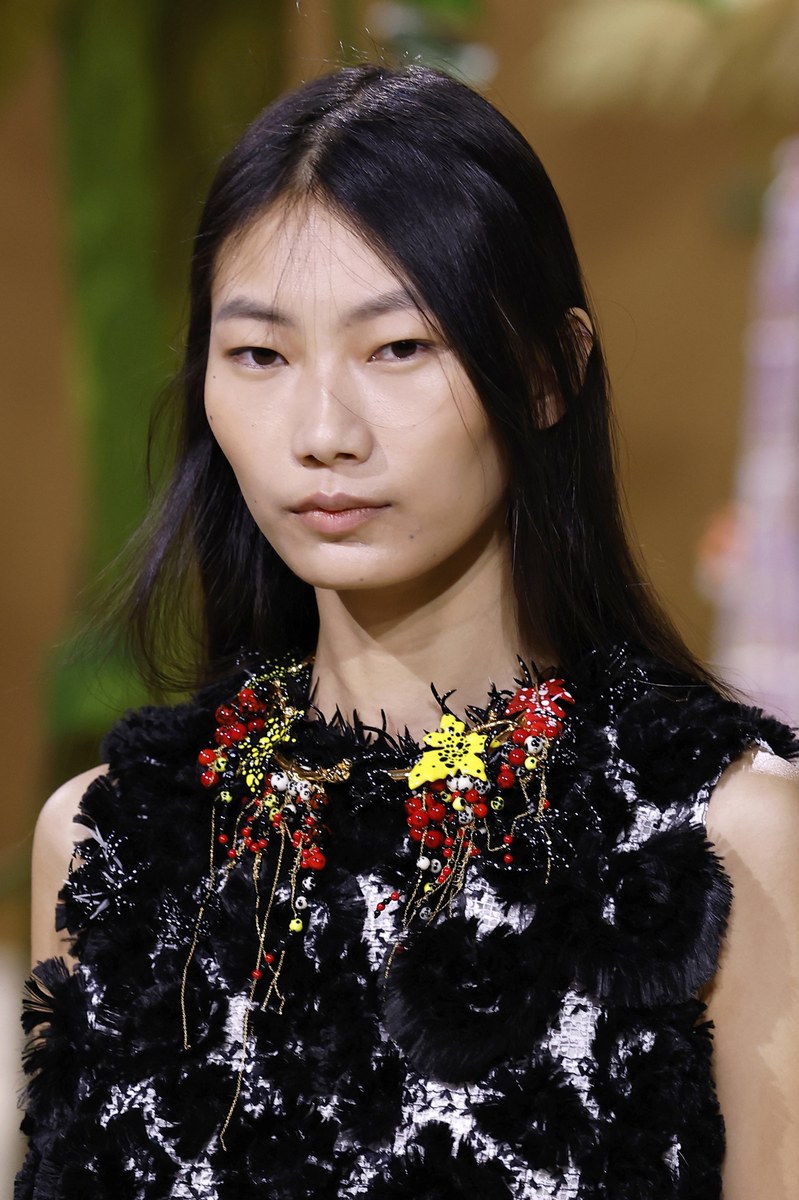
Victoria Beckham FW26 Women Looks Report

Victoria Beckham FW26 Women Looks Report
Victoria Beckham FW26 Women Looks Report

Paris Fashion Week

Victoria Beckham FW26 builds a wardrobe around two poles: rigorous tailoring in navy and charcoal, and sculptural eveningwear that uses cutouts, sheer organza and three-dimensional floral appliqué to expose the body selectively. The collection speaks directly to a luxury market where corporate dressing and occasion wear are converging, and where clients want one designer to cover both.

Silhouette and Volume

The tailored half runs consistently oversized through the shoulder and clean through the leg, producing a long, vertical line that reads authoritative rather than boxy. Look 5 and Look 18 anchor this aesthetic: double-breasted blazers with strong padding sit over slim trousers, the jacket hem dropping well past the hip. Eveningwear reverses the logic entirely. Look 11, Look 19 and Look 20 are body-conscious through the torso and then release volume dramatically at the skirt, creating an hourglass tension that photographs with high impact.
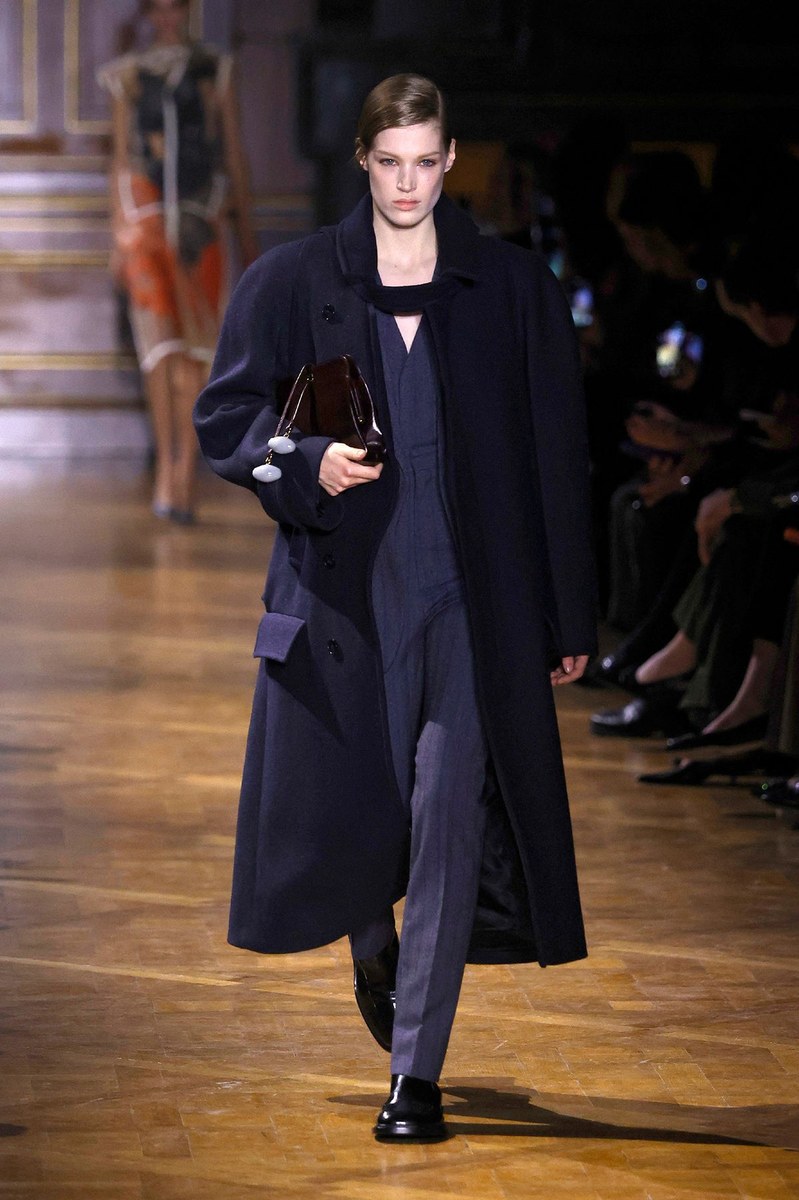
Look 5
Look 5

Color Palette

Navy dominates. It appears in at least seven looks, running from the deep wool of Look 1 and Look 9 to the iridescent organza of Look 6 and the velvet of Look 20. Charcoal and khaki-olive read as secondaries, grounding Look 7 and Look 14 in a muted, almost military register. Where the collection breaks color, it breaks hard: the saturated burnt orange of Look 3 arrives mid-show like a provocation and recurs as a ghost print in the sheer organza of Look 2.

Look 1
Look 1

Materials and Textures

Wool crepe and pinstripe suiting carry the tailored looks, with a surface weight heavy enough to hold the architectural shoulder without excessive internal structure. Silk chiffon, velvet and what appears to be a bonded or coated organza used in Look 2, Look 6 and Look 8 pivot the eveningwear strategy. This stiff, luminous fabric holds sculptural folds without lining. Three-dimensional appliqué made from fabric circles that cluster into floral formations appears on Look 3, Look 4, Look 11 and Look 15, and it functions as the collection's signature craft detail. Knitwear in Look 16 and Look 17 introduces a ribbed, chunky weight that contrasts directly with the sheerness placed beneath or beside it.

Look 2
Look 2

Styling and Layering

Coats are carried open or off the shoulder rather than worn closed, which keeps proportions legible and turns outerwear into a framing device rather than a cover-up. Look 1 layers a navy overcoat over a matching jumpsuit. Look 14 drapes a khaki military-length coat over a chunky knit dress worn over sheer tights, stacking three textures in one read. Footwear splits cleanly: the tailored looks take chunky black loafers or Oxford shoes, while eveningwear goes to a pointed-toe kitten or stiletto pump in tonal leather. Accessories stay spare, a structured top-handle bag in black patent or dark leather carried in the hand, never on the shoulder, which reinforces the upright, controlled posture the collection projects.

Look by Look Highlights

Look 2 The coated organza sheath printed with swirling grey and orange ink washes is the collection's most technically complex piece and the most immediate editorial pull.

Look 3 The burnt orange halter gown with circular fabric appliqué across the chest is the collection's singular color statement and will drive single-SKU coverage in fashion media.

Look 3
Look 3

Look 5 The all-navy wool crepe suit with an asymmetric lapel and no visible closure is the cleanest expression of the tailoring direction and the most immediate candidate for a core carry-over.

Look 9 A navy double-breasted coat worn open over a black top and a white floral-print mini skirt mixes formal and feminine registers in one buildable outfit that buyers can sell as separates.

Look 9
Look 9

Look 11 The navy chiffon halter gown with velvet circular appliqué replacing a traditional bodice is the most wearable of the cutout evening pieces because the appliqué provides coverage while the construction still reads as daring.

Look 11
Look 11

Look 15 The forest green silk blouse with a cutout collar worn over the all-green ruched floral skirt is the strongest monochromatic separates story in the collection and the one most likely to attract younger luxury clients.

Look 15
Look 15

Look 19 The strapless black velvet and matte jersey gown with geometric side cutouts achieves evening drama without sheerness, which makes it the safest high-margin formal buy in the lineup.

Look 19
Look 19

Look 20 The one-shoulder navy velvet bodice releasing into a full black taffeta skirt closes the show with maximum luxury material at minimum silhouette risk, and it will perform in the bridal adjacent market.

Look 20
Look 20

Operational Insights

Navy depth: Navy is so dominant across both categories that buyers should plan colorway continuity carefully. Ensuring dye-lot consistency between the wool suiting, velvet and chiffon versions will be critical for stores that floor the collection together.

Appliqué scalability: The circular fabric appliqué appears across four looks and functions as the collection's repeating craft signature. Product managers should confirm with the atelier whether this detail can be produced at sufficient volume for wholesale or whether it is positioned as a made-to-order element only.

Separates potential: Looks 9, 10, 15 and 17 all read clearly as mix-and-match separates rather than fixed outfit units. Style directors at multi-brand retailers should plan floor sets around this flexibility, as it extends the selling floor narrative and justifies broader depth buys on individual pieces.

Outerwear carry: The oversized navy and khaki coats in Look 1, Look 4 and Look 14 carry strong standalone commercial logic. They do not require the full look to make sense on a hanger, which reduces the markdown risk typically associated with runway-specific silhouettes.

Eveningwear positioning: The cutout gowns in Look 3, Look 11 and Look 19 target a client who wants occasion dressing with a structural rather than purely decorative rationale. Luxury department store buyers should position these against Bottega Veneta and The Row eveningwear rather than against traditional gown brands, as the customer overlap sits firmly in the understated-luxury segment.

Complete Collection

Look 4
Look 4
Look 6
Look 6
Look 7
Look 7
Look 8
Look 8
Look 10
Look 10
Look 12
Look 12
Look 13
Look 13
Look 14
Look 14
Look 16
Look 16
Look 17
Look 17
Look 18
Look 18
Look 21
Look 21
Look 22
Look 22
Look 23
Look 23
Look 24
Look 24
Look 25
Look 25
Look 26
Look 26
Look 27
Look 27
Look 28
Look 28
Look 29
Look 29
Look 30
Look 30
Look 31
Look 31
Look 32
Look 32
Look 33
Look 33
Look 34
Look 34
Look 35
Look 35
Look 36
Look 36
Look 37
Look 37
Look 38
Look 38
Look 39
Look 39
Look 40
Look 40
Look 41
Look 41

Fashion Designer

About the Designer

Victoria Beckham was born Victoria Caroline Adams on April 17, 1974, in Harlow, Essex, and grew up in Goffs Oak, Hertfordshire, in a prosperous household that she would later describe with some ambivalence, aware from an early age of how material comfort could become its own kind of social liability. Her father ran a successful electronics business and drove a Rolls-Royce, which she famously asked him not to park outside her school. That school was a place she struggled in: she was bullied, deemed a poor learner, and at the performing arts college she attended afterward, she was deliberately positioned in the back row because of her weight. Those years of being told she was not enough became, by her own account, the engine of everything that followed. She trained in acting, singing, and dance, and at twenty was selected as one of five young women to form the Spice Girls.

The group spent roughly four years together as an international phenomenon, selling more than a hundred million records and generating a cultural moment that had very little to do with music and everything to do with image, persona, and the carefully choreographed performance of personality. She became Posh Spice, the composed, style-conscious member, which both described something real and trapped her in a reductive frame she would spend the next two decades dismantling. After the Spice Girls disbanded, she released a solo album in 2001 and tried for several years to sustain a music career before the direction became clear. Fashion had been her real conversation all along. She began with a denim line in 2004 and a sunglasses collection, then launched her eponymous high-end collection of dresses at New York Fashion Week in September 2008. In 2011, the British Fashion Awards named her Designer Brand of the Year.

The references she has cited are specific and period-bound: the corsetry and silhouette architecture of 1940s and 1950s tailoring, art galleries including Tate Britain and the Frick Collection in New York, the discipline of dressing a particular kind of woman who is powerful but not aggressive. The label moved to the Paris Fashion Week calendar, and in 2024 staged its most significant show yet at the Palais d'Iéna in front of six hundred guests, with a rainstorm threatening the entire event. The path to that moment ran through a near-collapse in 2016 when the business accumulated tens of millions in debt and she confronted the possibility of losing everything. She has been candid about those years in interviews and in a 2025 Netflix documentary that traced her arc from pop group phenomenon to fashion house founder. She is now creative director of Victoria Beckham, which operates across womenswear, beauty, and fragrance, and was awarded an OBE in 2017 for services to the fashion industry.

"I've been in the fashion industry for almost two decades. I was in the Spice Girls for four years and have been so defined by that four-year period. I think people would be surprised to know that. I've been in fashion nearly two decades, but people like to pigeonhole."

"I get a lot of inspiration from the '40s and '50s, so corsetry plays a huge role in the collection. Everything that I design I would wear myself."

✦ This report was generated with AI — combining human editorial vision with Claude by Anthropic. Because the future of fashion intelligence is already here.