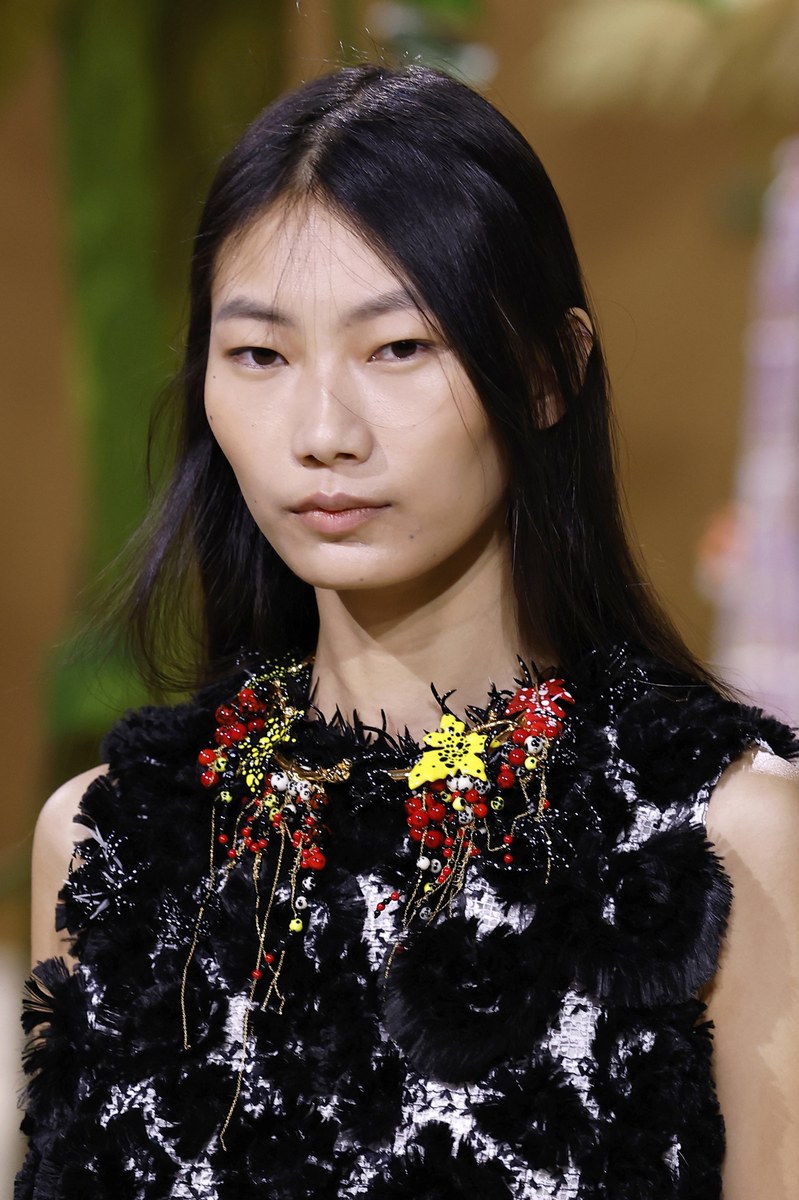
Weinsanto FW26 Women Looks Report
Paris Fashion Week
Victor Weinsanto built FW26 around a sustained argument that corsetry, sheer construction and streetwear volume can occupy the same wardrobe without apology. Buyers will find this argument arrives at exactly the right moment, when the market is actively searching for product that bridges occasion dressing and everyday edge.
Silhouette and Volume
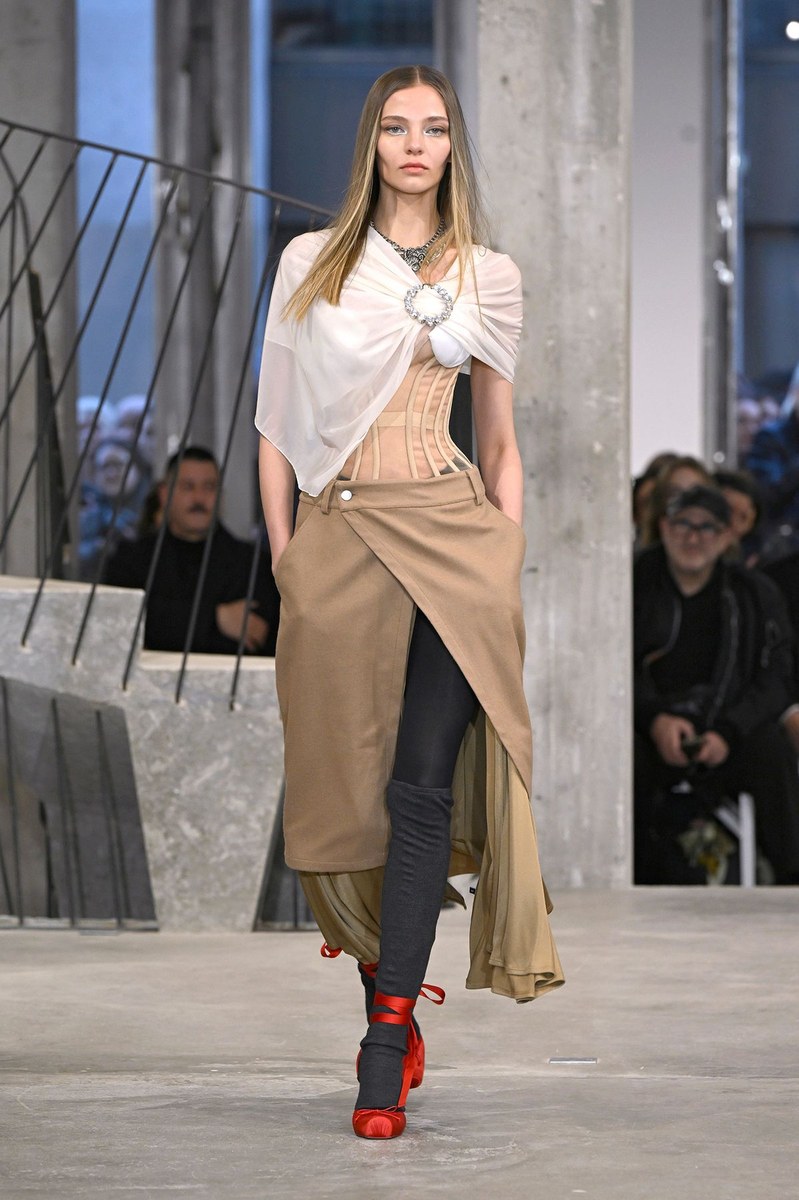
The collection splits cleanly between two poles: body-skimming corset-structured silhouettes that grip the torso with boning and lace-up hardware, and aggressively oversized outerwear and suiting that inflates the shoulder and drops past the knee. Look 1 layers both impulses at once, wrapping a nude corset inside a draped khaki skirt and a billowing white chiffon cape. By the finale, the volume logic reaches its extreme. Look 19 deploys a multi-tiered white tulle ballgown that reads more architectural installation than garment. Look 20 closes in a white embroidered satin jumpsuit with a full face mask and cathedral veil.
Color Palette
A tight neutral spine of khaki, nude, black and off-white anchors the collection, then concentrated hits of olive gold (Looks 7 and 8) and burgundy-crimson velvet (Look 17) punctuate that foundation. Black dominates the mid-collection stretch, running through leather, mesh, lace and matte jersey without monotony because surface texture carries the variation. Opening and closing white looks create a deliberate bracket, giving the collection a ceremonial structure that photographs well and sequences cleanly in a retail context.

Materials and Textures
Sheer mesh and chiffon recur constantly, used here not as layering filler but as primary construction fabric, visible in Look 2, Look 4, Look 10 and Look 12. Corset boning appears as an external structural element rather than an undergarment, executed in nude tulle with visible busk closures (Look 6), dark lace-up webbing (Look 5), and heavy olive satin (Look 8). Velvet, leather, faux fur cut in a loose shag pile (Looks 3 and 11), and a fluid olive duchess satin that drapes into a strapless column gown in Look 8 round out the material story. Weight contrasts are deliberate and frequent, pairing something dense and structured against something that barely registers.

Styling and Footwear
Two recurring silhouettes dominate footwear: a lace-up ankle boot in white or nude (Looks 2 and 12) and a ribbon-tied platform heel in red or brown that grounds multiple looks (Looks 1, 15 and 17). Accessories stay spare. Crystal brooches and rhinestone necklaces function as the primary jewellery language, consistently positioned at the throat or chest. The W logo functions as a quiet branding marker on sportswear separates (Looks 9 and 13) rather than as a print or graphic, keeping the commercial pieces legible without loudness. Braided hair extensions in black and blonde streaks serve as a styling device repeated across the cast, functioning almost like an accessory category in themselves.
Look by Look Highlights
Look 1 layers a nude boned corset over black leggings beneath a voluminous draped khaki midi skirt and a white chiffon capelet, making it the collection's most complete statement piece for buyers who need a single rack-defining look.
Look 5 pairs a camel wool belted coat with a dark baroque corset worn over a white poplin shirt and black bodysuit, a combination that translates directly into separates buying across at least three distinct product categories.

Look 8 presents a strapless olive duchess satin gown with integrated corset boning and a cascading side train, worn by a heavily tattooed cast member whose presence reframes the gown's formality entirely.

Look 10 wraps a plus-size model in an asymmetric black mesh gown with diagonal boning that runs from shoulder to hip, demonstrating that the corset architecture scales across bodies without losing structural logic.

Look 12 sends a high-neck sleeveless sheer dress down the runway with silver and gold metallic appliqués placed in organic, branch-like formations, making it the collection's clearest evening proposition for specialty retailers.

Look 16 delivers an all-black oversize leather set in bomber-style top and wide-leg trouser with a visible Weinsanto logo waistband, the most immediately commercial streetwear unit in the lineup.

Look 17 combines a burgundy velvet lace-up midi dress with a high-neck printed base layer beneath a draped black wool coat, a three-piece layering story with strong potential for editorial placement and department store feature windows.
Look 20 closes in a white embroidered satin structured jumpsuit with a bird-beak face mask and full tulle veil, functioning less as a saleable unit and more as a brand image asset that will drive press coverage and wholesale conversation.

Operational Insights
Corset hardware standardization: The lace-up busk closure appears across at least eight looks in different fabrics and colorways. Request a single hardware specification sheet to assess production consistency and cost-per-unit implications before committing to depth.
Sheer fabrication risk: Mesh and chiffon used as primary garments (Looks 2, 4, 10, 12) will require clear undergarment guidance for retail display and sell-through, especially in markets with conservative return policies around fit transparency.
Size range signal: Looks 10 and 13 present the corset and sportswear language on non-sample bodies without adjustment to the construction, which signals that patterns are developed with range in mind. Confirm grading specifications before launch planning.
Streetwear entry point: Looks 15 and 16 represent the lowest barrier-to-entry product in the collection, with recognizable silhouettes, logo branding and wearable colorways. These two looks should anchor any open-to-buy conversation for accounts that are new to the brand.
Runway performance element: The choreographed physical interaction in Look 14 and the masked finale in Look 20 are deliberate spectacle choices that generate social content. Coordinate with marketing teams to align digital campaign assets with these moments during the wholesale selling period.

Complete Collection


About the Designer
Victor Weinsanto, born Victor Brunstein in 1993 in Souffelweyersheim, a small town near Strasbourg in the Alsace region of France, grew up in a household where his mother worked in healthcare and his father in information technology. Neither had any connection to fashion or the arts industry as a profession, but his father ran the household on rock music, playing Nina Hagen records and taking young Victor to Red Hot Chili Peppers concerts. The theatrical, outrageous exterior of Hagen, with her horror-film makeup and structurally impossible hair, lodged itself early in a sensibility that would eventually become his entire design language. At four he started classical dance, by eight he was enrolled at the Conservatoire de Strasbourg, and by fourteen he had left home to study at a rigorous ballet school in Stuttgart connected to the Stuttgart Ballet. He was eventually expelled for indiscipline, sent to a school in Dresden, and returned to Alsace at seventeen with a decade of professional dance training, no path forward in that world, and a first dress he had already torn from the red lycra of his dormitory bedsheets and sewn together himself.
Back in Alsace, he spent evenings taking sewing lessons from Anne-Marie, a neighbor of his parents, while studying for his baccalauréat at a local lycée. He enrolled at the Atelier Chardon Savard in Paris and accumulated internships at Chloé, Y/Project, and other houses. His way into Jean Paul Gaultier came through an improbable coincidence: artists Pierre et Gilles, long-time friends of Gaultier, were commissioned to produce a portrait of the designer as a younger man, and they cast Weinsanto in the role because of a striking physical resemblance. Standing opposite his idol during the shoot, he simply asked for a job. He spent two years at Gaultier, working on the Fashion Freak Show cabaret revue and absorbing the working method of a house that still functioned by the standards of the old couture ateliers, surrounded by dancers, choreographers, and craftspeople simultaneously.
When Gaultier announced his retirement in 2020, Weinsanto spent his final months at the house designing his own collection at night after the atelier closed. He presented it in March 2020 with Gaultier sitting in the front row next to his mother. Adrian Joffe of Comme des Garçons was also present, thought the show was funny, and invited him into the Dover Street Market Paris showroom. The brand took the name Weinsanto, the Alsatian variant of his maternal grandmother's family name, which itself originated from a clerical error made when an ancestor named Vincent Dau arrived in Strasbourg and had his name converted into something Germanic. Weinsanto now shows at Paris Fashion Week, is a member of the official Fédération de la Haute Couture et de la Mode calendar, and has dressed Madonna and Beyoncé. His references run from the Alsatian traditional costume to the cabaret and drag cultures of Paris, from Fellini's Juliet of the Spirits to the shibari and burlesque traditions, always filtered through the choreographic instinct of someone who spent his childhood training to make a body move through space.
"I love taking things to a second degree. I love taking obvious styles and transforming them into sexy, fun, joyful shapes."
"Don't think about what people will say, and choose instead to always have fun. I learned that from Monsieur Gaultier. Everything is so much better that way."
Sonnet 4.6Estesa
✦ This report was generated with AI — combining human editorial vision with Claude by Anthropic. Because the future of fashion intelligence is already here.