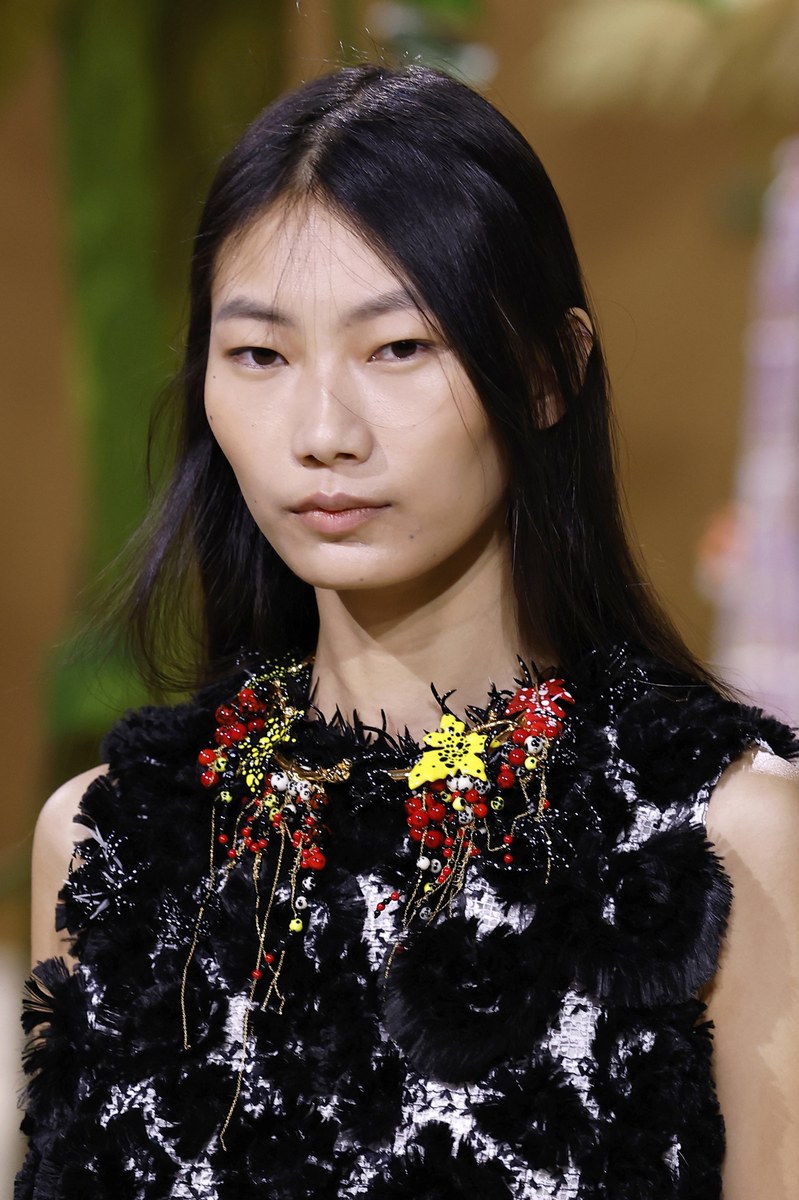
Yohji Yamamoto FW26 Beauty

Yohji Yamamoto FW26 Beauty
Did you know? Yohji Yamamoto pioneered the use of unconventional draping techniques in the 1980s by studying how fabric naturally falls and folds, rejecting traditional pattern-making in favor of intuitive construction methods that influenced a generation of designers. His approach to negative space and asymmetrical silhouettes challenged the fitted aesthetic that dominated Western fashion at the time.

Yohji Yamamoto FW26 Beauty

Yohji Yamamoto FW26 treats the face as a site of controlled damage, pairing near-blank skin with sparse, angular marks rendered in black, graphite, and deep navy that read more like calligraphy than cosmetics. For makeup artists, art directors, and product teams tracking the post-maximalist shift in avant-garde beauty, this signals a clear appetite for graphic restraint over layered drama.

Skin

The base runs uniformly pale and fully matte across the show, pushed toward a chalky, drained finish rather than anything luminous or skin-like. Coverage reads as full on lighter skin tones, erasing the complexion rather than refining it. No visible highlight, flush, or texture work interrupts the flat surface, which functions as deliberate negative space against the hair and mark-making.
Eyes

The dominant eye treatment is sparse and architectural. Small, precise marks in black or near-black appear at the outer corners, under the lashline, or scattered as short strokes around the orbital bone, placed to suggest fracture or decay rather than a conventional liner shape. Brows read largely untouched and natural in weight, neither groomed into a sharp arch nor bleached, keeping the face from tipping into editorial polish. Photo 13 and Photo 14 push furthest into graphic territory, with angular black and deep navy strokes extending below and beside the eye in a fragmented, multi-directional arrangement. Photo 16 layers dark smudging at the outer corner into something closer to a bruised, diffused kohl effect.

Lips

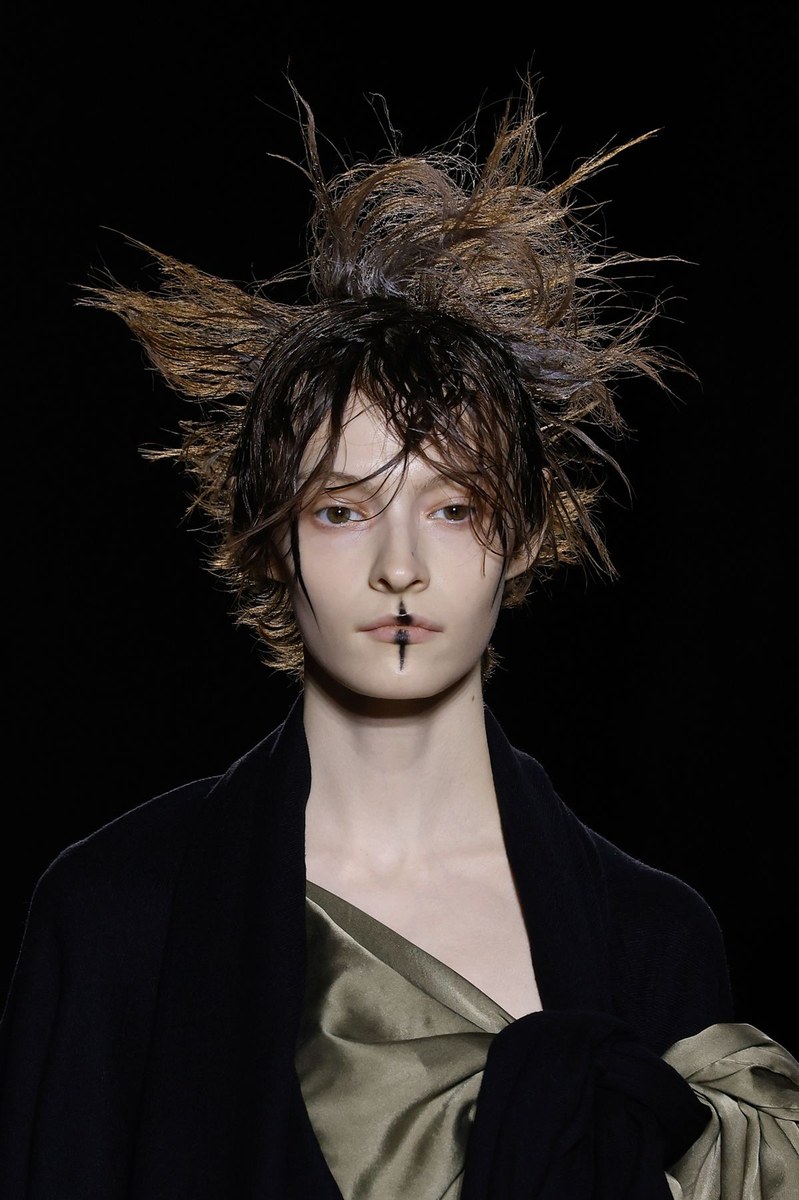
Black lipstick, applied in a full matte finish and kept within the natural lip line, anchors the darkest looks. Photos 3, 5, 10, and 12 all use this treatment, and the effect reads flat and dry rather than lacquered, suggesting a blotted or mattified application rather than a high-pigment gloss. Several looks opt instead for a minimal tinted balm in a near-nude or pale mauve tone, letting the lip almost disappear against the bleached skin base. Most precise is the deviation in Photos 1 and 8, where a single short vertical mark in black bisects the center of the lower lip and chin, functioning less as lipstick and more as a brushstroke placed on the face.

Cheeks and Color

No blush, contour, or highlight is visible across any look in the show. The absence is total and reads as a considered structural choice, keeping all visual weight in the hair and the individual marks placed on the face.

Hair

Hair is the loudest design element here, operating as a kind of crown architecture built from deliberately degraded texture. Across the majority of looks, hair is back-combed, dried out, and teased to extreme vertical volume, sitting above the head as a mass of frizzed, disintegrated fiber rather than a styled shape. Photos 1, 8, and 12 use the most spiked and fractured versions, with individual strands separating into sharp, straw-like points. Photos 5, 9, 11, and 13 push toward dense, rounded volume built from curl and frizz rather than spike. Photo 6 layers a cloud of near-colorless, gossamer fiber on top of natural curl, making the hair feel assembled rather than grown. Photo 16 is the sole outlier, where voluminous structure is anchored by an ornamental headpiece that fuses the hair direction with an object. Color across the show spans natural auburn, golden blonde, dark brown, and near-black, with no visible bleach or toning, and the wet or product-soaked roots visible in Photos 3, 10, and 12 contrast sharply against the parched, matte ends above.

Photo by Photo

Photo 1 A vertical black stroke splits the lower lip and chin from the cupid's bow downward, reading as a single brushmark that replaces conventional lip color with mark-making.

Photo 1
Photo 1

Photo 3 Full matte black lip paired with a total absence of eye makeup creates one of the show's starkest contrasts, the face reduced to a single dark focal point against white skin.

Photo 3
Photo 3

Photo 10 A single thin white or pale grey diagonal stroke crossing the right brow functions as an erasure mark, sitting in opposition to the black lip and making the face feel partially overwritten.

Photo 10
Photo 10

Photo 13 Fragmented black liner strokes radiate from the outer corners and under-eye area in multiple directions, offering the most directly referenceable graphic eye technique in the collection for editorial work.

Photo 13
Photo 13

Photo 14 Deep navy angular marks placed below the eye and at the outer corner, rather than in black, shift the mood toward something cooler and more wearable while keeping the fractured placement intact.

Photo 14
Photo 14

Photo 16 The only look where hair construction merges with a mounted headpiece, making the boundary between hair and object indistinct, a useful reference for editorial styling that uses the head as a three-dimensional installation surface.

Photo 16
Photo 16

Photo 9 Darkened inner corner and smudged under-eye in grey-black read as one of the softer eye treatments in the collection, closer to a diffused kohl than a graphic mark, sitting against an otherwise bare face.

Photo 9
Photo 9

Photo 4 A single curved dark mark descends from the corner of the mouth onto the chin, offering a clean, isolated reference for face mark-making that does not touch the eye area at all.

Photo 4
Photo 4

More Photos

Photo 2
Photo 2
Photo 5
Photo 5
Photo 6
Photo 6
Photo 7
Photo 7
Photo 8
Photo 8
Photo 11
Photo 11
Photo 12
Photo 12
Photo 15
Photo 15

✦ This report was generated with AI — combining human editorial vision with Claude by Anthropic. Because the future of fashion intelligence is already here.