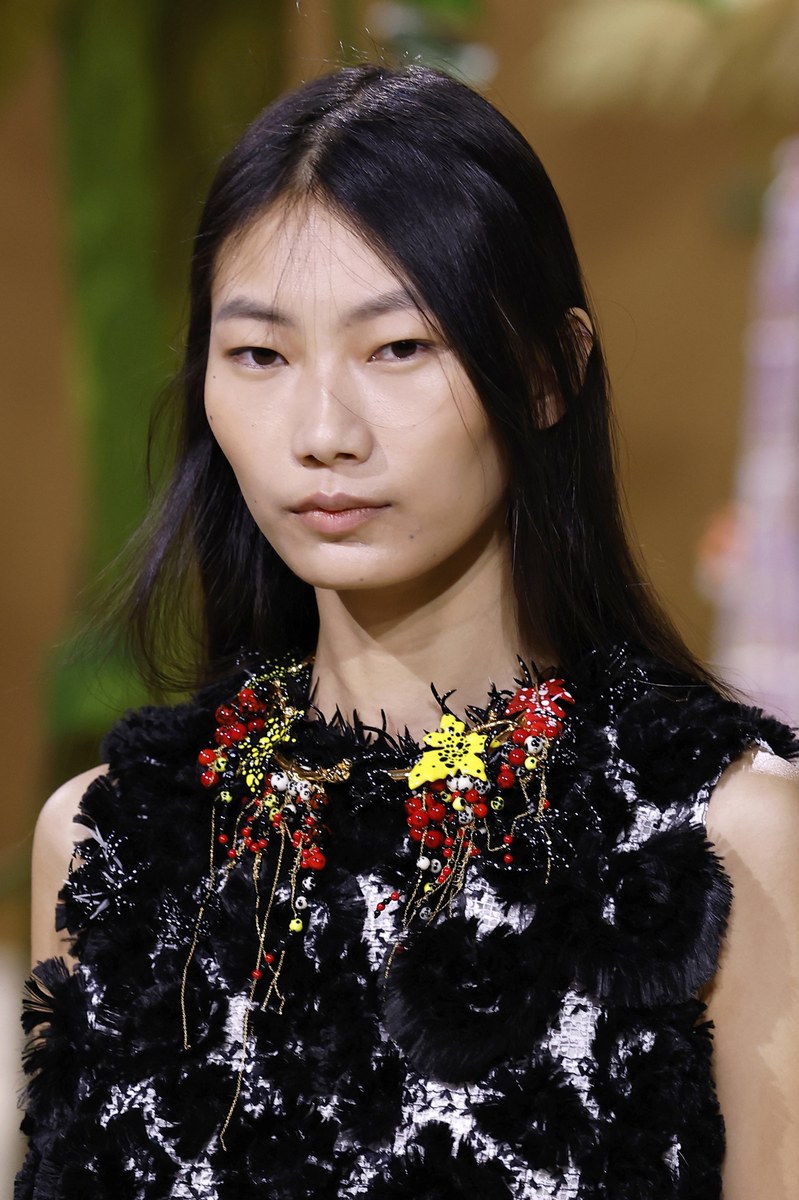
Yohji Yamamoto FW26 Details
Yohji Yamamoto FW26 Details Report
Accessories and garment details function as a single continuous design language across Yohji Yamamoto's FW26 lineup, layering textile contrasts, sculptural knotting, and printed narrative imagery into every category. For buyers and product managers sourcing across apparel and accessories simultaneously, this collection makes a direct argument for cross-category coordination at the point of purchase.
Category Overview
Two categories dominate this edit: Dress Detail and Headwear. Crushed velvet collides against fine-stripe suiting cloth, black lace drapes over matte crepe, and Japanese woodblock print fabric layers across plain wool grounds. Headwear splits between two distinct poles: the severely functional wide-brim felt hat in Details 12 and 13, and the ceremonially charged sculptural headpiece in Detail 11. Rather than decorative, the accessories strategy proves structural, using each piece to complete or complicate the garment's volume.
Material and Construction
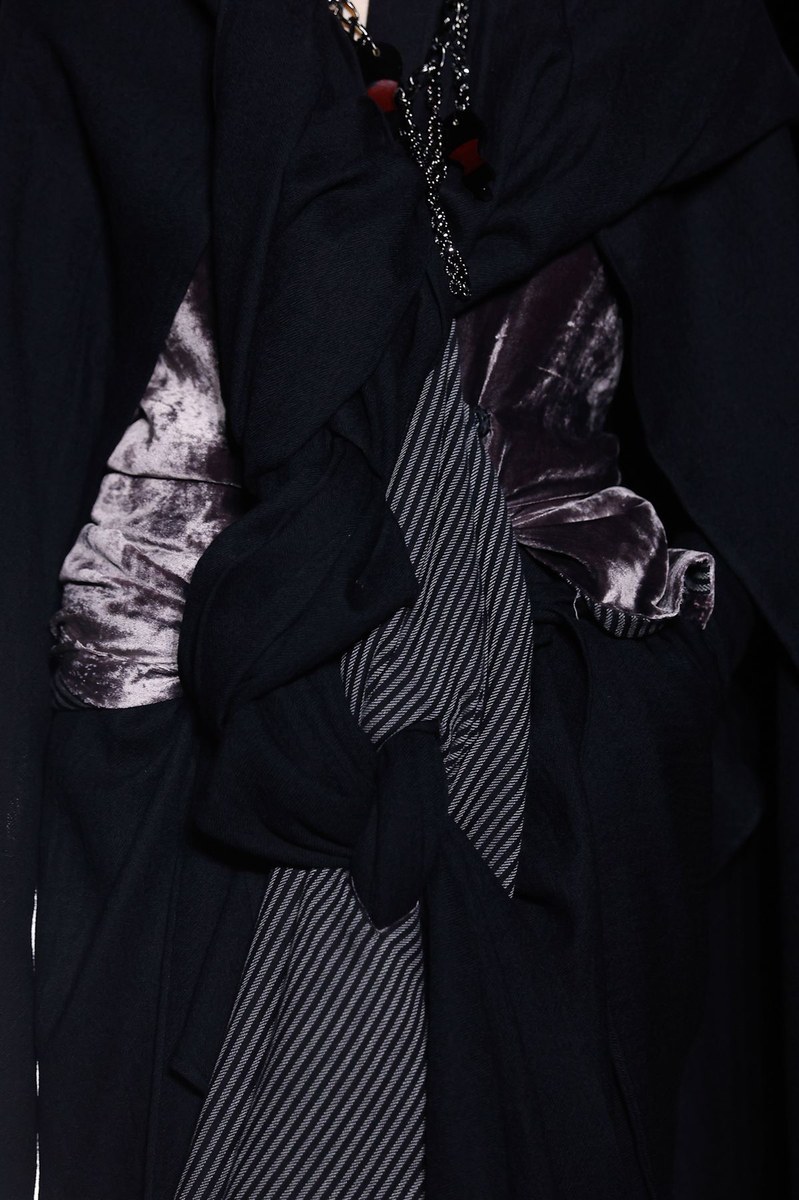
Crushed velvet in muted aubergine and pewter appears across Detail 1 as both sleeve insert and wrapped sash element, its crinkled surface contrasting hard against flat wool crepe. Black floral lace over a white or pale grey ground gets cut into a sharp triangular panel in Detail 3 and finished with a black chain running vertically through the center. Detail 6 rolls houndstooth wool and gathers it into a large rosette at the shoulder, secured with a fragment of black fur or mohair. A coat lining in purple and gold metallic jacquard becomes visible in Detail 7, revealed through a wide open-faced lapel cut in matte black wool.

Color and Finish Direction
Ink black, charcoal, and deep navy dominate the collection, with deliberate punctuation in high-contrast accents. Red appears exclusively in Detail 11 as braided cord drops flanking the lacquered red and black headpiece, making it the single warmest tone in the entire lineup. Teal, olive, rust, and violet break through in Details 5 and 7, specifically in patchwork jacquard and brocade inserts. Woodblock print fabrics in Details 8 and 9 introduce figurative color, confining ivory, ochre, red and jade green to printed panels rather than base cloth.
Key Pieces and Details
The wide-brim felt hat in Details 12 and 13 stands as the single most commercially transferable piece in this collection. Its crown dips at the front, the brim fans wider at the sides than front or back, and it sits low enough to obscure the eyes entirely, a proportion that reads as directional without veering into costume. Detail 11's sculptural headpiece, built from lacquered red and black geometric panels with hanging red braided cord, functions as limited-edition or runway-only work, but it signals the collection's appetite for headwear with a craft or artisan narrative. For product managers, the knotted belt details in Details 1, 4, and 5 present the clearest replication opportunity as removable sash or obi-style belt accessories in striped or plain fabrications.
Detail by Detail Highlights
Detail 1 (Dress Detail) layers crushed aubergine velvet as both a sleeve wrap and a knotted center-front sash over grey fine-stripe fabric, creating a three-texture composition that reads as deliberate rather than collaged.
Detail 3 (Dress Detail) sets a triangular panel of black-on-white floral lace into a deep V-opening on a black crepe ground, with a black metal chain running along the lace seam as a structural and decorative closure simultaneously.

Detail 6 (Dress Detail) rolls black-and-white houndstooth wool into a dense shoulder rosette pinned with a black fur or mohair tuft at the center, converting a suiting fabric into a statement millinery-adjacent volume.

Detail 8 (Dress Detail) wraps voluminous panels of figurative Japanese woodblock print fabric around and over a plain black coat, with tigers, cranes, florals and architectural motifs printed on sheer or semi-sheer ground cloth.

Detail 10 (Dress Detail) places a greyscale photographic or screen-printed image of a robed figure riding a deer or elk on a pleated black ground, the scale of the figure large enough to read as artwork rather than surface pattern.

Detail 11 (Headwear) constructs an asymmetric crown from lacquered red and matte black geometric panels, stabilized by black cord at the base and finished with long red braided rope drops that fall to shoulder level.
Detail 12 (Headwear) presents the collection's most buyable piece, a wide-brim black felt hat with a concave crown and forward-tilting brim proportion that covers the brow line completely and pairs here with a black and grey floral lace collar.

Detail 14 (Headwear) integrates the hood directly into the coat construction in olive wool, layering a blue floral lace underscarf behind the hood opening so that the lace frames the face as a built-in secondary layer rather than a separate accessory.

Operational Insights
Wide-brim felt hat production: Details 12 and 13 present a hat silhouette with genuine broad-market potential. Wool felt weight, crown-shaping methodology, and brim-stiffening treatments warrant careful assessment when sourcing or commissioning equivalents, as the precise concave crown profile separates this from a standard floppy hat.
Sash and obi belt crossover: The knotted sash elements in Details 1, 4, and 5 are strong candidates for development as standalone accessories. Sampling in both woven stripe and plain matte crepe, with a long enough cut to allow multiple tying configurations, should be a priority for product managers.
Print fabric as accessory fabric: Details 8 and 9 demonstrate that large-scale narrative prints, specifically woodblock or painting-derived imagery, function as visual accessories in their own right. Accessories directors sourcing scarves or wraps for FW should brief suppliers on oversized figurative print with art-historical reference.
Lace as a structural panel material: Detail 3 uses lace as a shaped insert rather than a trim, which changes its sourcing classification. Body and opacity matter more than delicacy here, specifically black-on-white or black-on-pale-grey grounds with a floral repeat at medium scale.
Chain hardware integration: Black metal chain visible in Detail 3 functions as both a zipper-pull alternative and a seam-line marker. Blackened or oxidized steel should be the spec, consistent with the collection's avoidance of bright metallic contrast throughout.
More Details


✦ This report was generated with AI — combining human editorial vision with Claude by Anthropic. Because the future of fashion intelligence is already here.