Yohji Yamamoto FW26 Shoes

Yohji Yamamoto FW26 Shoes
Did you know? Yohji Yamamoto established his label in 1981 with a deliberate strategy of showing in Paris rather than Tokyo, positioning Japanese design as a serious contender to European fashion houses at a moment when Japanese fashion was largely dismissed by Western industry gatekeepers. This decision to compete directly on the Paris calendar fundamentally shifted how Japanese designers were perceived and valued in global luxury markets.

Yohji Yamamoto FW26 Shoes Report

The FW26 footwear from Yohji Yamamoto swings between extreme elevation and deliberate flatness. Each silhouette anchors itself in matte black, interrupted by just one decisive monochrome contrast moment. For buyers and product managers, this signals a commercial opening for platform construction and Japan-coded traditional forms, both gaining traction in directional wholesale accounts.

Silhouettes and Construction

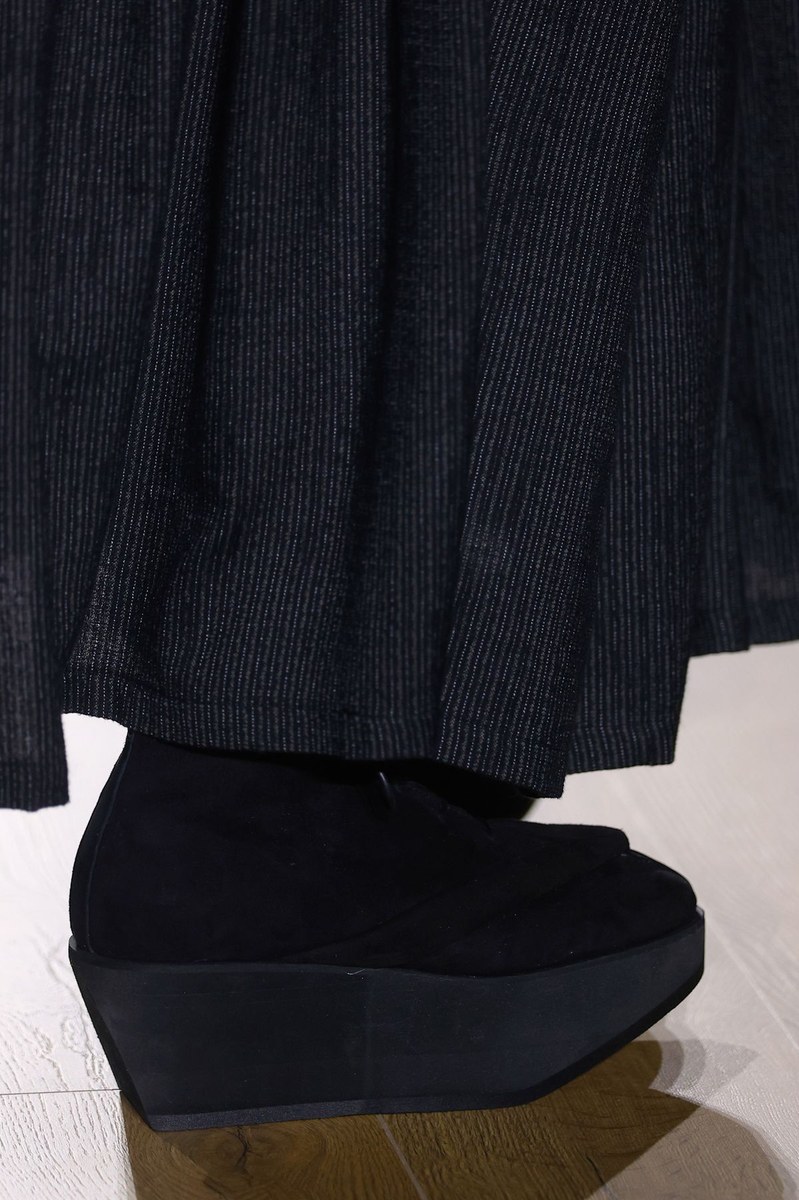
Three clear silhouette families emerge here: a geometric wedge platform, a flat loafer, and a traditional Japanese geta sandal rebuilt with modern proportions. Shoe 1 carries the most architectural weight, squared toe box paired with a solid wedge platform running approximately 60 to 70mm at the heel and tapering cleanly to a near-flat forefoot. Shoe 3 breaks from Western footwear construction entirely, sitting on a lacquered two-post geta base that lifts the foot on two rectangular pillars rather than a continuous sole.
Materials and Finishes

Matte black suede covers Shoe 1 across the upper, with a molded platform sole finished in the same flat black, creating a single-material visual block with no tonal break. Soft matte leather or brushed suede appears to construct Shoe 2, with a gathered or ruched toe ornament suggesting unlined or minimally structured upper work. Cream-white knitted tabi sock liner pairs against the sandal base in Shoe 3, worn separately and contrasted with a high-gloss lacquered black wooden or resin geta platform finished with thick velvet or grosgrain straps.

Color Direction

Black dominates all three silhouettes as ground tone rather than accent. One departure arrives in Shoe 3, where the off-white tabi sock introduces a stark ivory contrast reading as intentional and graphic against the black geta base. This palette signals a buyer direction toward near-tonal dressing with one high-contrast punctuation point, suiting both advanced contemporary and luxury departmental floor sets well.

Key Models and Details

Shoe 1 presents a slip-on wedge with no visible closure, relying entirely on suede upper tension and a precise toe box cut for fit and structure. Built on a flat or near-flat sole with minimal heel lift, Shoe 2 functions as the commercial anchor of the trio, its ruched front detail reading as the sole decorative element. Combining the tabi toe-split construction of the knitted sock with the two-post geta platform, Shoe 3 is the editorial statement piece, referencing Edo-period craft vocabulary while landing as fully current runway proposition.

Shoe by Shoe Highlights

Shoe 1 The squared suede wedge presents a clean production brief for buyers seeking a platform silhouette with minimal hardware and maximum silhouette return. Strong candidate for directional footwear capsules in Q3 and Q4 deliveries.

Shoe 1
Shoe 1

Shoe 2 The flat matte loafer with ruched toe detailing occupies the accessible price tier, translating most directly into commercial reorder potential for accounts carrying advanced contemporary women's footwear.

Shoe 2
Shoe 2

Shoe 3 The lacquered geta platform worn over tabi socks represents the collection's most production-complex proposition. Two-post wooden base requires specialist sole construction while the tabi pairing positions it firmly as a limited-quantity, high-margin editorial piece.

Shoe 3
Shoe 3

Operational Insights

Platform construction: Shoe 1 demonstrates that a single-material wedge with no hardware achieves strong visual impact, reducing BOM complexity while maintaining a directional price point.

Tabi pairing strategy: Shoe 3 opens a commercial channel for sock and sandal co-sells, allowing buyers to merchandise the geta base and knitted tabi as a bundled unit rather than separate SKUs.

Flat silhouette retention: Shoe 2 confirms that Yamamoto is not abandoning accessible heel heights, giving product managers a low-risk entry point within an otherwise architecturally driven collection.

Material focus: Consistent use of matte suede and matte black finishes across Shoe 1 and Shoe 2 points toward a supplier consolidation opportunity, with both styles potentially sharing the same tannery or finishing house.

Cultural reference as commercial lever: Geta construction in Shoe 3 positions the collection inside a broader market conversation around Japanese craft traditions, which several luxury multi-brand retailers are actively programming for FW26 floor narratives.

✦ This report was generated with AI — combining human editorial vision with Claude by Anthropic. Because the future of fashion intelligence is already here.