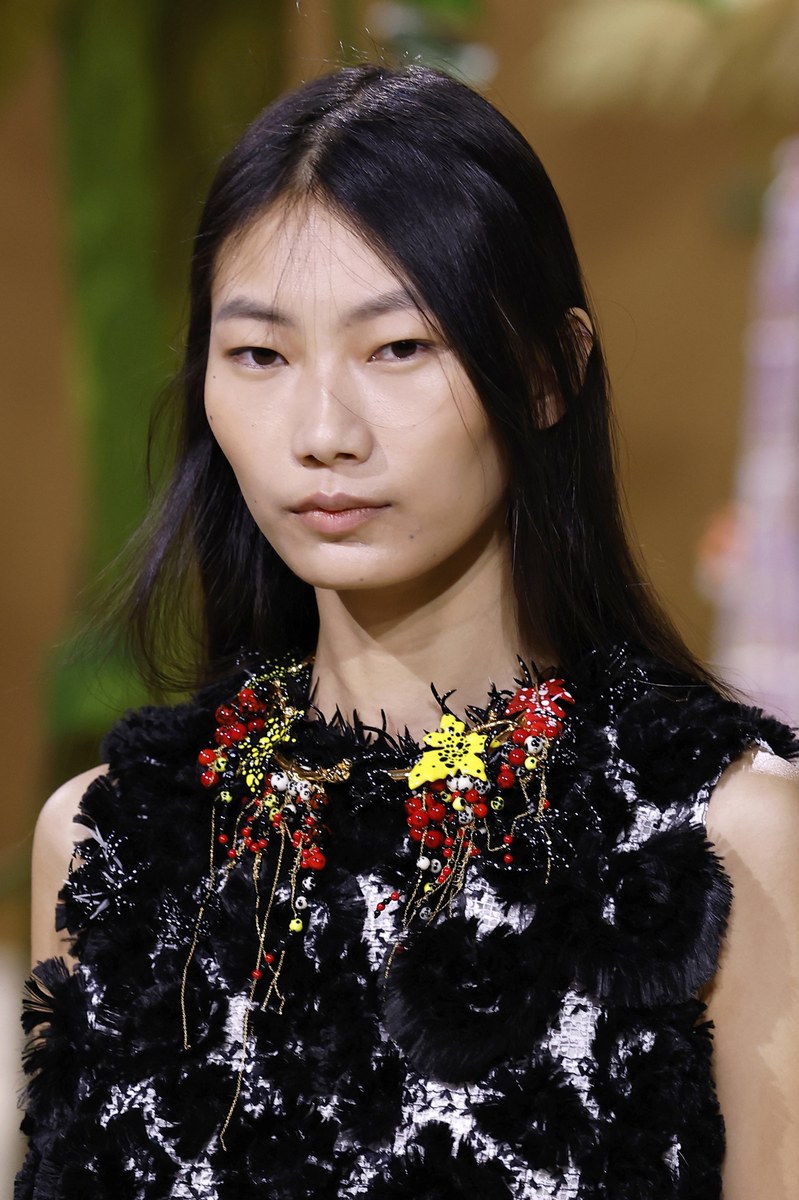
Yohji Yamamoto FW26 Women Looks Report
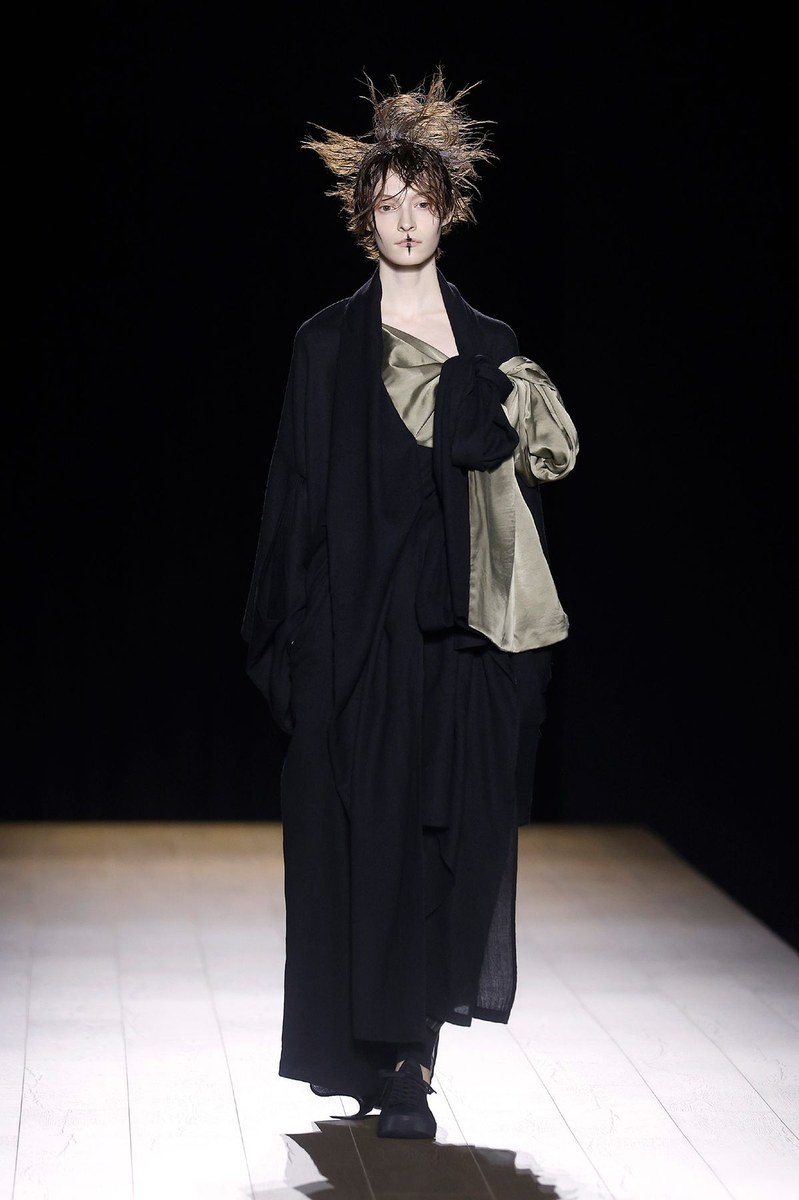
Paris Fashion Week
Yohji Yamamoto's FW26 women's collection builds a world of ritual and ceremony through kimono-derived construction, layered wrapping, and a near-total commitment to black as a structural language rather than a color choice. For buyers and style directors operating in a market where maximalist layering and cultural heritage dressing continue to accelerate, here is a precise, authoritative statement with strong carry-over commercial potential.
Silhouette and Volume
The dominant shape is a wide, cocoon-like wrap that originates at the shoulders and falls to the ankle or floor, drawing directly from the haori and kimono traditions of Japanese dress. Sleeves are exaggerated, often bat-wing or bell-shaped, adding lateral volume that contrasts with the vertical elongation of the skirt or trouser beneath. Look 4 and Look 9 make this architecture most legible, with oversized outer layers sitting above narrow, draped bottoms. Volume is always external, always draped, never constructed through tailoring darts or seaming, and fitted bodices are avoided entirely.
Color Palette
Black dominates all 20 looks, operating in multiple weights and finishes simultaneously rather than as a flat uniform tone. Look 7 introduces a deep slate and charcoal grey combination, the only moment where black fully recedes. Indigo-toned blue appears through large-scale brocade and printed textile panels in Looks 8 and 9, providing the collection's most visible color punctuation. Dark heather plaid built from blue-grey, charcoal, and muted green makes Look 18 the most immediately wearable departure for buyers seeking tonal variety.

Materials and Textures
Wool and heavy wool crepe carry the structural outer layers, giving the wide silhouettes enough weight to hold their drape without collapsing. Satin, velvet, and brocade panels appear in Looks 2, 3, 6, 8, 9, and 16, creating deliberate surface tension between the dull and the reflective. Look 12 pairs a matte black kimono coat with a black-and-white optical-wave printed skirt, the only moment of graphic pattern contrast built entirely from monochrome. A loosely woven wool blend with visible fringe trim along the joining seams defines the plaid in Look 18, adding a raw, unfinished edge that aligns with the collection's anti-polish ethos.

Styling and Layering
Layering logic runs consistently: a wide outer wrap or coat sits over a mid-layer garment, which in turn falls over narrow trousers or a long skirt. Footwear resolves quietly in almost every look, with flat black lace-up shoes or black loafers keeping the base grounded and utilitarian. Raised platform sandals in the geta tradition appear in Looks 19 and 20, worn with white tabi socks, marking the closing sequence as a deliberate nod to Japanese street and ceremonial dress. Headpieces are theatrical throughout, ranging from spiked sculptural forms to wide-brimmed black felt fedoras in Looks 5, 14, 16, and 17, but buyers should read these as runway direction rather than commercial product.
Look by Look Highlights
Look 1 pairs a fluid olive satin slip layer with a floor-length black wool coat left open, establishing the collection's foundational push-pull between luxe undergarment and austere outerwear from the first exit.

Look 6 uses a heavily distressed botanical-print textile in muted burgundy and grey as a shawl panel wrapped across a black base. Buyers sourcing statement outerwear fabric programs will respond strongly to the aged, painterly surface quality of that fabric.

Look 8 presents the most commercially transferable piece in the collection: a black V-neck dress with wide indigo brocade sleeves and a gathered brocade skirt panel, structured enough to read as occasion wear while retaining the Yamamoto anti-fit DNA.

Look 11 layers a chunky black ribbed knit scarf-wrap over a black kimono coat printed with cranes, flamingos, and botanical forms in cobalt blue and lilac. This makes it the single look with the clearest crossover into the elevated gifting and statement-piece market.

Look 14 grounds the collection's most tailored moment in a double-breasted caped wool coat with a paisley-lined collar, worn under a wide-brimmed black felt hat. Here the collection comes closest to a direct retail-ready outerwear silhouette.

Look 16 wraps a long black wool coat around a full-length lace-print inner robe in pale silver and black, creating a reveal-and-conceal layering that rewards slow viewing and translates directly into a two-piece selling story.

Look 18 stands alone as the collection's only fully non-black look, built from a large-scale dark plaid in blue-grey and charcoal with fringe-stitched seam detailing. Strong standalone product potential emerges here for buyers who need one entry point into the collection without full commitment to the all-black program.

Look 20 closes the group sequence with a black jersey wrap coat embroidered with a botanical motif and vertical calligraphy, paired with ribbed knit and geta sandals. This signals that the graphic print program running through the collection has genuine depth for a dedicated capsule.

Operational Insights
Fabric sourcing: Indigo-dyed jacquard weaves with a medium weight and high drape coefficient define the brocade panels in Looks 8, 9, and 16. Japanese and Italian specialty mills should be engaged early by buyers, as these fabrics carry long lead times and limited yardage availability per colorway.
Print program: Crane and flamingo imagery in Look 11 and calligraphy embroidery in Look 20 indicate a deliberate Japanese motif strategy across the collection. Style directors building print stories should treat these as a coordinated thematic group rather than isolated SKUs, since grouped presentation increases perceived collection depth on the floor.
Silhouette scaling: Kimono-sleeve and wide haori shapes require a grading approach that preserves horizontal span at the shoulder and sleeve hem. Standard grade rules built for Western tailoring will distort the intended volume, so product managers should brief pattern rooms on this before bulk production begins.
Footwear: High-editorial but low-conversion for most retail environments, the geta platform sandals in Looks 19 and 20 should take a backseat to the flat black loafer and lace-up shoe that anchors the majority of looks. Those silhouettes are both on-trend and commercially proven across the minimalist wardrobe segment.
Color strategy: With 18 of 20 looks built on black, careful floor presentation is essential to avoid visual monotony. Indigo brocade groupings in Looks 8, 9, and 16, plus the plaid look in Look 18, function as color anchors and should be positioned as focal points rather than buried in a run of all-black adjacencies.
Complete Collection


Fashion Designer

About the Designer
Yohji Yamamoto was born in Tokyo in 1943, the only child of a mother who was left to raise him alone after his father was killed in the Philippines during the Second World War. Fumi Yamamoto supported them both by working sixteen-hour days as a dressmaker out of a small shop in the Kabukicho district of Shinjuku, a neighborhood that ran on nightlife and the economy of entertainment. That environment, with its particular image of women shaped by performance and commercial femininity, became a persistent shadow in Yamamoto's creative thinking, something he would spend decades consciously working against. He grew up watching his mother cut and sew, learning what fabric does and how a body carries weight, before he was old enough to formalize any of it. When the time came to choose a career path, he enrolled in law at Keio University and graduated in 1966, not out of any particular conviction but because it was the expected route. The law held no appeal. He told his mother he wanted to help her instead, and at her insistence also enrolled at Bunka Fashion College, which he entered not knowing that the profession of fashion designer even existed.
After graduating from Bunka and a scholarship period in Paris, Yamamoto returned to Japan and launched his first label, Y's, in 1972, before presenting collections in Tokyo from 1976. The work he was developing was already structurally unlike anything coming from the West: oversized and asymmetrical, cut to fall away from the body rather than reveal it, constructed from fabrics that were allowed to look worn, unfinished, deliberately imperfect. In 1981, he brought his collection to Paris for the first time, in the same season that Rei Kawakubo showed Comme des Garçons there. The response from the French press, which used phrases like "Hiroshima chic" and "yellow peril," was hostile, but the clothes had already done their damage to the prevailing idea of what fashion was supposed to want from a woman's body. His label printed on every piece read: "There is nothing so boring as a neat and tidy look." It was a position, not a provocation.
His references are rooted in the Japanese concept of ma, the meaningful space between the cloth and the body, in the working clothes of postwar Japanese laborers, in the black worn historically by monks and scholars and his own mother going about her daily work. He visited Vivienne Westwood and Malcolm McLaren's punk shop in London in the late 1970s with Kawakubo, and the encounter reinforced something he already understood: that destruction was a legitimate creative method. In 2003 he launched Y-3, the collaboration with Adidas, which brought his thinking into sportswear. He filed for bankruptcy in 2009 and documented it openly, without embarrassment, in his memoir. He is now eighty-one years old and still working as creative director of Yohji Yamamoto, presenting collections at Paris Fashion Week each season, running a business he has described as growing steadily, and maintaining the same studio on the top floor of his building in the third arrondissement where he has worked for decades.
"I think perfection is ugly. Somewhere in the things humans make, I want to see scars, failure, disorder, distortion."
"I didn't want to join the ordinary society. So I told my mother after graduation: I want to help you."
✦ This report was generated with AI — combining human editorial vision with Claude by Anthropic. Because the future of fashion intelligence is already here.