Zankov FW26 Details
Zankov FW26 Details Report
Zankov FW26 builds its accessories and detail language around aggressive textile mixing, oversized paillette embellishment, and a deliberate collision of sportswear codes with tailored or ceremonial garment construction. Buyers and product managers should pay close attention now because the collection signals a near-term commercial appetite for layered textile stories and embellished knitwear that moves beyond seasonal novelty into repeatable product architecture.
Category Overview
Two categories anchor this collection: dress details and headwear. Rather than operating as separate product tracks, they function as a unified embellishment system. Paillette application connects Detail 9 (Headwear) to the knit bodies in Details 3 and 4, signaling a deliberate house-wide embellishment strategy rather than isolated styling choices. Detail 2 and the draped construction in Detail 8 ground the collection in structured outerwear, while Details 1, 5, and 6 introduce softer, more accessible entry points through ruffled hemlines, striped knits, and neckerchief styling. Such breadth suggests a buying range that can be tiered across price points without losing a coherent design identity.
Material and Construction
Wool bouclé, mohair-blend knit, and pressed wool coating dominate the outerwear and top details. Dense surface texture appears in Detail 2, while the fuzzy pile shows up in Details 3 and 9. Large-format matte discs rather than metallic sequins create the paillette work in Details 3, 4, and 9. These are stitched in dense, irregular scatter formations that create a fish-scale surface weight. Detail 7 introduces a gold metallic lattice embroidery over a neutral base cloth, with raw fringe ends left deliberately unfinished at the cuff hem. This points to a construction philosophy that treats rawness as a finish choice rather than an oversight. Cut and drape drive Detail 8 entirely, with no applied embellishment, demonstrating that the collection balances surface decoration with pure structural garment work.

Color and Finish Direction
Deep burnt sienna and tobacco brown move into acid yellow-green, cobalt blue, and a high-voltage orange-red. Lavender and putty serve as the quiet neutrals. Burnt orange and terracotta tones recur across Details 5, 6, and 9, functioning as the collection's throughline color rather than an accent. Matte finishes dominate almost entirely, with the exception of the gold metallic lattice in Detail 7 and the liquid satin skirt in Detail 4, which reads as teal-to-emerald depending on light. This near-total matte commitment makes the occasional shine land harder and positions the collection's color story as warm and tactile rather than reflective or high-gloss.

Key Pieces and Details
The lavender paillette beret in Detail 9 stands out as the single most commercially transferable piece in the shoot. It translates directly to a standalone accessories buy, carries strong visual identity without requiring the full look, and the matte disc application makes it producible at accessible price tiers if the disc material is switched from resin to acetate. Detail 3 represents the most complex layering proposition, stacking a yellow-black wave-pattern knit jacket over an ochre-and-black zigzag knit under a large-paillette scatter cape, all closed with an oversized hardware clasp. High-risk, but high-impact for editorial and wholesale anchor pieces. Detail 2 presents the strongest outerwear commercial case: a putty-tone double-faced wool coat with asymmetric wrap front and black button closures. Even pulled away from the more experimental styling context of the rest of the collection, it reads as a clean, wearable silhouette.
Detail by Detail Highlights
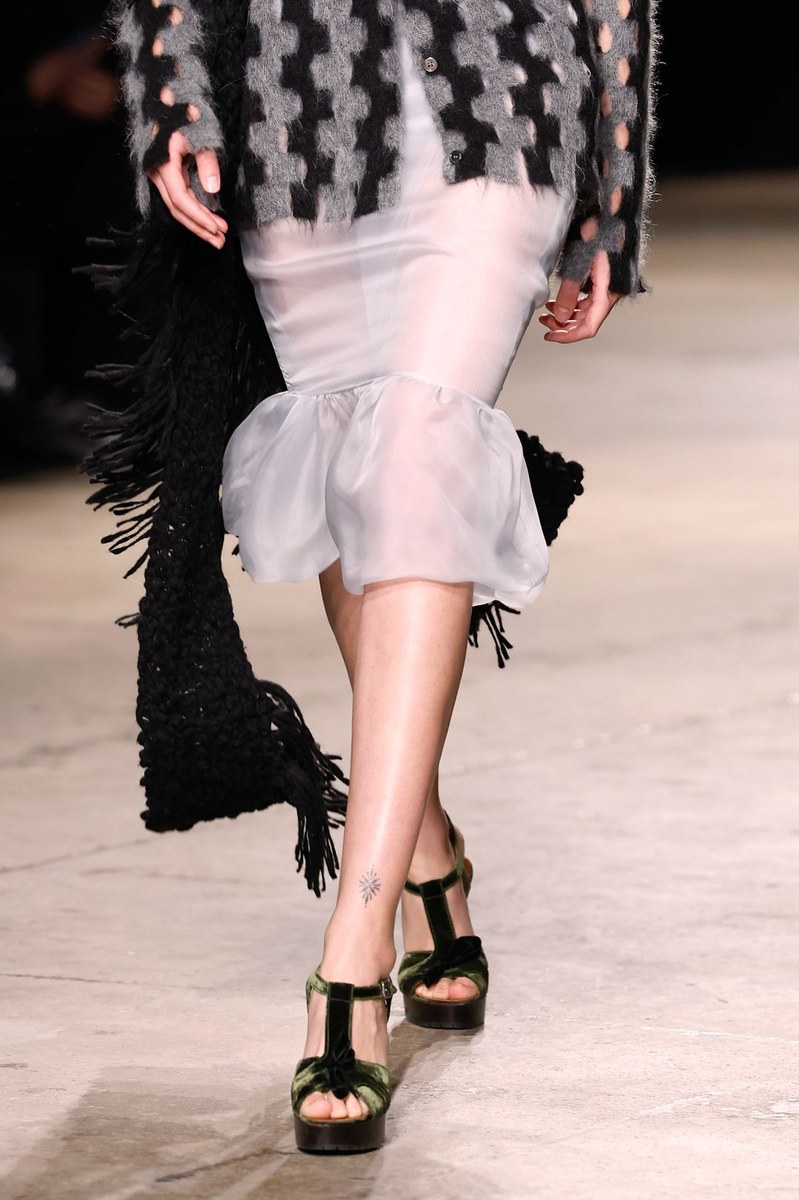
Detail 1 (Dress Detail) A sheer white organza skirt hem finishes in a full gathered ruffle balloon, worn over opaque leg with green velvet T-strap platform sandals, creating a proportional contrast that reads as both romantic and deliberate in its awkwardness.

Detail 2 (Dress Detail) A putty-tone double-faced wool coat wraps asymmetrically across the front torso, fastened with four matte black horn-style buttons, with the lower front panel falling open to expose a gold metallic diamond-net skirt beneath.
Detail 3 (Dress Detail) A yellow and black wave-knit jacket is layered under a large white matte paillette scatter cape, closed at the chest with a single heavy silver hardware clasp, stacking three distinct textile identities into one torso.

Detail 4 (Dress Detail) A grey ribbed zip-polo knit carries a horizontal band of cobalt blue mohair-pile fabric embellished with navy matte paillettes across the chest, worn over a teal satin bias skirt and an orange stripe turtleneck.

Detail 5 (Dress Detail) A striped knit top in putty, rust, and cream horizontal bands zips at the collar placket and is styled with a rust and black diagonal-stripe silk neckerchief secured by a bulbous polished silver clasp hardware piece.

Detail 6 (Dress Detail) A flat-weave orange-red knit top is layered over a beige trench sleeve with gold metallic lattice embroidery, accessorized with a pale pink knotted bead rope necklace and a trailing hand-painted silk ribbon pendant.

Detail 7 (Dress Detail) The beige cotton trench sleeve in this shot is overprinted with a gold metallic diamond-grid embroidery, finished at the cuff with raw fringe ends, and punctuated by a single circular navy paillette cluster appliqué at mid-forearm.
Detail 9 (Headwear) A lavender mohair-knit beret is completely covered in large matte lavender resin disc paillettes in a dense irregular scatter, with a matching lavender velvet ribbon tail at the rear, worn low over the brow against a rust turtleneck.
Operational Insights
Paillette sizing: The collection uses oversized matte-finish disc paillettes, approximately 20 to 25mm diameter, rather than standard 8 to 12mm sequins. Buyers sourcing embellished knitwear or headwear should spec this disc size explicitly to capture the intended surface weight and visual scale.
Beret as standalone SKU: The lavender paillette beret in Detail 9 has immediate standalone commercial potential as a licensed or private-label accessory buy. Its material story is legible without context, and the matte finish avoids the dated quality of metallic sequin headwear.
Layering architecture: Multiple looks stack three or four distinct textiles on a single body. Product managers building buy plans should account for this by treating the knit base, embellished mid-layer, and outerwear as separates designed to function together, rather than buying them as standalone units at equal depth.
Clasp and closure hardware: The oversized polished silver clasp in Detail 3 and the similar closure in Detail 5 represent a recurring hardware accent. Accessories directors should track this silhouette, a dome-form or sculptural single-clasp closure, as a viable trim and jewelry direction for FW26 delivery windows.
Color anchor for buying: Burnt orange and terracotta appear across knitwear, scarves, and headwear in at least four separate details. Buyers should treat this tone as the season's key reorder color and build option planning around it, particularly in knit and woven categories where it functions as both hero and layering partner.
More Details

✦ This report was generated with AI — combining human editorial vision with Claude by Anthropic. Because the future of fashion intelligence is already here.