Zimmermann FW26 Women Looks Report

Zimmermann FW26 Women Looks Report
Did you know? Zimmermann pioneered a vertically integrated manufacturing model by establishing their own factories in Sydney, allowing the Australian label to maintain strict quality control and reduce lead times while producing primarily in-house rather than outsourcing production. This operational structure has enabled the brand to scale luxury production domestically while maintaining the hand-finished details characteristic of their signature silk pieces.

Zimmermann FW26 Women Looks Report

Paris Fashion Week

Zimmermann FW26 pulls the brand's signature romanticism into harder, more layered territory by mixing equestrian utility, 1970s sportswear codes and fluid evening construction within a single offering. For buyers, this signals a deliberate push toward versatile, higher-unit-value pieces that can cross multiple selling floors, from outerwear to occasion wear, without diluting core femininity.

Silhouette and Volume

Two dominant shapes emerge throughout. A cinched, belted torso that flares dramatically at the hem appears in the denim trench of Look 5 and the olive parka of Look 15. Soft, gathered volume pools or floats at the ankle in the cream cable-knit set of Look 10 and the art nouveau printed maxi of Look 20. Sharp padding in the suiting of Look 2 contrasts sharply with fluid wide-leg trousers across the shoulders. Shorter hemlines like the gathered mini of Look 1 and the draped dark navy dress of Look 14 function as punctuation early on, offsetting the longer, more enveloping shapes that dominate the second half.
Look 5
Look 5

Color Palette

Warm, oxidized gold anchors everything from the literal gilded jersey of Look 6 to the sandy beige suiting of Look 2 and the tan leather jumpsuit of Look 17. Deep navy and indigo ground the collection across denim constructions in Looks 5, 7, 11 and 14. Burgundy, tobacco brown and burnt sienna recur as accent tones through scarves, belts and knit trims, creating an autumnal feel without relying on black. Cream and ivory, concentrated in Looks 2, 4, 8, 10 and 20, prevent the collection from feeling heavy and sustain Zimmermann's commercial sweet spot.

Look 6
Look 6

Materials and Textures

Silk-twill scarf fabric does significant structural work here, functioning as a draped body garment rather than an accessory in Looks 1, 3 and 7, where multiple printed squares are knotted and layered to construct tops and skirts. Heavyweight indigo denim with visible contrast stitching performs as a suiting-weight cloth, most clearly in the floor-length draped dress of Look 11 and the caped trench of Look 5. Cable-knit cotton and rib-knit wool appear in functional, oversized cuts in Looks 8, 10, 12 and 16, with surface texture providing tactile contrast against smoother poplin stripes and silk prints nearby. Fur, whether real or faux, functions as a collar, stole or coat lining across Looks 3, 4, 10 and 17, adding weight and luxury hand to utilitarian silhouettes.

Look 11
Look 11

Styling and Layering

Accumulation, not simplicity, builds these looks. A silk scarf tucked into a belt, a leather glove extending past the cuff, a cable-knit vest over a turtleneck over a printed underlayer, these combinations create visual density without chaos. Footwear divides cleanly into two options: chunky Mary Jane platforms with ruched cable socks in Looks 1 and 14, and flat penny loafers or moccasins worn with the same ruched socks in Looks 9, 12 and 16. That sock and loafer pairing appears so consistently it functions as both a collection signature and a straightforward accessory sell-through opportunity.

Look by Look Highlights

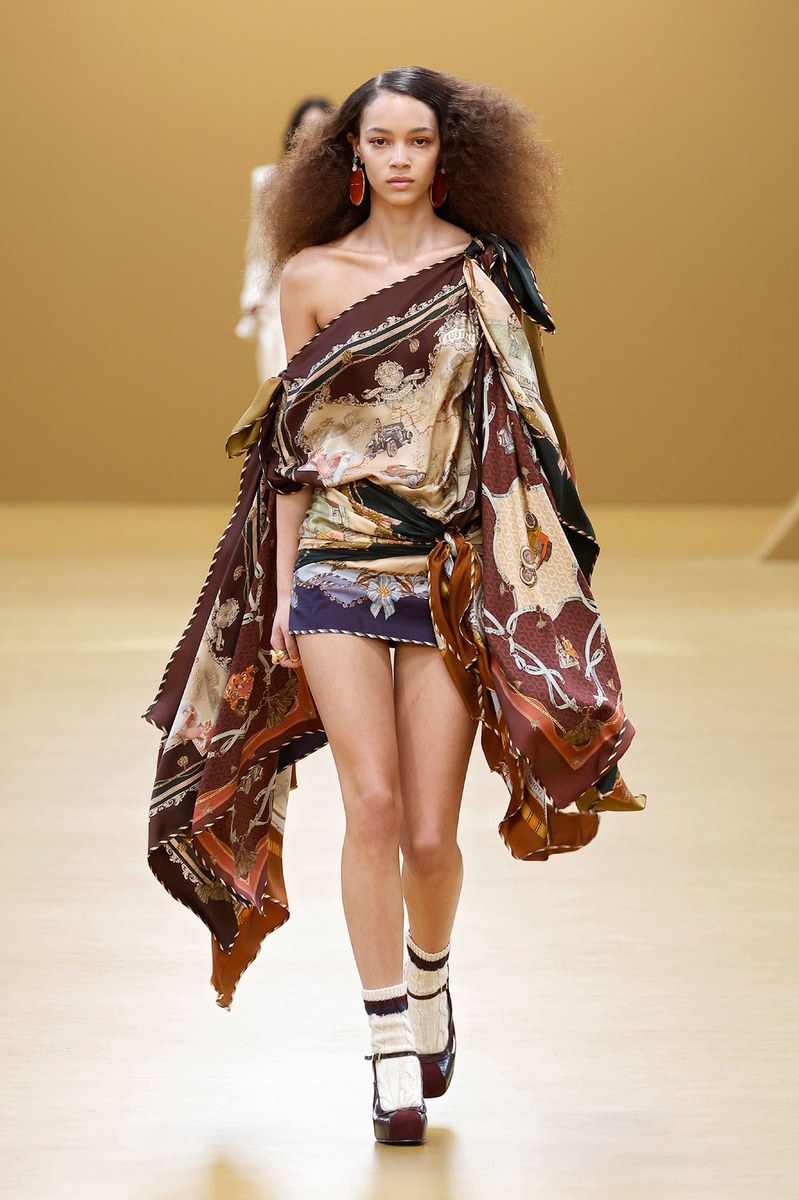
Look 1 Constructs an entire asymmetric mini from knotted silk-twill scarf panels, making it the collection's clearest statement on fabric-as-garment and a strong editorial lead image.

Look 1
Look 1

Look 2 Delivers a three-piece cream wool suiting group, jacket with structured shoulders, buttoned vest and wide-leg pleat-front trouser, that functions as a wholesale anchor for buyers needing a wearable, high-margin capsule.

Look 2
Look 2

Look 6 Works a single gold-toned stretch jersey into a cutout wrap construction with raw-edged flared panels, producing the collection's most directional evening piece with strong red-carpet placement potential.

Look 11 Demonstrates how heavyweight denim can perform as eveningwear when draped and gathered into a sleeveless column with a cowl collar, expanding the material's unit price ceiling considerably.

Look 13 Packages equestrian references, tobacco cotton blouson, matching flare trousers with knee patches, wide leather belt and a printed scarf hem frill, into a complete lifestyle outfit that will photograph well across print and digital retail.

Look 13
Look 13

Look 15 Consolidates the outerwear argument with a belted olive anorak-trench long enough to clear the knee, layered over a stripe shirt and wide-leg trouser, giving buying teams a clear top-of-range coat with broad seasonal relevance.

Look 15
Look 15

Look 19 Closes the collection's darker chapter with a black lace long-sleeve bodysuit under a layered taffeta and lace midi skirt, a constructed evening look that targets the formal occasion segment Zimmermann has been building toward.

Look 19
Look 19

Look 20 Opens the final sequence with a deep-V batwing maxi in champagne and ivory art nouveau print on fluid satin-weight fabric, a pure commercial proposition that balances resort, occasion and gifting markets simultaneously.

Look 20
Look 20

Operational Insights

Scarf-as-garment: Scarf construction appearing in Looks 1, 3 and 7 represents a production decision with direct implications for packaging and storytelling. Buyers should request a dedicated styling guide so that retail staff can demonstrate the wrapping method, otherwise sell-through risk runs high.

Outerwear depth: At least five distinct outerwear silhouettes span denim, cotton canvas, wool knit, leather and fur categories throughout. Product managers should prioritize SKU rationalization early, selecting no more than two to three silhouettes per door to avoid margin erosion through markdowns on slower-moving styles.

Sock footwear system: Ruched cable socks styled with both flat loafers and platform Mary Janes appear across eight or more looks. This is a low-cost, high-frequency accessory bundle opportunity and should be planned as a coordinated add-on at point of sale rather than a standalone SKU.

Color capsule logic: Cream and ivory span knitwear, suiting, printed silk and jersey, making it the most cohesive standalone capsule in the offering. Style directors building curated floor sets or digital edits should lead with this group as a de-risked opening buy before committing to deeper equestrian and scarf-heavy looks.

Fur and fur-adjacent pieces: Fur trim and fur outerwear appear in Looks 3, 4, 10 and 17. Buyers operating in markets with regulatory or consumer-sentiment restrictions around animal fur should confirm material sourcing and labeling status with Zimmermann directly before placing orders, as styling prominence of these pieces makes a faux substitution commercially necessary in several territories.

Complete Collection

Look 3
Look 3
Look 4
Look 4
Look 7
Look 7
Look 8
Look 8
Look 9
Look 9
Look 10
Look 10
Look 12
Look 12
Look 14
Look 14
Look 16
Look 16
Look 17
Look 17
Look 18
Look 18
Look 21
Look 21
Look 22
Look 22
Look 23
Look 23
Look 24
Look 24
Look 25
Look 25
Look 26
Look 26
Look 27
Look 27
Look 28
Look 28
Look 29
Look 29
Look 30
Look 30
Look 31
Look 31
Look 32
Look 32
Look 33
Look 33
Look 34
Look 34
Look 35
Look 35
Look 36
Look 36
Look 37
Look 37
Look 38
Look 38
Look 39
Look 39
Look 40
Look 40
Look 41
Look 41
Look 42
Look 42
Look 43
Look 43
Look 44
Look 44
Look 45
Look 45
Look 46
Look 46
Look 47
Look 47
Look 48
Look 48
Look 49
Look 49
Look 50
Look 50
Look 51
Look 51
Look 52
Look 52

Fashion Designer

About the Designer

Nicky Zimmermann co-founded the Sydney-based label that bears her name alongside her sister Simone in 1991, and has served as its Creative Director since the brand's inception. She grew up in Sydney, and the particularities of that environment, its bleached light, its proximity to water, the specific texture of Australian leisure, have remained a persistent undercurrent in everything she makes. Before fashion formally claimed her, she studied at East Sydney Design Studio, grounding herself in construction and craft rather than concept alone.

The sisters opened their first store in Paddington, selling swimwear alongside ready-to-wear at a moment when that combination felt genuinely unusual. What followed was a slow, deliberate expansion built on the logic of the garment itself: intricate broderie, layered chiffons, the kind of embellishment that rewards close looking. Nicky has consistently cited the natural world as a primary source, not as decoration but as structural thinking, the way light moves through water, the geometry of botanicals, the colors of reef and dusk.

Zimmermann now operates across dozens of markets worldwide, with a significant presence in the United States and Europe, and Nicky continues to direct the creative vision of every collection. The brand occupies a rare position, genuinely crafted and internationally commercial at once, and that balance reflects her sustained refusal to separate beauty from rigor.

"I always come back to nature. It's endlessly generous as a reference." "There's something about femininity that I never tire of exploring. It's not a limitation. It's a lens"

✦ This report was generated with AI — combining human editorial vision with Claude by Anthropic. Because the future of fashion intelligence is already here.